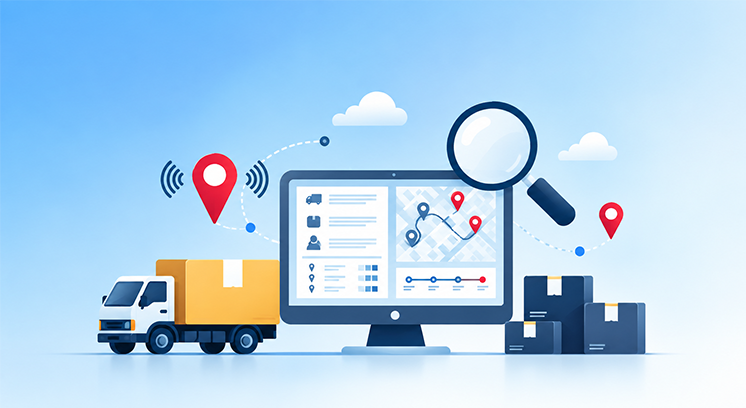
The Big-Bang Supply Chain Project Is Dead
Replacing a legacy TMS, ERP, WMS, or other core supply chain system mean signing up for a massive transformation project.
Define everything. Build everything. Integrate everything. Test everything. Then wait 12 - 18 months and hope the business still needs what you built.
That model doesn’t justify itself anymore.
Supply chains change too quickly. Carriers change. Customer requirements change. Regulations change. Data sources change. Even the technology you selected at the beginning of a project can change by the time of implementation. That’s just how it is.
There’s a better approach which is even more practical: start small, connect to what already works, prove value quickly, and then scale.
Why Big-Bang Supply Chain Projects Struggle
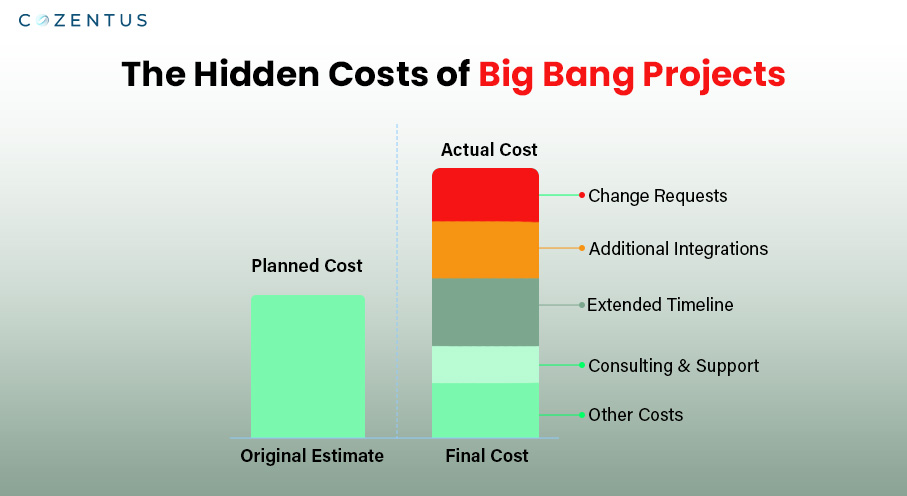
The problem with a big-bang implementation is not that large platforms are automatically bad.
The problem is putting too many business decisions, integrations, processes, and technology changes into one project.
A typical transformation can involve:
- TMS or ERP replacement
- WMS integration
- Carrier connectivity
- EDI and API integrations
- Customer portals
- Data migration
- Reporting and analytics
- Pricing and rate management
- Shipment visibility
- Document processing
- User training
- Change management
Each part depends on another part working correctly. If one critical integration is delayed, the entire timeline can move. If the business process changes during implementation, the project scope changes too.
And by the time everything is finally ready, the operation has usually changed again.
What Is Composable Supply Chain Technology?
Composable technology uses modular applications and services that work together through APIs, integrations, and shared data.
Instead of replacing everything at once, a company can introduce a specific capability where it creates the most value.
For example:
Existing TMS + shipment visibility platform + AI document processing + automated freight audit + analytics
The TMS remains the system of record. New capabilities sit around it and improve specific parts of the operation.
This is important because many companies do not actually need a completely new TMS. They only need to fix what the TMS does not handle well.
Start with the Problem - Not the Platform
A better technology project starts with a business problem.
Maybe operations teams spend hours manually checking shipment updates across carrier portals. Maybe document teams retype information from commercial invoices and bills of lading. And maybe finance teams manually compare freight invoices against rate cards and contracts.
These are measurable problems. So, instead of launching a three-year transformation, the company can choose one problem and solve it.
For example:
- Problem: Manual document processing
- Solution: Intelligent Document Processing (IDP) using OCR, NLP, and AI
- Initial scope: Two document types
- Integration: Existing ERP or TMS through API or Service Bus
- Timeline: A few weeks
- Measurement: Processing time, extraction accuracy, manual effort
Now there is something concrete to measure.
If it works, expand it.
If it does not, change it.
That is a much safer technology decision than discovering the problem 14 months into a transformation program.
The Value of Modular Logistics Technology
Composable technology is not just about faster implementation. It changes how companies manage technology risk.
A modular approach can provide:
- Faster time to value: Individual capabilities can go live in weeks rather than waiting for a full transformation.
- Lower implementation risk: Problems are contained within smaller projects.
- Better flexibility: New capabilities can be added as operational needs change.
- Less disruption: Existing systems do not have to be removed immediately.
- Easier experimentation: Companies can test AI, automation, analytics, and other technologies without committing to a complete replacement.
- Better scalability: Successful capabilities can be expanded across customers, countries, business units, or processes.
The biggest benefit may be the ability to make smaller technology decisions. You do not have to spend the entire budget on one big project and hope it works.
AI Is Moving Faster Than Big-Bang Projects
The rise of AI is another reason the big-bang approach is losing relevance.
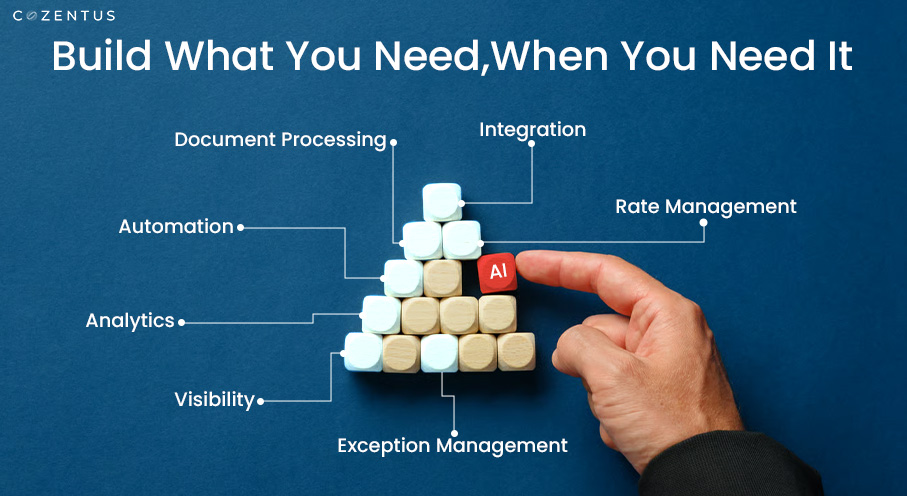
AI capabilities are changing quickly. New models, APIs, document intelligence platforms, AI agents, and automation tools are appearing faster than traditional enterprise implementation cycles can accommodate.
A supply chain company should not have to wait three years to introduce an AI capability because it is tied to a larger transformation program.
A modular architecture makes it easier to introduce AI where the business case is clear, such as:
- AI-powered document extraction
- Predictive ETA
- Automated exception management
- Freight invoice anomaly detection
- AI-assisted customer service
- Natural language analytics
- Automated rate validation
- Shipment risk monitoring
The important question is not where AI can be added.
It is where AI can remove a real operational bottleneck.
Conclusion: You Won’t Need One Giant Platform
Large enterprise platforms will continue to play an important role in supply chains. Companies will still need systems of record for core processes.
But the idea that one platform should solve every operational problem is becoming less practical.
The future is likely to look more like an ecosystem.
Core systems provide stability. Modular applications provide specialist capabilities. APIs connect the pieces. Data moves across the environment. AI and automation sit on top of these capabilities to improve specific decisions and workflows.
That is a more realistic model for a supply chain that changes every month.
The big-bang project promised transformation at the end of a very long road. While composable technology asks a simpler question:
And honestly, nobody ever got fired for shipping useful value in six weeks.
FAQs
1: What is composable technology in supply chain?
A: Composable technology is a modular approach where businesses combine independent software capabilities to solve specific operational problems. These capabilities can connect with existing TMS, ERP, WMS, carrier and other systems through APIs and integrations.
2: Why do supply chain technology projects fail?
A: Supply chain technology projects can fail because of unclear requirements, poor data quality, complex integrations, scope changes, weak change management, unrealistic timelines, and trying to transform too many processes at once. Large projects can also take so long that business requirements change before implementation is complete.
3: What is the future of supply chain technology?
A: The future is likely to combine core enterprise systems with modular applications, APIs, cloud platforms, AI, automation, analytics, and specialist logistics capabilities. Companies can adopt new technology incrementally instead of waiting for one large transformation project to finish.