Gartner's forecasts that the market for Agentic AI will grow from roughly $2 billion today to more than $53 billion by 2030. For freight leaders, that number is less important than what it represents.
For freight and logistics companies, AI agents can monitor operations, manage exceptions, coordinate workflows, and support decisions in real time.
The bigger question now is whether the operation underneath it is ready or not. AI agents depend on accurate data, connected systems, and consistent processes to work effectively. The freight companies that will get the maximum value from Agentic AI will not be the ones who first adopt it. They will be the ones who have already built the operational foundation that’s needed to support it.
In this blog, we'll look at why many freight businesses are not fully prepared today, the operational challenges Agentic AI is likely to expose, and the practical steps logistics leaders can take to prepare for what's coming next.
The Hidden Gaps Agentic AI Will Expose
Most freight businesses already have access to large volumes of data. Shipment events, carrier updates, and financial records are constantly flowing through the organization. The challenge is that this information often sits across multiple systems, with each platform holding only a small part of the bigger picture.
For example, a shipment delay may first appear in a carrier portal, then in a visibility platform, and later in a TMS. Teams can usually access the information they need, but gathering it usually requires moving between systems and piecing together multiple contexts from multiple sources.
Only the experienced operators know which carrier updates require verification, which systems are generally more reliable, and which customers need special handling. Over time, businesses do develop practical ways to bridge the gaps between platforms, allowing operations to move despite fragmented information.
Those workarounds may include:
- Customer service teams checking multiple systems for shipment updates
- Planners relying on carrier performance spreadsheets
- Exceptions managed through email threads
- Shipment data manually reconciled across systems
- Customer instructions stored outside core platforms
Most organizations have made these operations normal because experienced employees have learned how to navigate them.
For many freight businesses, Agentic AI will provide a clear view of where information flows smoothly, where processes rely on manual intervention, and where critical knowledge still sits outside formal systems. Those findings will have less to do with AI capability and more to do with operational readiness.
Why Agentic AI in Supply Chain Doesn't Scale
When businesses identify operational challenges, the first response is to invest in more technology. But many organizations discover it does not automatically remove the core problems.
Let’s consider how an experienced freight planner responds to a disruption. Before making a decision, they typically review:
- Shipment status
- Carrier updates
- Customer commitments
- Alternative routing options
- Service-level requirements
- Commercial impact
Much of this information comes from different systems and is interpreted through experience rather than documented rules. Over time, planners develop a strong understanding of which signals matter, which updates require verification, and which actions are likely to deliver the best outcome.
The same operational context is required when an AI agent becomes part of the process. If critical information remains spread across systems, spreadsheets, inboxes, and undocumented workflows, the AI can only work with half of the picture of the situation. As a result, many AI pilots give impressive demos but struggle during a broader deployment.
The challenge is not the technology itself, but the environment surrounding it. AI agents depend on access to accurate, connected, and timely information. When that foundation is missing, automation inherits the same problems that already affect day-to-day operations.
This is why some businesses see strong results from Agentic AI while others don’t even move beyond proof-of-concept projects. Organizations with clear decision flows and connected systems get the maximum value out of automation.
Looking for Custom AI Solutions?
How Logistics Leaders Prepare for Agentic AI
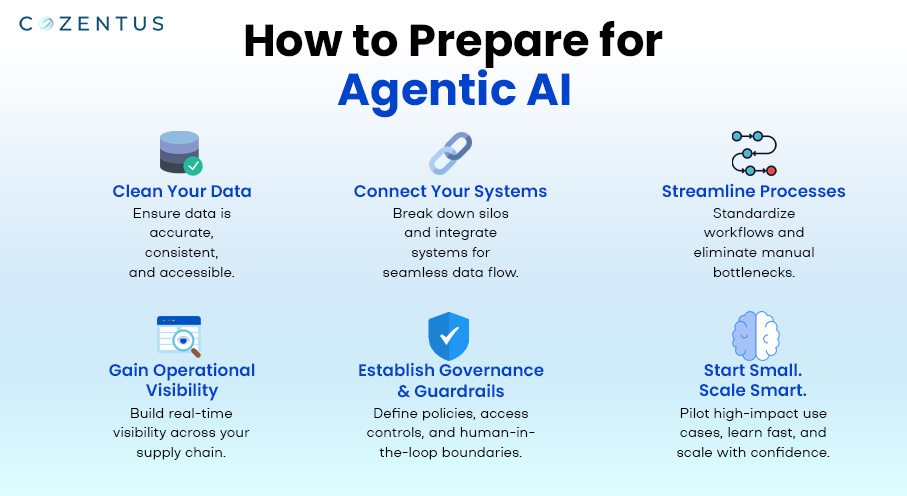
The organizations that get the most value from Agentic AI are focusing on being ready before expanding their AI capabilities. They examine where information originates, how it moves between teams, and what employees need before they can take action.
This process usually reveals hidden inefficiencies in the processes.
For example, one mid-market logistics provider found that customer service teams regularly checked four different systems before responding to shipment enquiries. Over time, the process had evolved because no single platform provided enough context to answer customer questions confidently. This resulted in slower response times, duplicated effort, and inconsistent customer experiences.
Before introducing additional automation, the company focused on simplifying how information moved through the operation. Key priorities included:
- Consolidating shipment information across systems
- Reducing duplicate data sources
- Improving visibility across teams
- Standardizing exception management processes
- Reducing manual information gathering
The impact was quick. Customer service teams spent less time searching for updates. Response times improved. Escalations decreased. Teams could make decisions faster because the information they needed was easier to access and trust.
Once those foundations were in place, automation became significantly easier to deploy and scale. You can see this pattern across successful freight technology transformations. The companies seeing the greatest returns from Agentic AI are often the ones that invest in operational clarity, visibility, and decision flows before investing heavily in AI platforms.
What To Build Before Investing in Agentic AI
At Cozentus, we don’t start our conversation with AI. We spend more time discussing operational bottlenecks, the decision-making process, and technology ownership than we do discussing AI features.
The freight businesses that are most likely to benefit from Agentic AI are usually the ones that have already established a strong operational foundation or are planning to do so ASAP.
That foundation typically includes several characteristics:
- Information flows consistently across teams and systems.
- Critical decisions do not depend on undocumented knowledge.
- Operational workflows are visible and repeatable.
- Employees work from a shared view of events and exceptions.
- Technology reflects how the business actually operates rather than forcing the business to adapt around technology.
Conclusion: The Right Way to Agentic AI
The engineers at Cozentus constantly innovate and build bespoke freight technology around those principles. Sometimes that means replacing fragmented workflows. Sometimes it means creating a unified operational environment. And sometimes it means preparing a business for future automation long before automation becomes an immediate requirement.
Most importantly, our clients own everything we build. There are no licensing dependencies, no vendor-controlled roadmaps, and no restrictions on how the technology evolves as the business changes.
That approach is not suitable for every organization. Businesses that operate effectively within the constraints of standard platforms may never need a bespoke solution. However, companies that view technology as a long-term competitive asset often reach a different conclusion. They recognise that flexibility, control, and ownership are more valuable when operational requirements evolve.
If this sounds like the conversation you've been waiting to have, book a quick consultation with our experts.
Only a couple of minutes. No proposal at the end of it - just an honest assessment of where you are.