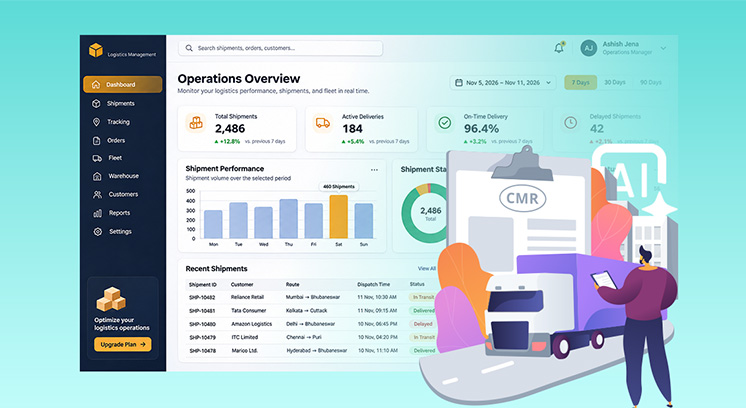
The AI Advantage of Mid-Sized Freight Forwarders
Mid-sized freight forwarders have a bigger opportunity to win the AI race than they might think. While large logistics companies deal with complex legacy systems, lengthy approvals, and company-wide technology changes, mid-sized firms can adopt AI in freight forwarding faster and with fewer complications.
The Loadstar reports that freight forwarding in developed markets often operates on net margins of 1–2%, with labour the highest cost after the freight rate itself. That makes the manual work that can be avoided a direct margin concern.
From freight automation and Intelligent Document Processing (IDP) to freight auditing, rate management and shipment visibility, they can start with one process and scale gradually.
Early AI adoption will help them reduce operational costs, improve efficiency, minimise manual work, and handle more shipments without increasing overheads at the same rate. But this opportunity won't last forever. They need to start as early as possible to have this competitive advantage.
This blog looks at why mid-sized freight forwarders can move faster, where they should start with AI automation, and why waiting too long could make it harder to catch up.
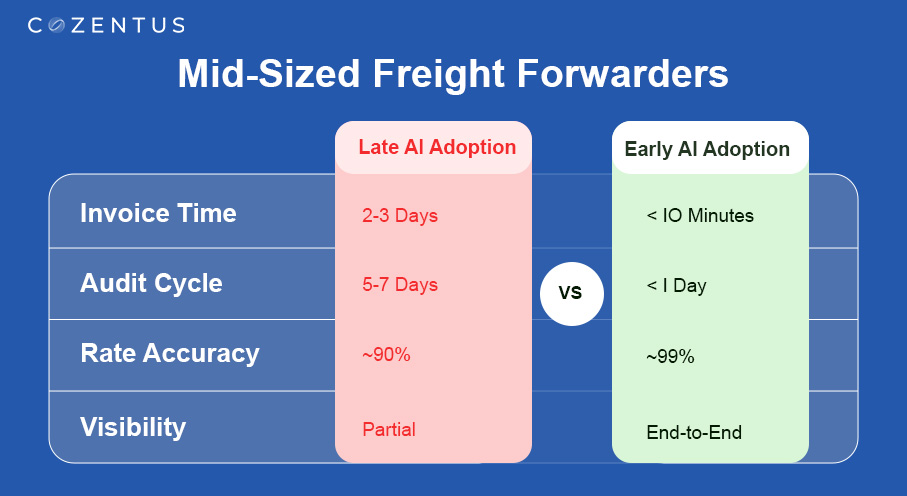
Why Mid-Sized Freight Forwarders Have an Advantage
Large logistics companies have resources that smaller firms can only dream of. They have established IT departments, dedicated innovation teams, enterprise software, and access to extensive shipment data. Naturally, this gives them the upper hand in adopting AI.
However, size also matters.
A technology change in a large freight forwarding organisation can involve multiple departments, regional offices, existing software vendors, compliance teams, and management approvals. Even a relatively small automation project can take months to move from planning to implementation.
Whereas mid-sized freight forwarders often have a simpler decision-making structure. Their leadership teams are closer to daily operations, and changes can be approved and tested without going through several layers of management.
This gives them some practical advantages:
- Faster decisions: Fewer approval layers make it easier to identify problems and invest in solutions.
- Focused implementation: Automation can start with one department, customer or trade lane instead of a company-wide rollout.
- Quicker feedback: Operations teams can identify what works and adjust without waiting for lengthy review cycles.
- Lower implementation complexity: Smaller projects can be easier to manage, test, and scale.
A mid-sized forwarder does not need to automate everything at once. It needs to identify the right problems and start solving them.
AI Automation Does Not Require a Massive Transformation
One common misconception about AI adoption is that companies need to replace their existing systems or invest in expensive enterprise-wide platforms.
That can make the entire process look complicated and expensive.
In reality, freight forwarders can start with specific operational activities that consume significant employee time. Many of these processes involve repetitive tasks, manual data entry and information moving between different systems.
For example:
- Document Processing: AI-powered Intelligent Document Processing (IDP) can extract information from invoices, packing lists, bills of lading, and other shipping documents in a fraction of the time required for manual entry in suitable workflows. Actual processing time depends on document quality, layout variation, validation rules and exception handling.
- Freight Invoice Auditing: Automation can compare freight invoices against agreed rate cards, contracts, and shipment records to identify discrepancies.
- Rate Management: Automated rate management can centralise carrier rates, simplify rate comparisons, and reduce manual calculations.
- Shipment Visibility: AI-powered tracking solutions can show shipment updates in real time and help teams identify delays and potential disruptions.
- Booking Automation: Automated booking workflows can reduce repetitive data entry, improve accuracy, and speed up shipment processing.
These are some common practical starting points that Cozentus offers. A company can automate one process, see the results, and gradually expand into other areas.
Looking for Custom AI Solutions?
Start with One Process and One Measurable Result
Here’s how you should approach AI adoption:
Consider a company handling shipments across several international trade lanes. Its operations team spends hours processing shipping documents, checking carrier rates, and updating shipment information.
Instead of introducing an organisation-wide AI programme, the company could select one busy trade lane and automate its document processing workflow.
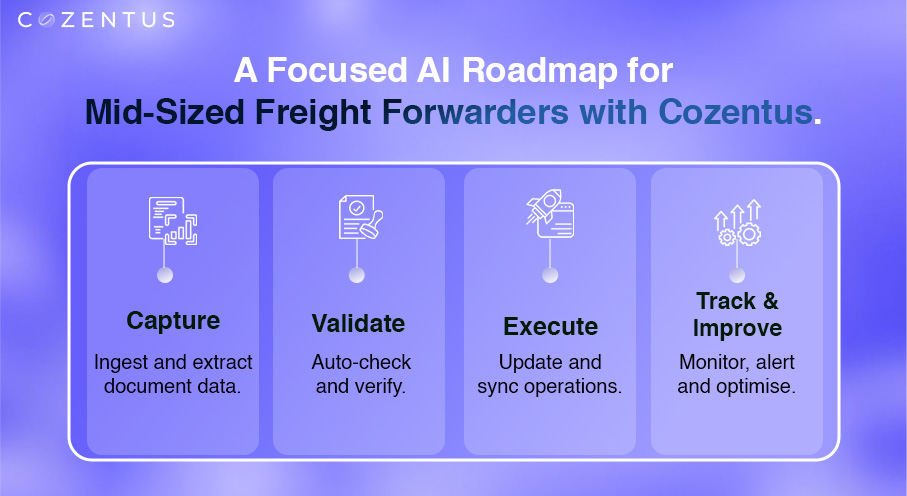
The implementation could involve:
- Identifying the most time-consuming documentation activities.
- Connecting an IDP solution to existing document sources such as email, SFTP or APIs.
- Using OCR and AI models to extract shipment information.
- Validating extracted data against existing business rules.
- Sending validated information to the company's TMS or ERP through an integration layer.
The company can then measure processing time, manual intervention, extraction accuracy, and operational costs.
Once the results are clear, the company can extend the same approach to other trade lanes or document types.
This makes AI adoption easier to justify because management can see what the investment is delivering. It also gives employees enough time to adapt to new workflows.
The Benefits of Adopting AI Early Compound Over Time
When a company automates a process, the immediate benefit you’ll see will be reduced manual effort or faster processing. But the longer-term benefits can be much greater.
Consider what happens when a freight forwarder gradually automates document processing, rate management, freight auditing, and shipment tracking.
Over time, it can build a more connected operational environment where information moves between systems with fewer manual touchpoints.
This creates several advantages:
- Lower operational costs: Reduced manual processing helps teams handle more shipments without increasing administrative overhead at the same rate.
- Better data quality: Automated extraction and validation reduce errors caused by repetitive manual entry.
- Faster customer responses: Teams spend less time searching for information and more time addressing customer requirements.
- Better decision-making: Centralised operational data gives managers better visibility into costs, performance and exceptions.
- Better scalability: Growing shipment volumes become easier to manage without expanding every operational team proportionately.
There is also a data advantage. As more processes become automated, companies can build better historical datasets to support reporting, predictive analytics, and AI-driven decisions.
The earlier a company starts, the more time it has to improve these processes and build on the results.
The Longer You Wait – The Harder It Gets
The opportunity for mid-sized freight forwarders won't last forever. As more companies adopt AI, those with automated processes, connected systems, and better data will have an advantage.
Companies still depending on spreadsheets, emails, and manual work may find it harder to keep up. Customer expectations are also changing. They want faster quotations, accurate shipment updates, clear costs and quick responses when problems occur. Meeting these expectations is difficult when teams spend hours on repetitive tasks.
This is where the right technology partner can help. Cozentus continuously helps freight forwarders, 3PLs, and logistics providers automate most of their day-to-day tasks.
The best way to start is simple: pick one problem, automate it, measure the results, and build from there.
The earlier you start, the easier it is to stay ahead.
FAQs
1. How can AI help mid-sized freight forwarders?
Ans: AI can help mid-sized freight forwarders automate document processing, freight invoice auditing, rate management, shipment tracking, and customer communication. These applications reduce repetitive manual work, improve data accuracy and help teams manage higher shipment volumes.
2. What are the best AI applications for freight forwarding companies?
Ans: Some of the most useful applications include Intelligent Document Processing (IDP), automated freight auditing, AI-powered shipment visibility, rate management, predictive ETA, and booking automation. The right starting point depends on the company's operational challenges and available data.
3. Is AI adoption expensive for small and mid-sized freight forwarders?
Ans: AI adoption costs depend on the solution, integration requirements, and scale of implementation. Companies can begin with focused automation projects instead of investing in a complete enterprise-wide transformation. Starting with one process also makes it easier to measure ROI before expanding.
4. How can freight forwarders start implementing AI?
Ans: Freight forwarders should begin by identifying repetitive, time-consuming processes that affect operational efficiency. They can then select a suitable AI solution, integrate it with existing systems, test it on a limited workflow, and measure improvements before scaling it across the business.