AI Agents are your new Co-Workers
Those logistics teams say they're "digitally transformed", wait till you walk into their ops floor.
Someone's still copying ETAs into emails. Someone's still chasing PODs at 11 PM. And someone's still updating the TMS manually because two systems refused to talk to each other.
That's the real freight industry. And honestly, that's exactly why AI agents are becoming impossible to ignore.
Not dashboards. Not chatbots. Actual Agentic AI logistics systems that can monitor shipments, trigger alerts, update records, validate freight documents, update TMS records, and handle repetitive operational work automatically.
The shift is happening faster than most companies expected. According to Gartner, 60% of supply chain disruptions could be resolved without human intervention by 2031.
In this blog, we'll break down 5 logistics workflows AI agents can realistically handle today and 3 areas where human operators still matter a lot more than the hype suggests.
What Is Agentic AI in Logistics?
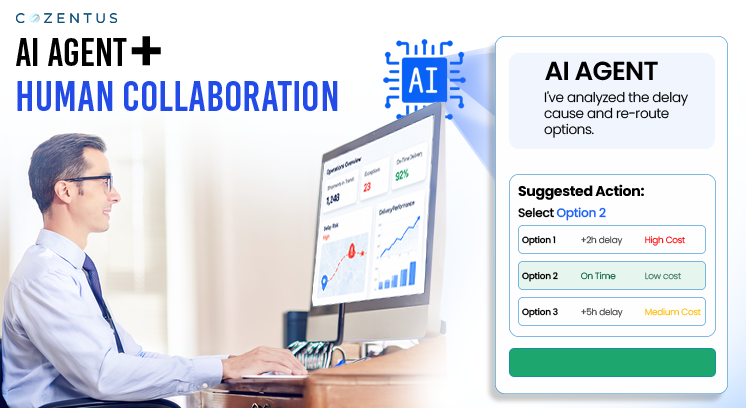
Traditional AI mainly helps people make decisions by analyzing data, spotting patterns, or generating recommendations. Agentic AI goes one step further. It can execute operational tasks on its own within predefined rules and workflows.
Technically, AI agents are software systems that can read data, make decisions based on logic or AI models, and trigger actions automatically across multiple systems.
In freight operations, AI agents can:
- Monitor shipment milestones and ETA deviations
- Read emails, portals, and operational updates
- Update TMS records automatically
- Trigger alerts and customer notifications
- Validate freight documents and shipment data
- Escalate exceptions to operations teams
- Coordinate repetitive logistics workflows
And they can do all of this without waiting for someone to manually trigger every action.
That's the real shift happening in autonomous AI logistics right now.
But there's an important catch here. AI agents work best in logistics workflows that are repetitive, structured, and follow clear operational rules. Once situations involve customer pressure, carrier relationships, major disruptions, or difficult decision-making, human judgment still matters a lot more than automation.
5 Logistics Workflows AI Agents Can Easily Do Now
1. Shipment Monitoring and Delay Alerts
This is probably one of the most valuable use cases for AI supply chain orchestration right now.
Most operations teams spend a huge part of their day just checking whether shipments are moving on time. Carrier portals, GPS feeds, emails, ELD updates, warehouse systems. Teams keep jumping between screens trying to piece together what's happening.
And after staring at updates all day, delays and missed alerts naturally slip through.
This is exactly the kind of repetitive operational work AI agents are very good at handling.
A well-configured AI agent can:
- Detect ETA delays early
- Send customer notifications automatically
- Update shipment milestones in the TMS
- Escalate critical disruptions
- Recommend the next operational step
This is where the idea of a self-healing supply chain starts feeling real. At Cozentus, companies often see immediate operational relief here because teams spend far less time manually chasing shipment updates all day.
2. Appointment Scheduling and Rescheduling
Appointment scheduling sounds simple until you actually work in logistics.
Most of the work includes:
- Checking dock availability
- Matching carrier arrival windows
- Sending emails
- Updating portals
- Confirming slots
- Rescheduling delays
AI agents can handle a large percentage of this workflow automatically.
They can:
- Read inbound scheduling emails
- Extract appointment requirements
- Coordinate available slots
- Update systems
- Send confirmations
- Escalate conflicts to humans
More importantly, they can do it continuously without creating bottlenecks during peak operational hours.
Looking for Custom AI Solutions?
3. Freight Documentation Validation
Freight operations still run heavily on documents, and unfortunately, documentation mistakes are still everywhere. Wrong shipment references. Missing invoice fields. Incorrect container numbers. Incomplete delivery paperwork.
This is another area where intelligent supply chain automation is becoming extremely useful.
AI agents can now:
- Read freight documents automatically
- Extract shipment and invoice data
- Compare records across multiple systems
- Detect mismatched shipment details
- Flag missing or incomplete information
- Route exceptions to the right teams
- Request correct documents automatically
Human review is still important for complex edge cases, especially in customs or compliance-related workflows. But the amount of repetitive manual validation work drops significantly.
4. Customer Shipment Updates
A huge percentage of customer communication in freight operations is repetitive. Customers usually want the same core information:
- "Where is the shipment?"
- "What's the ETA?"
- "Was the delivery confirmed?"
- "Is there a delay?"
- "Was the delivery rescheduled?"
AI agents work very well here because the responses are mostly data-driven and operationally straightforward.
AI systems can send proactive updates, answer routine shipment questions, and escalate sensitive conversations to human teams when needed.
And honestly, customers usually care more about getting fast, accurate updates than whether a human typed the message personally.
5. Operational Triage and Prioritization
One of the hardest parts of logistics operations is deciding what deserves attention first.
Everything feels urgent when hundreds of alerts hit the system at once. AI agents are becoming very effective at sorting operational noise by actual business impact.
They can prioritize issues based on:
- Revenue exposure
- SLA risk
- Customer priority
- Delay severity
- Downstream disruption impact
That helps operations teams focus their energy on the problems that genuinely need immediate attention.
3 Workflows AI Agents Shouldn't Do (Yet)
1. Carrier Negotiation and Relationship Management
Freight is still deeply relationship-driven.
Capacity negotiations, service recovery, pricing conversations, and long-term partnerships involve nuance that AI still struggles to handle naturally.
One poorly handled automated interaction can damage a carrier relationship that took years to build. That's a real operational risk.
2. High-Stakes Operational Crisis Management
Certain situations simply evolve too fast and too unpredictably for full autonomy.
Things like:
- Customs escalations
- Cargo theft
- Regulatory issues
- Severe weather rerouting
- Major customer disputes
AI can absolutely assist with coordination and visibility. But experienced human operators still need to make the final decision.
3. Strategic Supply Chain Planning
Despite all the excitement around autonomous supply chain systems, long-term strategic planning still depends heavily on human judgment.
AI can optimize routes and analyze scenarios. But business priorities, market conditions, customer behavior, and geopolitical shifts are not always black and white.
That kind of uncertainty still requires experienced leadership.
Conclusion: Agentic AI is the Start
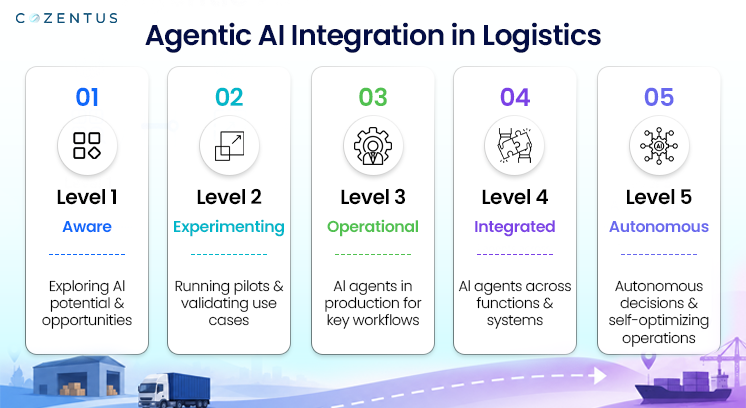
The future of logistics probably won't be fully autonomous. At least not anytime soon.
What's far more realistic is collaborative autonomy, where AI agents handle repetitive operational execution while humans focus on judgment-heavy decisions, relationships, and strategy.
Cozentus is already collaborating with many logistics companies to develop custom agentic AI solutions. The companies getting the best results from agentic AI in 2026 are not trying to remove humans from operations completely. They're trying to remove time-consuming repetitive work.
And honestly, that's a much smarter approach.