The Real Reason Why More Freight Companies Want Custom TMS
It usually starts with small things. Teams start using spreadsheets outside the system. Customer updates require manual follow-ups. Different departments start relying on disconnected workflows just to keep operations moving.
As shipment volumes grow and customer expectations rise, many logistics companies start realizing that off-the-shelf transport management software (TMS) cannot always support the way their business actually operates.
Freight companies want stronger automation, better visibility, more workflow flexibility, and long-term operational control.
But building a custom TMS is a serious investment. Development costs vary significantly based on integrations, workflows, scalability requirements, and real-time visibility capabilities. The TMS build timeline is also longer than most companies initially expect.
This blog breaks down the real-world side of custom TMS development, including realistic TMS development cost expectations, implementation timelines, major cost drivers, and the types of freight operations where custom logistics software delivers the strongest ROI.
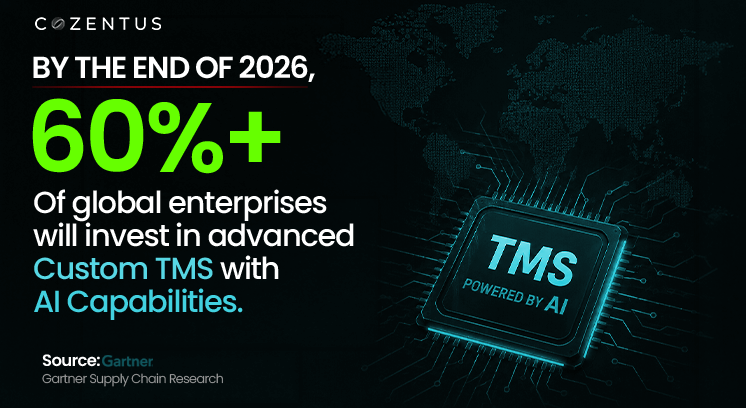
What is a Custom TMS?
A custom TMS, also known as a bespoke transport management system, is software built specifically around a company's operational workflows, customer requirements, shipment processes, and integration ecosystem.
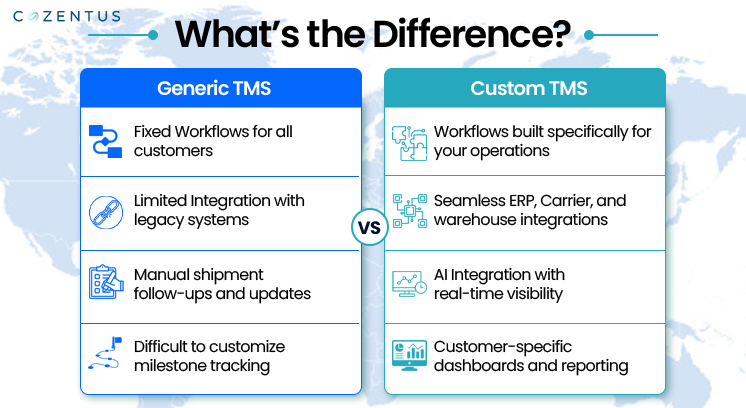
Unlike generic SaaS platforms, which are designed for broad market use, custom logistics software is tailored around how the business actually operates daily.
That distinction becomes important quickly in freight operations because no two logistics businesses operate exactly the same way. For example, a domestic transportation company may need simple dispatch and billing workflows, while a global freight forwarder may require multi-modal coordination, customs handling, and automated exception management.
A modern custom TMS can include capabilities such as:
- Shipment planning and execution
- Carrier and rate management
- Customer portals
- Real-time shipment visibility
- Milestone tracking
- Invoice automation
- Warehouse integrations
- Document management
- Analytics dashboards
- ERP integrations
- AI-driven alerts
- Predictive ETAs
- Customs process management
The biggest reason companies pursue custom TMS development is flexibility.
The software adapts to the business instead of forcing the business to work around software limitations. As freight operations grow more specialized, that flexibility becomes extremely valuable.
Looking for a Custom TMS ?
TMS Development Cost: What Companies Should Expect
The cost to build a TMS from scratch in 2026 usually ranges between $80,000 and $500,000+, depending on operational complexity. A smaller custom logistics software platform with basic shipment workflows and limited integrations may stay under $100K, while enterprise-grade bespoke transport management systems with real-time visibility, automation, analytics, and multi-system integrations can easily cross several hundred thousand dollars.
Most freight companies assume the investment mainly goes into dashboards and user interfaces. In reality, the biggest TMS development cost drivers are:
- Backend infrastructure
- Workflow automation
- System integrations
- Real-time visibility architecture
- Scalability planning
- Testing and validation
One of the largest cost factors in custom transport management system development is integration complexity. Most freight operations already rely on multiple systems, including:
- ERP platforms
- Carrier APIs
- EDI providers
- Warehouse systems
- Accounting software
- Customer platforms
Connecting these systems reliably requires significant logistics software development because every platform handles shipment data differently.
What Increases Custom TMS Development Costs?
Freight workflows are deeply interconnected. A single shipment event can impact invoicing, warehouse scheduling, customer communication, customs handling, and delivery coordination simultaneously. That makes the software more complicated to build.
1. Workflow Customization
Many freight companies operate with customer-specific workflows that standard SaaS TMS platforms struggle to support effectively.
These workflows often include:
- Multi-step approvals
- Specialized billing structures
- Region-specific compliance workflows
- Custom reporting formats
- Customer-specific milestone tracking
- Multi-modal coordination processes
The more specialized the operation becomes, the more testing and configuration effort is required.
2. AI and Automation Features
AI-driven logistics software is becoming increasingly common across freight operations.
Many companies now want their bespoke transport management system to support:
- Predictive shipment delays
- Automated exception handling
- AI-generated operational alerts
- Smart shipment prioritization
- Risk monitoring
- Forecasting capabilities
3. Scalability Requirements
A platform supporting 20 users is very different from a system supporting:
- Multiple regions
- Thousands of daily shipments
- Hundreds of customers
- Real-time concurrent operations
- Large operational data volumes
TMS Build Timeline: How Long Does Custom TMS Development Take?
Most custom TMS projects take anywhere between 6 to 12 months, while large enterprise-grade freight forwarder technology platforms can take 12 to 18 months or longer, depending on integrations, automation requirements, and operational complexity.
Many freight companies initially assume they can build and deploy custom logistics software within a few months. That doesn't usually happen because freight operations are deeply connected across transportation, warehousing, finance, documentation, visibility systems, and customer communication.
A shipment delay, for example, does not only affect transportation. It can also impact invoicing, warehouse scheduling, customer updates, customs processing, and delivery planning. That makes the software much more complex to design and build properly.
Before development begins, companies usually spend several weeks documenting operational workflows and identifying gaps between teams and systems.
Once the discovery phase is complete, the project typically moves through:
- System architecture and database planning
- UI and backend development
- API and third-party integrations
- Workflow automation setup
- Testing, validation, and deployment
Projects usually take longer when companies require:
- Real-time visibility
- AI-driven automation
- Customer-specific workflows
- Multi-region operations
- Large-scale integrations
The smoothest implementations usually happen when companies treat custom TMS development as an operational transformation project, not just a software installation.
When Does Building a Custom TMS Actually Make Sense?
Not every freight company needs a tailored transport management system. For smaller operations with simple transportation workflows, off-the-shelf software may remain the best option for years.
However, there are specific situations where custom logistics software delivers a strong ROI much faster.
1. Your Operations Are Highly Specialized
If teams constantly rely on:
- Spreadsheets
- Manual coordination
- Email-based workflows
- Disconnected systems
- Repetitive workarounds
Operational inefficiencies start compounding very quickly. Over time, those inefficiencies become expensive.
2. Customer Requirements Keep Increasing
Enterprise customers now expect:
- Customized reporting
- Real-time visibility
- Automated communication
- Customer-specific workflows
- Integration support
- Operational transparency
Many standard SaaS platforms struggle to support these requirements consistently.
3. SaaS Costs Continue Growing
Many freight companies eventually realize they do not fully control:
- Licensing costs
- Vendor roadmaps
- API accessibility
- Feature priorities
- Data ownership
Technology ownership creates more operational flexibility over the long term.
4. Real-Time Visibility Is Business Critical
Visibility is no longer considered a premium logistics feature. Customers now expect:
- Live shipment tracking
- Proactive updates
- Faster disruption communication
- Predictive delay notifications
Companies that provide stronger visibility often improve customer retention and operational trust significantly.
5. You Need Better Scalability
As shipment volumes increase, disconnected operational workflows create pressure very quickly.
Custom transport management systems help companies scale processes without continuously adding manual coordination layers.
Final Thoughts: Generic TMS Are Holding You Back
Most freight companies do not decide to build a custom TMS because it sounds exciting.
They do it because operations slowly become harder to manage. Teams start relying on spreadsheets, customer updates become manual, visibility gaps increase, and existing software starts creating more work than it removes.
That is usually the turning point.
A well-built custom transport management system (TMS) helps companies simplify operations, improve visibility, automate repetitive tasks, and scale without adding operational confusion.
At Cozentus, all our custom logistics software projects start with understanding how freight teams actually work day to day. The goal is not to force operations into rigid software. It is to build technology around real workflows, integrations, and customer requirements.
The companies investing in custom TMS development early are usually the ones avoiding much bigger operational problems later.