Do Freight Forwarders Still Need a TMS in 2026?
Transportation Management Systems (TMS) have been the default choice in freight forwarding for years. If you search for the best TMS software today, you will still see endless comparisons, feature lists, and vendor rankings. That process feels familiar and safe for most teams.
But logistics in 2026 do not behave the same way. Freight forwarding operations now are faster, more unpredictable, and heavily dependent on real-time shipment visibility. Delays are more common, customer expectations are higher, and teams are expected to respond instantly. In this kind of environment, traditional TMS platforms often feel slow.
So, do freight forwarders still need a TMS? Yes, but the role has changed. A TMS now works better as a supporting system for execution, documentation, and planning, while real-time visibility, AI-driven insights, and integrations handle speed and decision-making.
In this blog, we will explore what a TMS does today, especially a custom-built TMS. Why freight forwarders are rethinking it and what a modern logistics technology stack looks like in 2026.
What Is a Transportation Management System in Freight Forwarding?
A Transportation Management System, or TMS, has been a core part of freight forwarding for years. It is designed to help logistics teams plan, execute, and track shipments while keeping operations organized and efficient.
Most modern TMS platforms are built to handle key functions such as:
- Shipment planning and scheduling
- Route optimization and load consolidation
- Carrier selection and rate management
- Real-time or near real-time shipment tracking
- Documentation, billing, and compliance processes
These capabilities helped bring structure to complex logistics operations. They reduced manual effort, improved coordination across teams, and created a more controlled way of managing freight.
Even in 2026, TMS platforms continue to deliver value, especially for companies with stable and predictable workflows. They provide a strong foundation for execution.
However, as logistics becomes more dynamic and data-driven, many freight forwarders are starting to look beyond these core functions to meet new operational demands.
Modern Logistics Technology Stack in 2026 for Freight Forwarders
Freight forwarders are slowly moving toward more flexible logistics technology setups. Instead of depending on one big system to handle everything, teams are building a mix of tools that actually work well together.
This shift is not happening overnight, but it is clearly visible across the industry.
A typical modern logistics stack now includes:
- API-based integrations to connect different systems
- Cloud platforms that are easier to scale
- AI tools for insights and predictions
- Real-time data pipelines for continuous updates
This kind of setup gives teams more control. It also makes it easier to adjust things when operations change, which happens quite often now.
1. AI in Freight Forwarding Operations
AI is becoming more and more practical in freight forwarding. It is no longer just a concept that sounds good in presentations. Teams are now actually using it in daily operations.
Some of the common use cases are:
- Predicting shipment delays using real-time and past data
- Identifying risks before they turn into actual problems
- Suggesting alternate routes during disruptions
- Improving planning and delivery timelines
These small improvements add up. Teams spend less time reacting and more time making better decisions.
2. Logistics Systems Integration Strategy
Many companies are not in a rush to replace their entire system. That process takes time, effort, and often creates disruption. So instead, they are improving what they already have.
This usually involves:
- Adding smaller tools to solve specific problems
- Connecting systems through APIs for smoother data flow
- Automating repetitive tasks that slow teams down
It is a more practical approach. Things improve step by step, and teams do not have to deal with a complete reset.
Challenges with Traditional Transportation Management Systems in 2026
Transportation Management Systems still play an important role in freight forwarding. At the same time, many teams are starting to feel the gaps more clearly now.
As operations become faster and more unpredictable, some of the limitations of traditional TMS platforms are becoming harder to ignore. These challenges are pushing freight forwarders to rethink how they use these systems.
1. Long TMS Implementation Timelines Slow Down Progress
Implementing a TMS is not very quick. In most cases, it takes several months, and sometimes even more than a year, to go live properly.
During this time, business needs often keep changing. By the time the system is fully implemented, some of the original requirements already feel outdated. This makes it difficult for companies to move as fast as they want.
2. Limited Flexibility in Adapting to New Logistics Workflows
Freight forwarding doesn’t always stay the same for long. New routes, new partners, and new processes keep coming in.
Many TMS platforms need heavy configuration to handle these changes. Even small adjustments can take time and effort. This slows teams down, especially when quick decisions and fast changes are needed.
3. Low User Adoption Across Logistics Teams
When a system feels complex, teams do not always use it the way it was intended. Over time, this creates small gaps that turn into bigger operational issues.
- Incomplete or inconsistent data entry
- Dependence on manual workarounds
- Lower efficiency across daily operations
4. Integration and Real-Time Data Challenges in TMS
Freight forwarding depends on multiple systems working together. But in reality, connecting everything smoothly is not always easy.
- Delays in data updates
- Gaps between different systems
- Limited real-time visibility across operations
Because of this, getting a complete and accurate view of shipments becomes difficult. Teams often have to rely on multiple sources to understand what is really happening.
What Successful Freight Forwarders Are Doing Differently in 2026
Freight forwarders who are doing well in 2026 are not necessarily using completely different tools. The real difference is in how they approach technology decisions.
They are taking a more structured and practical approach. There is more focus on solving actual operational problems and building systems that can adapt over time.
1. Starting with Clear Operational Problems
Strong teams do not begin with software selection. They start by understanding what is actually slowing them down.
This usually includes areas like:
- Workflow bottlenecks across operations
- Delays in shipment processing and execution
- Lack of real-time shipment visibility
This clarity helps them avoid unnecessary tools and focus only on what adds real value.
2. Building a Strong Data Foundation
Without reliable data, even the best systems struggle to perform well. Leading freight forwarding companies are putting effort into:
- Maintaining data accuracy across multiple systems
- Enabling real-time data updates and synchronization
- Making data accessible across operations, customer service, and management teams
3. Adopting an Iterative Approach to Technology
Instead of large, one-time implementations, many companies are moving in smaller steps. This feels slower at first, but it usually works better in the long run.
Their approach often includes:
- Testing new solutions in smaller phases
- Collecting feedback from actual users
- Making continuous improvements based on real usage
This helps in building systems that actually fit day-to-day operations.
4. Balancing Automation with Human Expertise
Automation is helping reduce repetitive work across logistics operations. It improves speed and consistency, especially in high-volume processes.
At the same time, human expertise continues to play a critical role. Teams still focus on:
- Managing exceptions and complex shipment scenarios
- Making strategic and operational decisions
- Building and maintaining customer relationships
Conclusion: What’s in the Future of TMS in Freight Forwarding
Transportation Management Systems are still very much part of freight forwarding. Teams are using them every day for execution, documentation, and keeping operations structured.
What is changing is how they are being used.
In many teams today, TMS is no longer where the real action happens. The pressure is coming from real-time visibility, constant disruptions, and faster decisions. And most traditional systems were not built for that pace.
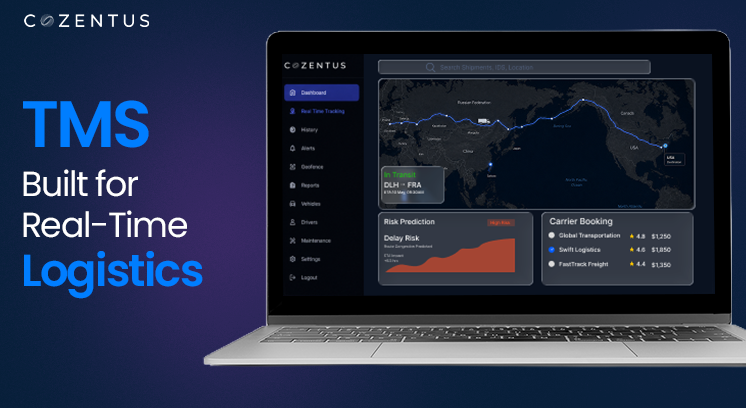
Cozentus has already built a custom AI-powered TMS solution for a client. It is designed around actual operations like real-time risk tracking, risk monitoring, and booking, and a whole lot more.
Forwarders who are moving in this direction are starting to feel the difference. Operations become more flexible, responses get faster, and teams spend less time adjusting systems.
It is still fairly early, but the direction is becoming quite clear.