Why Freight Forwarding Needs AI Today
Success in the freight forwarding industry has been defined by how quickly teams respond to disruptions. Delays, capacity constraints, and documentation issues have made quick response a core strength. But today’s supply chains are more complex, more connected, and far less predictable than before.
At the same time, customer expectations have evolved. Businesses now demand real-time visibility, faster decisions, and consistent outcomes. Relying only on experience and manual processes is becoming more and more difficult in this environment.
This is where Artificial Intelligence is helping.
AI helps freight forwarders to move from reacting to problems to anticipating them. By analyzing large volumes of real time and historical data, it provides early insights into potential risks and recommends the best course of action.
As a result, the role of the freight forwarder is no longer limited to managing shipments. It is expanding into orchestrating end-to-end logistics with better control and accuracy. This transition is already happening, and those who adapt early are going to have a more strategic future.
The Traditional Freight Forwarding Challenges
Freight forwarding has always been complex. It involves multiple stakeholders, disconnected systems, and constant uncertainty.
Some of the most common challenges include:
- Limited visibility across the shipment lifecycle
- Heavy reliance on manual processes and spreadsheets
- Delayed response to disruptions
- Fragmented communication across partners
- Difficulty in predicting risks and costs
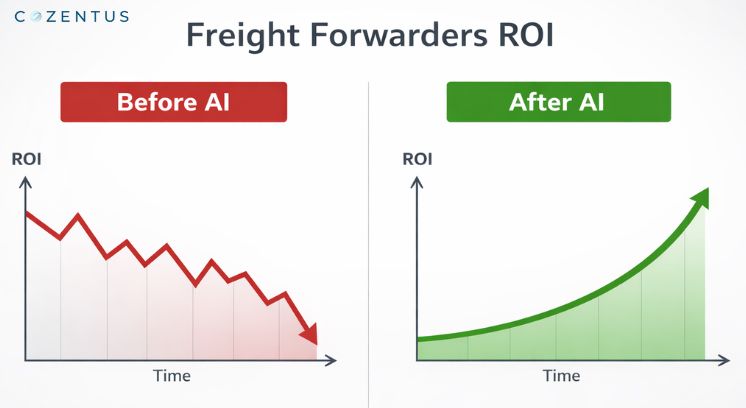
Most teams spend a significant amount of time reacting to problems instead of preventing them. This reactive approach creates inefficiencies, increases costs, and impacts customer trust.
Even the most experienced professionals find it difficult to stay ahead when decisions are based on incomplete or late information.
What Is AI in Freight Forwarding and How It Works
Artificial Intelligence is changing the way decisions are made in freight forwarding. Instead of relying only on historical reports and human judgment, AI processes vast amounts of real-time data and identifies patterns that are nearly impossible to detect manually.
Here’s what that means in practical terms:
- Continuous monitoring of shipments across modes and regions
- Early detection of risks such as delays or disruptions
- Intelligent recommendations for alternative routes or actions
- Automated data processing and document handling
- Predictive insights that improve planning accuracy
AI does not replace human expertise. It enhances it. It gives freight forwarders the ability to act earlier, decide faster, and operate with more confidence.
AI Converts Firefighting to Predictive Decision-Making
One of the biggest transformations AI does is the shift from reactive to predictive operations.
Previously, teams would respond after a delay occurred. Now, AI can identify signals that indicate a potential delay hours or even days in advance.
These signals may include:
- Port congestion trends
- Weather patterns
- Carrier performance data
- Historical transit times
- Real-time movement deviations
By analyzing these factors together, AI provides early warnings and suggests the best possible actions. This changes the role of the freight forwarder. Instead of managing crises, they start to manage risks before they escalate.
AI models also assign risk scores to shipments, which helps teams prioritize actions based on impact. They can simulate different scenarios and recommend alternatives such as rerouting, expediting, or adjusting delivery commitments. This enables faster, data-driven decisions with greater accuracy and consistency.
AI Improves Real-Time Shipment Visibility
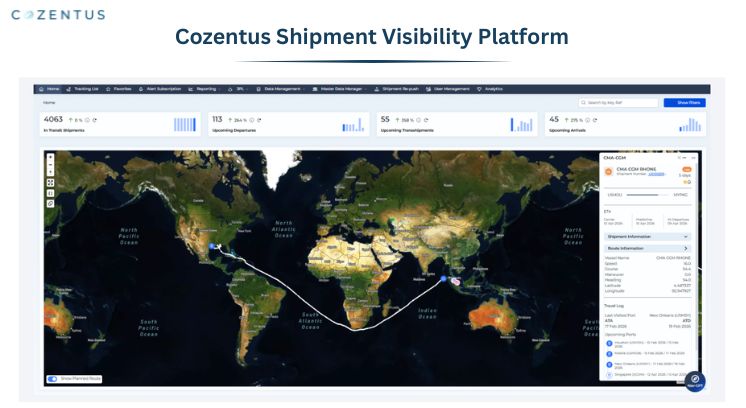
Visibility has always been a key requirement in logistics. However, traditional tracking systems often provide fragmented or delayed updates. AI-powered shipment visibility goes much deeper.
It combines data from multiple sources such as carriers, ports, IoT devices, and external data feeds. It then creates a unified and dynamic view of every shipment across the entire journey. More importantly, it adds context.
Instead of simply showing where a shipment is, it answers critical questions:
- Is the shipment on track
- What is the probability of delay
- What factors are influencing the journey
- What actions should be taken next
AI continuously cleans and organizes incoming data, combines updates from different systems, and connects related events to build a complete view. It identifies important patterns, highlights issues early, and helps teams focus on high-priority shipments, all while maintaining clear visibility across the entire supply chain network.
This level of visibility turns raw data into actionable intelligence and supports better coordination across teams, partners, and stakeholders.
AI Improves Freight Planning and Carrier Selection
Planning in freight forwarding has always been challenging due to constant change and uncertainty across routes, carriers, and external conditions. AI improves planning by introducing predictive intelligence that uses real-time and historical data together.
AI can:
- Forecast transit times with better accuracy
- Optimize route selection based on multiple variables
- Recommend the best carrier options
- Balance cost, service, and reliability
For example, instead of choosing a route based only on cost, AI evaluates the likelihood of delays, port congestion, carrier reliability, and past performance trends. This helps teams make more practical and data-backed decisions.
It also continuously learns from new data, improving recommendations over time. Over time, these improvements compound and create significant operational efficiency, better resource utilization, and stronger financial outcomes across the network.
AI Automates Manual Processes in Freight Forwarding
A large portion of freight forwarding operations involves repetitive, time-consuming tasks that slow down execution and increase the risk of manual errors.
These include:
- Data entry across multiple systems
- Document verification and validation
- Status updates across stakeholders
- Communication follow-ups and coordination
AI can automatically capture and input data from emails, PDFs, and shipment documents into core systems, eliminating manual entry. It validates information across multiple data sources and flags discrepancies in real time.
AI-powered Intelligent Document Processing (IDP) plays a critical role here. It can read, extract, classify, and verify data from documents such as:
- Bills of lading
- Invoices
- Packing lists
- Customs forms
It also matches data across documents, ensures compliance, and updates systems without human intervention.
Additionally, AI automates milestone tracking, generates real-time shipment updates, sends proactive alerts, and manages routine communication with customers and partners. It can also trigger workflows based on predefined conditions, such as delays or exceptions.
AI-Driven Control Towers for Centralized Operations
One of the most impactful applications of AI in freight forwarding is the concept of a control tower.
A control tower acts as a central intelligence layer that monitors, analyzes, and manages the entire supply chain from a single platform.
AI enhances this concept by adding predictive and prescriptive capabilities. Along with showing what is happening in real-time, it also helps understand what is likely to happen next and what actions should be taken.
An AI-powered control tower allows you to:
- Monitor all shipments in one place across modes and regions
- Identify risks across the network using real-time and historical data
- Prioritize actions based on shipment criticality and business impact
- Coordinate responses across teams, partners, and stakeholders
AI continuously collects data from multiple systems, applies machine learning models, and generates insights in real time. It can detect disruptions early, simulate different scenarios, and recommend the most effective response.
It also allows standardized workflows, automated alerts, and better collaboration across various functions.
This creates a more structured, data-driven, and scalable approach to managing operations. Many forwarders are adopting AI-powered control towers to improve visibility, reduce risk, and operate with better control.
Also Read: 7 Ways AI Is Turning Control Towers into Autonomous Decision Engines
Challenges to Consider in AI Adoption
While the benefits are clear, adopting AI requires careful planning.
Some common challenges include:
- Data quality and availability
- Integration with existing systems
- Change management within teams
- Initial investment and ROI clarity
The key is to start with focused use cases that deliver measurable value.
Many successful organizations begin with areas such as visibility or predictive ETAs and then expand gradually.
Working with the right technology partners also plays an important role. Even small differences in approach and execution can significantly impact outcomes.
Conclusion: The Industry Is Getting Smarter. Are You?
If you are in freight forwarding, you can already feel this change. Operations are getting more complex, customers expect quick and clear updates, and there is always something urgent to handle. Keeping everything under control is becoming more difficult.
At the same time, some forwarders have started working differently. They are using AI to spot delays early, adjust plans in advance, and bring more clarity into daily operations. Over time, this leads to fewer surprises, smoother execution, and better control across shipments.
This is where the difference becomes clear. While some teams are still chasing updates and managing issues manually, others are working with better visibility and more reliable insights. Decisions are quicker, and outcomes are easier to manage.
AI is changing how freight forwarding runs, especially in how decisions are made and how work gets prioritized. The shift is already happening. The real question is how long you want to keep working the old way before moving to a more stable and predictable approach.
Meanwhile, for custom AI-driven logistics solutions, there’s always Cozentus.