Modern Supply Chains Need AI-Driven Control Towers
For years, control towers have been the command centers of enterprise operations. They brought visibility into complex environments. Leaders could monitor shipments, track inventory, analyze performance metrics, and respond to disruptions. That visibility was valuable. But it came with a limitation.
Most control towers only provided insight. Humans still had to interpret the data, check options, and make decisions. In fast-moving supply chain logistics and global trade operations, this process was slow.
Today, a new generation of control towers is emerging. And it is with AI.
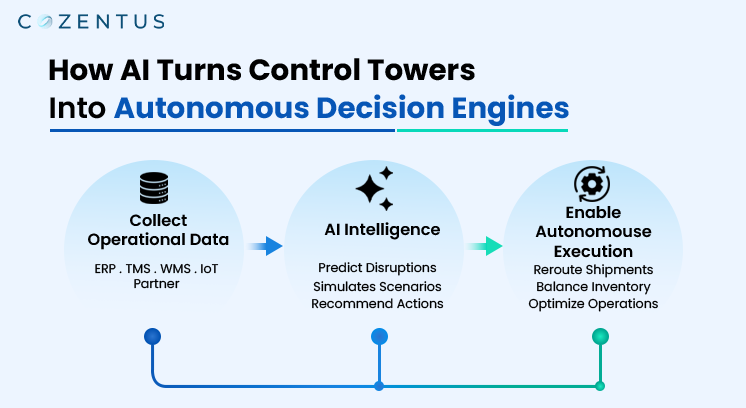
Instead of simply presenting information, AI-driven control towers can examine conditions, predict risks, simulate outcomes, and recommend or execute decisions in real time. The transformation is happening because AI brings several capabilities that traditional systems could not deliver, such as predictive intelligence and autonomous agents.
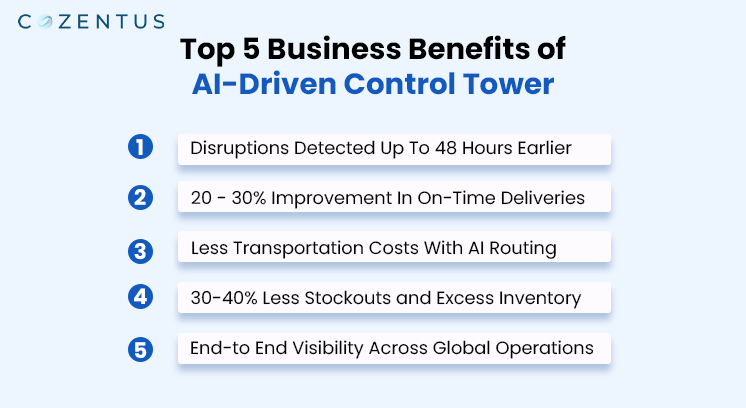
Organizations using intelligent control towers are already seeing measurable benefits such as lower operational costs, reduced inventory levels, better delivery performance, and faster disruption response.
Below are seven ways AI is turning control towers into autonomous decision engines.
1. Predictive Intelligence Replaces Reactive Monitoring
Traditional control towers operate like dashboards. They show what is happening now. They may show what happened earlier in the day. But they don’t usually provide accurate predictions about what will happen next.
AI changes this completely.
Machine learning models can analyze historical patterns, real time data streams, external signals, and operational constraints. Using this information, the system can predict disruptions before they occur.
For example, an intelligent control tower can predict:
- Shipment delays caused by weather or port congestion
- Demand spikes based on historical buying patterns
- Inventory shortages across distribution networks
- Supplier disruptions triggered by geopolitical or regional events
Predictive analytics transforms data into early warnings.
For leaders, this means less firefighting and more proactive management. Instead of responding after a disruption happens, teams can intervene before the issue spreads across operations.
In supply chain logistics, this predictive capability alone can significantly improve delivery reliability and inventory balance across the network.
2. Prescriptive AI Generates the Best Possible Actions
Prediction is valuable. But prediction alone does not solve problems. The real power of AI-driven control towers lies in prescriptive intelligence.
Once a disruption is detected, the system evaluates multiple potential responses. It considers constraints such as cost, delivery commitments, supplier availability, transportation capacity, and operational priorities. Then it recommends the most optimal course of action.
For example, if production is threatened by a supplier delay, the control tower might recommend splitting the order among alternative suppliers and switching part of the shipment from ocean to air freight.
This is called prescriptive analytics. The system evaluates several solutions and selects the most effective one.
For leadership teams, this dramatically shortens the time between problem detection and decision-making. Instead of waiting for analysts to monitor such scenarios manually, the AI system provides options instantly.
3. AI Connects Data Across Fragmented Systems
One of the biggest operational challenges in big enterprises is data fragmentation. Critical information is spread across ERP systems, transportation platforms, warehouse systems, supplier portals, and partner networks.
A modern control tower powered by AI can integrate these fragmented data streams and create a unified operational view.
This unified intelligence layer provides visibility across:
- Supplier networks
- Production systems
- Transportation operations
- Inventory levels
- Customer demand signals
AI helps process massive data volumes from these systems and convert them into actionable intelligence. End-to-end visibility across supply networks is a key capability of intelligent control towers.
When organizations achieve this level of integrated visibility, they can coordinate decisions across departments rather than optimizing each function independently.
4. Autonomous Agents Execute Operational Decisions
A major breakthrough in modern enterprise AI is the rise of autonomous agents. These systems not only analyze data but can also perform actions on behalf of the organization.
Autonomous agents break down high-level objectives into smaller operational tasks and execute them independently.
Inside an AI-driven intelligent control tower, these agents can handle tasks such as:
- Automatically rerouting shipments when delays occur
- Triggering inventory replenishment orders
- Adjusting delivery schedules
- Reallocating warehouse capacity
- Selecting the most efficient transportation routes
For example, if inventory levels drop below the threshold, the control tower can automatically trigger replenishment based on demand forecasts and supplier availability. This type of automation reduces manual intervention and speeds up operational execution.
In logistics networks where every hour matters, this speed can be the difference between service success and missed commitments.
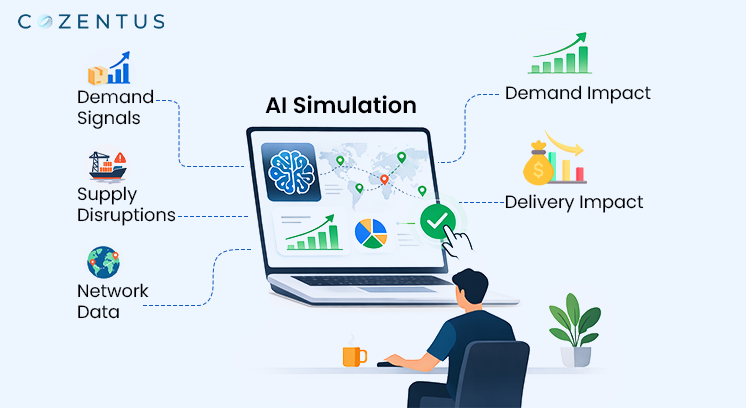
5. Real-Time Scenario Simulation Improves Strategic Decisions
Executives often need to make decisions where several factors must be considered. Cost vs speed. Inventory vs service levels. Sustainability vs operational efficiency.
AI-powered control towers allow organizations to simulate different scenarios in real time. Leaders can ask questions like:
- What happens if demand increases by 20% next quarter?
- How will port congestion affect the delivery performance?
- What is the impact of shifting distribution to a different region?
The control tower analyzes data from across the enterprise and provides the outcomes instantly. This capability allows leadership teams to evaluate risks and opportunities before making big strategic moves.
6. Continuous Learning Improves Decision Quality
Traditional automation follows predefined rules. But, AI-driven control towers keep on learning.
Every operational decision generates new data. Machine learning models analyze these outcomes and refine their predictions.
Over time, the system becomes more accurate. For example:
- Demand forecasts improve as new sales patterns emerge
- Risk detection models become more precise
- Supplier performance analysis becomes more predictive
- Logistics route optimization improves with operational data
This continuous learning capability allows control towers to evolve along with the business. It also helps organizations adapt to volatile environments where market conditions change rapidly.
7. AI Enables True End-to-End Operational Resilience
Global supply chains often face challenges from geopolitical events, climate disruptions, labor shortages, and rapidly changing demand patterns. AI-driven control towers strengthen resilience by coordinating various responses across the entire network.
Instead of solving problems within individual departments, the system evaluates impacts across the full operational ecosystem.
For example, a disruption at a supplier may affect manufacturing schedules, inventory availability, and customer delivery commitments.
An intelligent control tower can assess these dependencies and initiate coordinated mitigation actions.
Capabilities such as demand sensing, disruption monitoring, and cross-functional coordination allow organizations to respond faster and maintain operational continuity.
The Strategic Impact of AI for Enterprise Leaders
The evolution of control towers into AI-driven autonomous decision engines is not just a technology upgrade. It represents a fundamental shift in how organizations operate.
Enterprises are moving from:
- Reactive management to predictive intelligence
- Manual coordination to automated orchestration
- Fragmented data analysis to unified operational visibility
- Human only decision-making to AI-assisted execution
For leaders responsible for complex operations, this transformation creates new opportunities. Operational efficiency improves. Decision cycles shrink. Risks become more manageable.
At the same time, human expertise becomes more strategic. Teams focus less on monitoring dashboards and more on guiding the system with business priorities.
Final Thoughts: The Future Is Human-Guided Autonomous
Control towers originally started as visibility platforms. Now, AI is taking them much further.
Today’s intelligent control towers can sense disruptions, analyze scenarios, recommend solutions, and in many cases execute decisions automatically.
Yet autonomy does not remove the role of human leadership.
The most effective organizations in supply chains are combining machine intelligence with human judgment. AI speeds up decisions and handles operational complexity, while leaders provide strategic direction and governance.
This partnership between humans and intelligent systems is what ultimately unlocks the full value of autonomous decision engines.
Across industries such as supply chain logistics, manufacturing, retail, and global operations, this shift is already underway. And the organizations that build intelligent control towers today are quietly building the operating model of the future.