Your Systems Work. But Are They Thinking?
Artificial Intelligence, machine learning, predictive analytics, real-time data processing, and supply chain optimization are now crucial to digital transformation strategies across organizations. Companies that once invested heavily in ERP implementation, transportation management systems (TMS), and warehouse management systems (WMS) are now realizing that operational efficiency alone is not enough. They want intelligent decision-making systems.
Enterprise systems like the ERP, TMS, and WMS were built as systems of record. They manage transactions, enforce process controls, and provide visibility across finance, inventory, procurement, logistics, and distribution. However, in today’s volatile environment, recording transactions is not sufficient. Organizations need systems that can predict, recommend, and act.
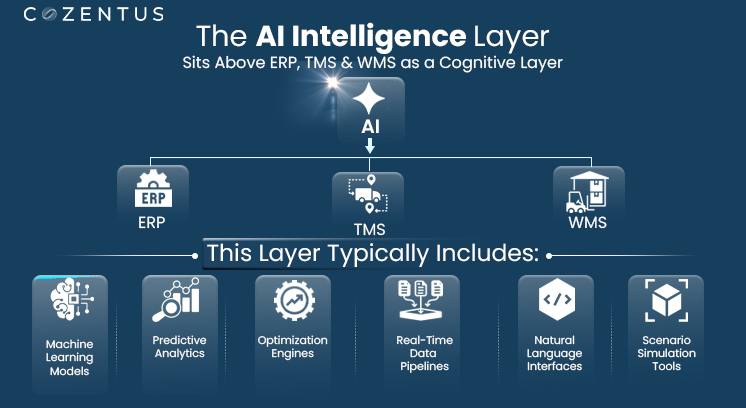
This is where AI is emerging as the intelligence layer above ERP, TMS, and WMS. It does not replace these systems. It elevates them. It transforms static enterprise software into dynamic, AI-powered decision engines.
Why Traditional Enterprise Systems Need an Intelligence Layer
Enterprise Resource Planning, Transportation Management Systems, and Warehouse Management Systems are still the foundation. They provide:
- Transaction accuracy
- Process standardization
- Regulatory compliance
- Inventory visibility
- Transportation execution
- Financial control
However, they were not originally designed for predictive analytics, machine learning driven optimization, or real-time cross-functional orchestration.
Modern business challenges require capabilities such as:
- Demand forecasting using multiple data signals
- Predictive maintenance and risk detection
- Real-time transportation optimization
- Inventory rebalancing across networks
- Scenario simulation for supply chain disruptions
Most ERP, TMS, and WMS platforms provide reports based on historical data and rule-based automation. They do not inherently learn from patterns or adapt continuously. AI is the one that introduces this adaptive intelligence.
What It Means to Place AI Above ERP, TMS, and WMS
The concept of an intelligence layer is simple but a powerful one. AI sits above core systems and performs four critical functions:
- Integrates data across ERP, TMS, WMS, and external sources
- Applies machine learning models to detect patterns and predict outcomes
- Runs optimization algorithms across multiple constraints
- Delivers actionable recommendations or automated decisions
Instead of operating in silos, systems start to function as a single, unified, intelligent ecosystem.
For example:
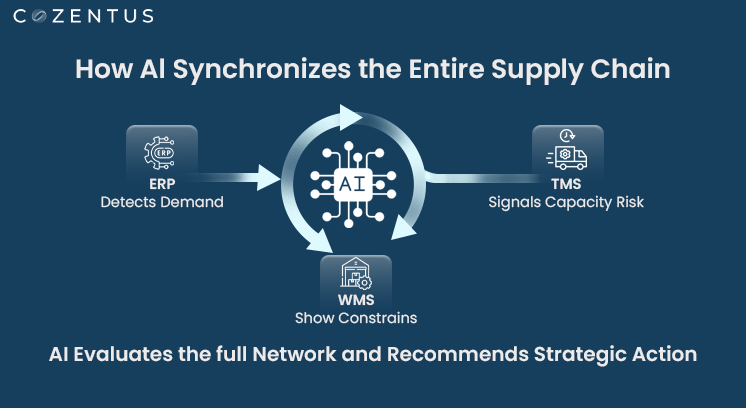
- Sales and order data from ERP feeds predictive demand models
- Shipment data from TMS feeds delays prediction models
- Inventory data from WMS feeds replenishment optimization engines
AI continuously evaluates these signals together rather than independently. It identifies correlations between demand variability, transportation capacity, production schedules, and inventory positioning. This cross-functional analysis enables coordinated decision guidance.
The intelligence layer also supports closed-loop feedback. When recommendations are executed within ERP, TMS, or WMS, performance data flows back into the AI models. Over time, models improve forecast accuracy, risk prediction, and optimization precision.
From a technical standpoint, this architecture typically includes real-time data pipelines, centralized data platforms, model training environments, and API integrations that embed AI outputs directly into operational workflows.
The result is faster decision cycles, improved forecast accuracy, optimized resource utilization, and stronger end to end supply chain visibility. AI transforms enterprise systems from transaction processors into decision engines that continuously learn and adapt.
AI Capabilities that Drive End-to-End Supply Chain Transformation
The most effective AI implementations in supply chains are built on a set of foundational capabilities. These capabilities are practical, measurable, and directly connected to operational performance and business outcomes.
1. Machine Learning and Predictive Analytics
Machine learning models analyze historical and real time data from ERP, TMS, WMS, manufacturing systems, and supplier platforms to uncover patterns that traditional analytics cannot detect.
Common enterprise-wide applications include:
- Demand forecasting across regions and channels
- Supplier risk prediction and lead time variability analysis
- Predictive ETAs for inbound and outbound shipments
- Inventory optimization across multi-echelon networks
- Production planning accuracy improvement
2. Real-Time Data Processing
Traditional supply chain reporting is largely based on batch processing, where data is updated at fixed intervals. Whereas, AI-powered platforms use real-time data pipelines that continuously capture and process information from:
- Order management systems
- Supplier portals and EDI feeds
- Manufacturing execution systems
- Transportation tracking platforms and telematics
- Warehouse scanning and inventory systems
- External data such as weather, traffic, port congestion, and fuel price indices
3. Optimization Engines
Supply chain decisions are interconnected. Every choice affects cost, service levels, capacity utilization, and operational risk. AI-driven optimization engines evaluate all of these constraints at the same time, including:
- Production capacity and changeover times
- Labor availability
- Transportation costs and lane capacity
- Service level agreements
- Inventory holding costs
- Network throughput limits
4. Scenario Simulation and Digital Twins
A digital twin is a virtual model that mirrors the physical supply chain. It allows organizations to simulate potential disruptions and strategic changes before implementing them.
Leaders can model scenarios such as:
- Supplier failure or raw material shortages
- Port closures or customs delays
- Regional demand spikes
- Capacity reductions at a manufacturing plant
- Carrier disruptions in critical lanes
How Leaders Can Put AI Above ERP, TMS, and WMS Effectively
Placing AI above ERP, TMS, and WMS is an architectural decision, not a system replacement project. The objective is to create a centralized intelligence layer that consumes data from existing systems, applies predictive analytics and optimization models, and feeds decisions back into execution workflows.
For leaders, the focus should be on execution, ROI, and minimal disruption to core operations.
1. Start with High-Value Supply Chain Use Cases
AI initiatives should begin with clearly defined, high-impact use cases tied to business KPIs. Avoid broad transformation programs without measurable targets.
Typical starting points include:
- Demand forecasting improvement using machine learning
- Predictive ETA and transportation risk modeling
- Multi-echelon inventory optimization
- Production planning optimization
- Supplier risk analytics
Each use case should link directly to cost reduction, service level improvement, working capital efficiency, or risk mitigation. Early measurable gains build internal credibility and executive support.
2. Build a Unified Data Architecture
AI performance depends on data quality and integration. Leaders must prioritize building a scalable data foundation that integrates:
- ERP transactional data
- TMS shipment and carrier performance data
- WMS inventory and throughput data
- Manufacturing execution data
- External signals such as weather, port congestion, and demand drivers
This typically requires a centralized data platform or lakehouse environment, supported by real-time or near real-time data pipelines and strong master data governance.
Without integrated data, cross-functional optimization is not possible.
3. Keep ERP, TMS, and WMS as Systems of Record
Core enterprise systems should remain the authoritative platforms for transaction processing and execution control. AI should operate as a separate intelligence layer connected through APIs and integration frameworks.
This ensures:
- Transactional stability
- Compliance and audit traceability
- Lower implementation risk
- Faster deployment cycles
AI generates predictions, risk scores, and optimization recommendations. Execution remains controlled within established enterprise applications.
4. Implement Model Governance and Performance Monitoring
AI in the supply chain directly influences financial and operational outcomes. Leaders must establish governance frameworks that include:
- Model validation and testing protocols
- Ongoing accuracy measurement
- Drift detection mechanisms
- Human oversight for high-impact decisions
- Clear accountability for automated outcomes
Model transparency and explainability are essential, especially when decisions affect production allocation, transportation spend, or inventory positioning.
5. Align Cross-Functional KPIs
AI creates the most value when supply chain decisions are evaluated at the network level rather than within functional silos.
Leaders should:
- Align procurement, manufacturing, logistics, and finance KPIs
- Define shared performance metrics such as OTIF, total landed cost, and inventory turnover
- Incentivize decisions based on total network optimization rather than departmental targets
Without KPI alignment, AI recommendations may conflict with local performance incentives.
6. Move from Decision Support to Controlled Automation
Most organizations begin with AI-driven decision support. Planners receive predictive alerts, risk flags, and optimization recommendations. Impact is measured and validated.
Once confidence is established, organizations can introduce controlled automation, such as:
- Automated safety stock recalibration within thresholds
- Dynamic transportation routing under governance rules
- Exception-based production schedule adjustments
Automation should operate within predefined guardrails to maintain operational control.
7. Track Clear Business Outcomes
AI deployment must be measured against financial and operational metrics. Leaders should track:
- Forecast accuracy improvement
- Transportation cost per shipment
- Inventory turnover ratio
- Working capital reduction
- Service level adherence
- Reduction in expedited freight
Clear KPI tracking ensures AI remains aligned with enterprise strategy and delivers sustained value.
The Road Ahead for Intelligent Supply Chains
The next phase of supply chain transformation is already underway. It is no longer about digitizing processes. It is about upgrading decision intelligence.
Most enterprises already have ERP, TMS, and WMS in place. The real question is whether those systems are helping you predict disruption and move faster than the market. AI is becoming the layer that makes that possible.
Supply chains that adopt AI early are seeing tighter inventory control, smarter transportation planning, faster response to demand shifts, and stronger network resilience. Those who delay risk operating with slower insights and higher cost structures.
The shift is happening across global enterprise networks. The leaders of the next decade will be those who move from transactional efficiency to intelligent execution. The foundation is already built. The advantage now comes from the intelligence you place above it.