The Evolution of Supply Chain Technology was Inevitable
There was a time when supply chain technology meant one thing - Record keeping.
We stored purchase orders. We printed invoices. We reconciled shipments at the end of the week. Data was important, but it was historical. It told you what happened yesterday.
Today, the conversation is different. Leaders expect real-time visibility and want predictive alerts. They want systems that not only show what is happening, but also recommend what to do next.
This is not a small change. It is a fundamental evolution. Supply chain technology has moved from record keeping to real-time decision intelligence.
If you are a leading operations, logistics, procurement, or retail distribution, this shift affects you directly. It changes how you plan, how you manage risk, and how you compete.
In this blog, we’ll walk through that journey in simple and practical terms, and more importantly, what it means for your business today.
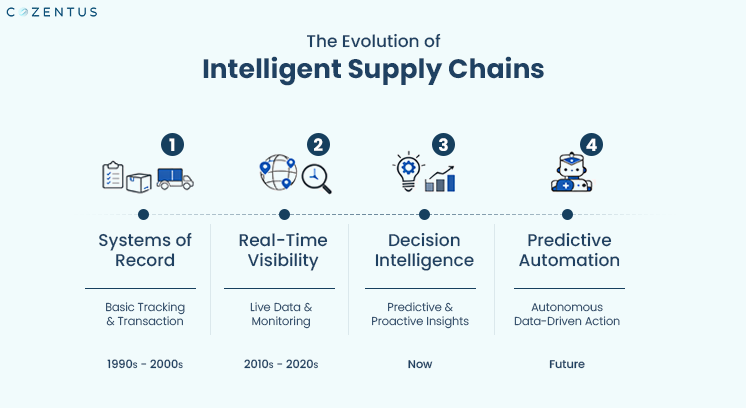
Phase 1: The Era of Digital Record Keeping
In the early days, supply chain systems were designed to solve one major problem, i.e. manual paperwork.
Enterprises adopted systems like ERP and basic warehouse management to digitize transactions. They documented orders, maintained inventory records, tracked shipments, and ensured operations aligned with finance.
This was a major step forward as it reduced errors and improved traceability. Furthermore, it helped companies, especially in the US, scale operations across states and regions.
But these systems had limitations.
- They were transaction-focused.
- They were batch-driven.
- They were reactive.
If a shipment was delayed, you often found out much later. If inventory ran out in one region while excess stock sat in another, the system would show the imbalance, but it would not fix it. Decision-making still depended heavily on people extracting reports and analyzing spreadsheets.
The technology was recording the past. It was not shaping the future.
Phase 2: Visibility and Integration Across the Network
As companies expanded their supplier base globally and built wider distribution networks, the operating model became far more complex. At the same time, customer and partner expectations increased across industries, with faster fulfillment cycles and tighter delivery commitments becoming standard across B2B and B2C supply chains.
This is when real-time visibility platforms and integration tools became critical.
Companies started connecting transportation systems, warehouse systems, and supplier portals. EDI, APIs, and cloud platforms allowed data to move faster across partners.
The focus quickly shifted from internal records to network visibility.
- You could now track shipments in transit.
- You could see inventory across multiple warehouses and distribution centers.
- You could monitor supplier and carrier performance.
For logistics teams, this was transformational. Real-time GPS tracking, control towers, and event management tools provided a live view of freight movement.
But even here, a gap remained.
Visibility answers the question, what is happening. But it does not automatically answer what you should do about it.
That is where the next shift began.
Phase 3: The Real Value Was in the “Data”
Over time, supply chains started generating massive amounts of data, such as:
- Lower warehouse and storage costs
- Improved inventory availability across the network
- Reduced excess and obsolete inventory
- Higher service reliability and fulfillment accuracy
For many organizations, this data was not used. It was stored, but not analyzed deeply.
Then advanced analytics entered the picture.
Companies began using data to improve demand forecasting, optimize inventory across distribution networks, and enhance transportation planning. Machine learning models increased forecast accuracy, while advanced optimization engines helped reduce freight costs and improve asset utilization.
Predictive analytics also helped with better capacity planning, production scheduling, and network balancing across multi-node supply chains.
In the supply chain sector, where margins are tight and competition is intense, this shift was crucial. Leaders realized that data could drive measurable financial impact.
It resulted in:
- Lower warehouse and storage costs
- Better in-store product availability
- Reduced clearance sales
- Higher customer satisfaction
At this stage, technology was not only recording and reporting, but it also started supporting decision-making.
Still, much of the process required human interpretation. Analysts developed the models, planners examined the results, and final decisions were typically made after internal discussions.
The next evolution changed that.
Phase 4: Enter Real-Time Decision Intelligence
Today, we are in the era of decision intelligence.
This goes far beyond analytics. It combines real-time data, artificial intelligence, automation, and business rules into one integrated system that not only predicts outcomes but also recommends actions.
Let us break this down in simple terms:
- Real-time data comes in from multiple sources.
- AI models analyze patterns continuously.
- The system identifies risks or opportunities.
- It recommends or triggers an action.
For example, imagine a logistics disruption caused by a major storm impacting a key port.
As vessels are delayed, container dwell times increase and overall lead times extend by several days. In a traditional system, you would likely discover the impact after shipments had already missed their targets.
With a visibility platform, you would see the delay as it happens. However, in a decision intelligence environment, the system would go further by generating an alert along with recommended corrective actions.
Instead of simply informing you about the delay, it would suggest practical responses such as:
- Divert shipments to an alternate port
- Expedite high-priority SKUs by air freight
- Rebalance inventory across regional warehouses to protect service levels
This is called proactive supply chain management. For senior executives, this means less surprises and faster response times.
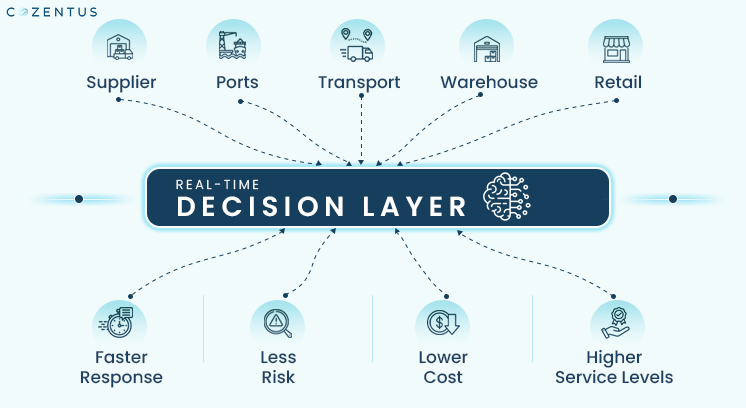
The Role of AI and Automation in Supply Chain Transformation
AI models process historical and real-time data to detect anomalies, forecast demand, and simulate real-world scenarios. Automation executes repetitive tasks such as replenishment orders, freight booking, invoice processing, and dynamic route updates.
In logistics, AI-driven route optimization can adjust delivery paths in real time based on traffic, weather, and fuel cost. Across the broader supply chain, AI-driven allocation ensures inventory is positioned at the right node in the network at the right time.
The key difference is speed.
Human teams cannot analyze thousands of variables in seconds. But machines can. However, this does not remove human leadership. Instead, it elevates it. Leaders now move from tactical decisions to strategic oversight. They focus on resilience, growth, and operational excellence, and let the technology do the heavy lifting.
Logistics: The Front Line of Real-Time Decisions
While decision intelligence spans the entire supply chain, logistics is often where impact becomes visible.
- Late deliveries damage customer trust.
- High freight cost erodes margins.
- Inefficient routing increases fuel usage and emissions.
Real-time logistics intelligence allows you to:
- Predict delays before they occur
- Optimize load consolidation
- Select carriers dynamically based on performance
- Reduce empty miles
- Improve on-time deliveries in full metrics
For companies managing large distribution networks across the globe, this level of control directly impacts both customer experience and cost structure.
Conclusion: The Future is Autonomous Supply Chains
Looking ahead, supply chains are moving toward autonomous operations. Systems will automatically detect disruptions, simulate alternatives, and execute corrective actions with minimal human intervention.
- Digital twins will model entire networks.
- AI agents will negotiate freight rates.
- Inventory will rebalance dynamically across nodes.
This is not science fiction anymore. Early versions are already in use in advanced supply chain environments.
The goal is simple. Reduce uncertainty. Increase resilience. Protect profits.
When the supply chain becomes intelligent, it becomes more strategic. It supports growth, protects margins, and strengthens customer loyalty.
And in markets where competition is intense and expectations are high, that intelligence becomes one of your most valuable assets.