How Mid-Contract SaaS Pricing Change Hurts Freight Forwarders
You usually don't notice it right away. Everything looks normal until one month the invoice feels slightly off, not dramatically higher, but enough to make you pause and take a closer look.
As you dig in, small changes start showing up. A feature that was always included is now billed separately. API usage is being calculated differently. None of it feels big in isolation, but together it starts adding up.
You go back to your contract expecting clarity, but most of it is flexible enough to allow these changes. That is when it starts feeling less like a simple pricing update and more like a loss of control.
For many years, freight companies have relied on TMS and logistics platforms to run operations efficiently. But with SaaS pricing changes mid-contract and hidden costs becoming more common, many are now questioning how much control they actually have over the systems they depend on.
In this blog, we also discuss how these hidden costs come up and how freight forwarding companies can reduce their dependency on vendor-controlled platforms and have more control over their technology.

Why Software Vendors Change Prices Mid-Contract
Pricing changes mid-contract are not random. They are made by contract flexibility + increasing dependency + low switching ease. It starts small, and most of the time, it's gradual and layered into how the platform evolves after you've already committed.
Here's what's typically happening behind the scenes:
1. Weak or flexible pricing clauses in contracts
Many agreements don't strictly lock pricing for the full term. Vendors leave room for "revised pricing," "feature-based billing," or "usage-based adjustments," which gives them flexibility later.
2. Shift from bundled to modular pricing
Features that were initially included (tracking, reporting, integrations) start becoming paid add-ons.
What was once part of the core offering becomes:
- Add-ons
- Premium modules
- Tier-based upgrades
3. API monetization and integration costs
As your dependency on the platform integrations increases, vendors start:
- Charging per API call
- Limiting API access by plan
- Introducing fees for additional integrations
Since integrations are critical to operations, this becomes hard to avoid.
4. Usage-based pricing kicks in later
Initial pricing may look flat or predictable. But as your volumes grow:
- Transaction-based charges
- Shipment-based billing
- Data usage costs start increasing your overall spend.
5. Feature gating and "advanced capabilities"
New features are introduced, but not included in your existing plan. Over time, essential capabilities get repositioned as "advanced," pushing you toward higher tiers.
6. Vendor lock-in reduces your flexibility
By the time these changes happen:
- Your workflows are deeply embedded
- Your data is stored within their system
- Your team is trained on their platform
- Your ecosystem depends on their APIs
Switching is possible, but it's expensive, time-consuming, and operationally risky.
7. Low switching leverage
Vendors understand that once implementation is complete and dependency is high:
- You have less control in pricing discussions
- Exit costs increase
- Switching to other options takes a lot of time
5 Ways Mid-Contract Pricing Changes Affect Freight Companies
When pricing changes happen mid-contract, the impact is far greater than just higher invoices. It starts affecting how teams plan, operate, and make decisions every day.
1. Less System Usage
When pricing is tied to usage (API calls, transactions, users), teams start being cautious.
- Features that were freely used now feel expensive
- API usage may be limited to avoid extra charges
- Teams avoid using certain modules
This means you end up using less of the platform you're already paying for.
2. Less Automation, More Manual Work
To control costs, teams often reduce usage of automated features and depend more on spreadsheets or offline tracking. Over time, this slows down operations and increases the risk of errors.
3. Slower Process Improvement
When every feature or action has a cost attached to it, teams hesitate to experiment more. Instead of optimizing workflows, they start thinking about cost impact first.
This reduces:
- Process innovation
- Adoption of new features
- Continuous improvement efforts
4. Hard to Plan Ahead
Unpredictable pricing leads to short-term thinking.
Teams spend more time:
- Adjusting budgets
- Justifying costs
- Managing vendor changes
And less time on:
- Long-term planning
- Process optimization
- Strategic improvements
5. Switching Isn't Easy
By the time pricing changes happen, the teams are highly dependent on it.
- Data is stored within the platform
- Integrations rely on vendor APIs
- Teams are trained on the system
Switching means:
- Migration costs
- Implementation time
- Operational risk
So even if pricing increases, moving away is not easy.
How to Avoid Pricing Surprises in Logistics Software
Once you've experienced unexpected pricing changes, the goal isn't just to react better next time. It's to set things up in a way where surprises are less likely in the first place.
1. Lock Pricing Terms Clearly in the Contract
A lot of issues start with vague contracts. Make sure your agreement clearly defines:
- Fixed pricing duration (for the full contract term)
- What counts as "included" vs "add-on"
- Limits on price revisions or new charges
If pricing can change, it should be tied to something specific and predictable, not some open-ended clauses.
2. Understand What You're Really Paying For
Initial pricing often looks simple, but the real cost sits in the details.
Go deeper into:
- API usage limits and costs
- Per-transaction or per-shipment charges
- Integration fees
- Support tiers
This helps you avoid situations where essential features suddenly feel "extra."
3. Avoid Over-Dependency on a Single Platform
The more everything depends on one system, the harder it becomes to adapt to something new later.
Try to:
- Keep integrations modular where possible
- Avoid over-customizing core workflows inside one platform
- Maintain access to your raw data outside the system
Some modern platforms, including newer players in the market, are starting to design for flexibility instead of lock-in. That makes a real difference over time.
4. Track Usage and Cost Trends Regularly
Pricing issues don't usually show up all at once. They grow slowly through:
- More API calls
- Higher transaction volumes
- Additional feature usage
Regularly tracking these helps you:
- Spot unusual cost spikes early
- Understand what's costing you
- Take action before it becomes a bigger issue
5. Choose Platforms That Keep You in Control
Not all platforms are built the same way. Some create long-term dependency. Others are designed to give you flexibility as you grow.
Look for systems that:
- Offer clear, predictable pricing without hidden changes
- Keep core features accessible, not locked behind upgrades
- Provide stable, open APIs without unexpected costs
- Allow easy access to your data and support smooth integrations
In many cases, it also helps to work with a partner who understands these challenges and builds around transparency, flexibility, and long-term control.
Because when your platform is built this way, you're not stuck with it. You stay in control of your costs, your operations, and how your business scales.
Composable Logistics Technology: The Best Solution
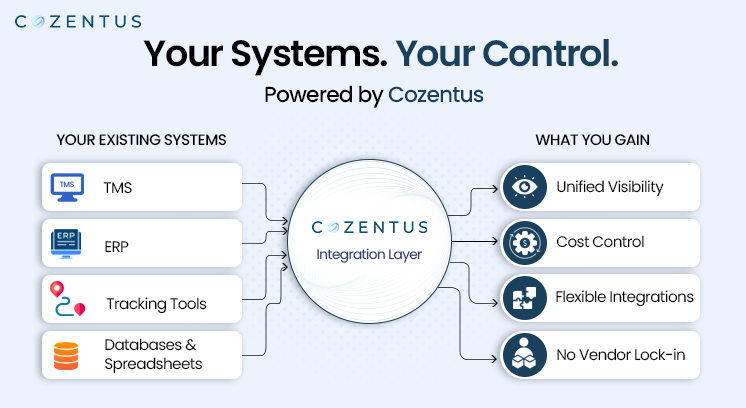
Composable technology is an approach where your system is built using modular components instead of one all-in-one platform.
Each component handles a specific task, and all of them work together through integrations. The key advantage is flexibility. You can update or scale parts of your system without impacting everything else.
This is exactly the approach Cozentus' custom solutions are built around. Our logistics tech solutions focus on flexibility and transparency, which gives freight teams more control from the start.
1. Build Only What You Need
You don't have to pay for a full suite when you only need certain capabilities.
With a composable setup:
- You pick specific modules (visibility, planning, integrations, etc.)
- You avoid paying for features you don't use
- You scale parts of the system independently
This keeps both cost and complexity under control.
2. Avoid Vendor Lock-In by Design
Since systems are modular, dependency on a single vendor is reduced.
- Your data isn't trapped in one system
- Integrations are not tied to a single provider
- Replacing one component doesn't break everything
This gives you flexibility without disrupting operations.
3. Control Your Integrations and APIs
In traditional platforms, integrations become a dependency and a cost center.
With a composable approach:
- APIs are designed to be open and usable
- Integrations are easier to manage and extend
- You don't rely on one vendor for every connection
This makes your tech stack more adaptable as your business evolves.
4. Scale Without Cost Surprises
Instead of pricing increasing unpredictably, scaling becomes more controlled.
- You expand only the components you need
- Usage is easier to track and manage
- Cost growth is more aligned with actual business needs
This reduces the chances of unexpected pricing changes mid-contract.
5. Built Around Flexibility and Transparency
Modern composable solutions are designed differently from traditional platforms.
They focus on:
- Transparent pricing structures
- Clear feature access without constant re-packaging
- Configurable workflows instead of rigid systems
This approach gives you more visibility and control from day one.
Conclusion: If You Don't Control It, You Don't Own It
Mid-contract pricing changes are rarely just about cost. They usually mean control has already shifted, from your business to the system you depend on.
When pricing changes without clarity, features move behind paywalls, or access to your own data becomes restricted, it limits how you operate and grow. Over time, you're not making decisions freely - you're adjusting to the system.
The companies moving ahead are solving this differently. They are choosing flexible, composable technology that keeps them in control of pricing, integrations, and how their operations evolve.
This is exactly where Cozentus stands out. With a composable approach, transparent pricing, and solutions built around real logistics workflows, Cozentus ensures you're not locked in or slowed down by hidden costs.
Because in the end, the real advantage isn't just using technology. It's controlling it.