Why Manual Operations Are Not Scalable Anymore
As companies scale, especially in high-volume industries like retail, logistics, and supply chains, manual processes like processing invoices, fixing data errors, and reading PODs become slower, more expensive, and difficult to manage. This leads to delays, higher error rates, and limited operational visibility.
Even when companies use workflow automation tools, their systems often remain disconnected. This means people still have to step in again and again to keep things moving, making true end-to-end workflow automation difficult to achieve.
This is where Agentic AI is transforming operations by enabling intelligent workflow automation that can plan, execute, and complete complex business processes on its own.
As per Mordor Intelligence, the Agentic AI supply chain market is expected to grow from $8.67 billion in 2025 to $16.84 billion by 2030, at a CAGR of 14.2%.
When combined with Intelligent Document Processing (IDP), AI agents allow businesses to automate document-heavy workflows such as invoice processing and proof of delivery (POD) validation with better speed, accuracy, and efficiency.
What is Agentic AI & Its Use in Supply Chain
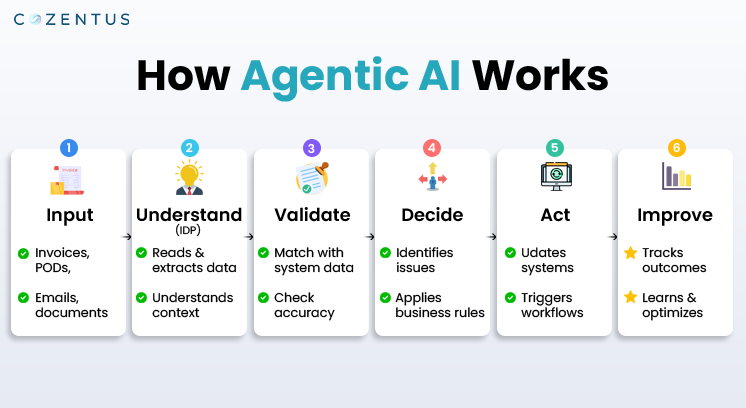
Agentic AI refers to advanced AI systems that can independently plan, execute, and complete tasks based on a defined goal, without the need for constant human input at every step. Unlike traditional automation, which follows fixed rules and handles only specific tasks, Agentic AI brings intelligence into the process by understanding context and taking actions accordingly.
It works more like a digital operator than a tool. Instead of waiting for instructions, it can manage entire workflows across systems and adapt when something changes. This makes it highly effective in dynamic environments like supply chain operations.
Agentic AI can:
- Understand context across different data sources
- Make decisions based on real-time information
- Execute tasks across multiple systems
- Adapt to exceptions and changing conditions
In supply chain and logistics, where operations involve high volumes of data, multiple stakeholders, and continuous movement of goods, this capability becomes extremely valuable. From managing shipments to validating documents and handling exceptions, Agentic AI helps reduce manual effort and improve speed and accuracy.
When combined with Intelligent Document Processing (IDP), its impact becomes even stronger. IDP uses AI to read and process unstructured documents such as invoices, proof of delivery (POD), bills of lading, and emails. Since most supply chain processes depend on these documents, this allows businesses to automate documentation more efficiently.
Operational Problems Agentic AI Solves
If you look at your operations closely, the challenge is not the work itself, but how it flows. Tasks are completed, but the handoffs between them create delays, errors, and inefficiencies.
Teams spend more time coordinating rather than actually executing. As the business scales, this gap becomes more visible. To understand the value of Agentic AI, it is important to first look at the core challenges it solves and how it addresses them in an intelligent way.
Problem 1: Invoice Processing Delays
Manual validation slows approvals and impacts cash flow. Invoices often get stuck due to mismatches, missing data, or late approvals.
Solution: Agentic AI automates invoice processing using Intelligent Document Processing (IDP), extracts key data, matches it with purchase orders, and flags discrepancies while initiating resolution workflows automatically.
Problem 2: High Error Rates
Data entry mistakes lead to rework and reconciliation issues. Incorrect or inconsistent data creates frequent mismatches across systems.
Solution: Agentic AI validates data in real time, detects anomalies early, and triggers corrective actions instantly, reducing dependency on manual checks.
Problem 3: Document Overload
Teams spend hours reviewing invoices, PODs, and contracts. Large volumes of unstructured documents make processing slow and difficult to scale.
Solution: With IDP, Agentic AI reads, understands, and processes large volumes of documents automatically, significantly reducing manual effort and processing time.
Problem 4: Disconnected Systems and Data Silos
Multiple tools do not communicate effectively, causing delays and inefficiencies. Data remains siloed, making it hard to get a single, accurate view of operations.
Solution: Agentic AI connects workflows across systems, enabling seamless data flow and execution without constant human intervention.
Problem 5: Handling Issues Only After They Happen
Issues are often addressed only after they disrupt operations. Lack of real-time visibility prevents early detection and resolution of issues.
Solution: Agentic AI continuously monitors workflows, identifies issues in real time, and resolves them proactively before they grow.
How Intelligent Document Processing (IDP) Powers Agentic AI
Most of the business operations still run on documents. Invoices, proof of delivery, contracts, emails, and forms are part of almost every workflow. The challenge is that these documents do not follow a fixed structure, which makes them hard to process using traditional systems.
This is where Intelligent Document Processing (IDP) plays a critical role. It acts as the foundation for Agentic AI by enabling systems to read, understand, and use information from documents in a meaningful way.
Without IDP, AI cannot fully interact with real-world business inputs. It may automate steps, but it cannot understand the context behind the data.
IDP helps systems to:
- Process both structured and unstructured documents
- Understand context, not just extract text
- Handle different formats, layouts, and document types
- Continuously improve accuracy through learning
What makes IDP powerful is not just data extraction, but what happens next. The extracted data is immediately used within workflows for validation, decision-making, and execution. This is what allows Agentic AI to move beyond simple automation and handle end-to-end processes.
In industries like supply chain logistics, where a single transaction often involves multiple documents, IDP becomes essential. It reduces the time spent on manual review, improves data accuracy, and ensures that workflows move forward without delays.
5 Real Agentic AI Business Benefits
Organizations that are using Agentic AI are seeing clear improvements in daily work, with faster processes, fewer errors, and smoother operations. Here are the top ones:
1. Work That Took Hours Now Gets Done in Minutes
Processes that earlier required multiple people and back-and-forth checks are now completed much faster. Tasks like invoice validation, document review, and data matching move forward without waiting in queues. This reduces turnaround time significantly and keeps operations moving consistently.
2. Less Time Spent on Repetitive Work
Teams no longer need to spend hours on manual data entry, document checks, or follow-ups. This reduces dependency on manual effort for routine tasks and allows teams to focus on work that actually needs human judgment. Over time, this leads to noticeable cost efficiency.
3. Fewer Errors and Less Rework
Manual processes often lead to small errors that create bigger issues later. With Agentic AI handling validation and checks in real time, data accuracy improves and the need for rework drops. This also reduces delays caused by mismatches and corrections.
4. Faster Decisions
Instead of waiting for someone to review and act, decisions are made as the workflow progresses. Real-time data and automated validation allow systems to take the next step immediately, helping teams stay ahead rather than reacting late.
5. Operations Can Scale Without Adding More People
As volumes increase, businesses usually need to expand teams to keep up. With Agentic AI, workflows handle higher volumes without the same increase in effort. This makes it easier to scale operations while maintaining speed and consistency.
The Best Operating Model: Humans + AI
There is often a concern that AI will replace people, especially in operations. In practice, what actually changes is how work gets distributed. Instead of doing everything manually, teams start working alongside AI to handle workflows more efficiently.
Agentic AI takes over the repetitive, time-consuming parts of the process, while people focus on areas that require judgment, context, and decision-making. This shift reduces workload without removing control.
With Agentic AI:
- Humans handle complex exceptions that need context and experience
- AI manages repetitive, rule-based workflows end-to-end
- Teams spend more time on analysis, planning, and improvements
This also brings better clarity to operations. Teams don’t get buried in day-to-day tasks and can focus on identifying gaps, improving processes, and driving outcomes.
Over time, this creates a more balanced way of working where efficiency comes from automation, and value comes from human decision-making.
Conclusion: Waiting on Agentic AI is a Big Risk
We are moving toward a model where workflows run automatically, systems stay connected, decisions happen in real time, and operations keep on improving without constant intervention.
For years, scaling meant adding more people to manage growing workloads. That approach worked, but it came with limits. More effort, more delays, more complexity.
Now, there is a different way to scale. Agentic AI handles the repetitive, multi-step workflows that usually slow teams down. It keeps work moving, reduces errors, and frees up time for more important decisions.
This shift is already underway. Many organizations have started moving in this direction, and the gap is starting to show.
The question is not whether this change will happen. It is how quickly you choose to adapt.
Because the teams that move early will not just work faster. They will operate differently, with systems that run, adapt, and scale without constant effort.