How AI Document Processing Reduces 95% of Manual Work
Every shipment generates documents. Every document creates work. Booking confirmations, commercial invoices, bills of lading, packing lists, customs declarations and freight invoices all need to be received, verified and entered into operational systems to move the shipment.
The problem is not the number of documents. It's the tedious manual work that happens around them. Multiply that across thousands of shipments every month, and document processing becomes one of the highest operational costs in the business.
That's exactly why AI document processing has become one of the fastest-growing investments in logistics technology. Instead of using your expert and experienced tech people to process routine paperwork, you can use AI-powered Intelligent Document Processing (IDP) to extract, validate, and route information automatically.
In this blog, know how AI-powered Intelligent Document Processing (IDP) helps organizations double the document processing speed with half the manual effort.
Why Manual Document Processing Still Persists
Despite significant advances in logistics technology, document processing still depends heavily on manual effort. One of the biggest reasons for this is that logistics documents do not usually follow a standard format. Every carrier, supplier and customer provides information differently, which makes traditional automation difficult.
A typical operations team spends its day handling tasks such as:
- Opening email attachments
- Downloading invoices and shipping documents
- Extracting shipment details from PDFs
- Entering information into the TMS or ERP
- Comparing freight charges with agreed rates
- Correcting missing or inconsistent data
- Forwarding documents to the next department
None of these activities directly improve customer service or shipment performance. They're simply necessary to keep information moving between disconnected systems.
The challenge becomes even bigger as shipment volumes grow. Processing a few hundred documents manually may be manageable, but processing several thousand every day quickly turns into a resource problem. Businesses often hire more people to handle the workload, even though much of the work follows the same repetitive pattern.
Looking for Custom AI Solutions?
How AI-Powered IDP Automates Logistics Document Processing
Traditional OCR only reads documents. AI-powered Intelligent Document Processing (IDP) understands them.
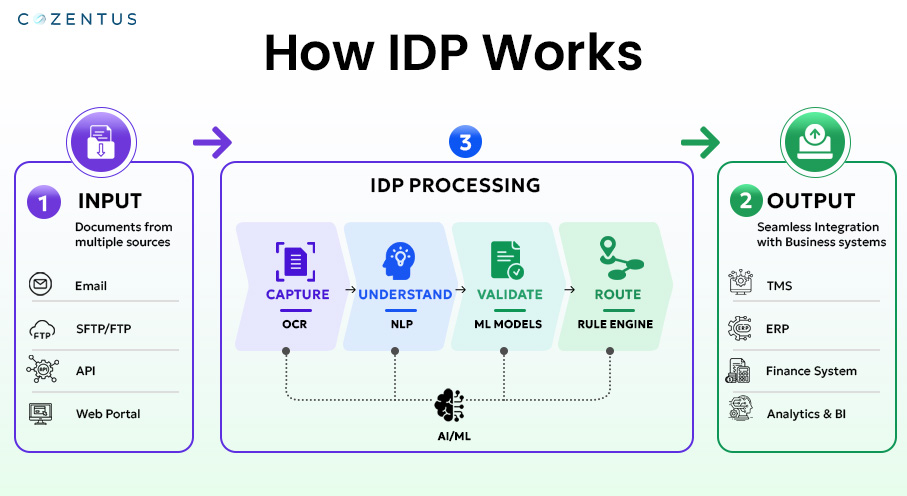
Instead of simply converting scanned documents into digital text, IDP combines Optical Character Recognition (OCR), Natural Language Processing (NLP) and Machine Learning (ML) models to capture, interpret, validate and route logistics documents automatically. Together, these technologies remove much of the repetitive work that slows logistics operations.
Here's how the process works:
- OCR extracts text from invoices, bills of lading, packing lists, purchase orders, freight invoices and other logistics documents, regardless of whether they are scanned, digital or image-based.
- NLP understands the context of the extracted information. It identifies what each field represents, even when different customers, suppliers or carriers use different document layouts, labels or formats.
- Machine Learning (ML) models continuously improve document classification and data extraction by learning from previously processed documents. As it processes more documents, it becomes better at recognising layouts, identifying key shipment information and handling new document variations with greater accuracy.
Once the information is extracted, IDP validates it against predefined business rules and operational data. Shipment references can be matched with the TMS, freight charges compared against contracted rate cards, mandatory fields verified, duplicate documents detected and inconsistencies flagged before they impact downstream processes.
Only those documents that contain genuine exceptions are routed to an operations executive for manual review. The remaining documents move automatically into downstream systems such as the TMS, ERP or finance platform without the need for manual data entry or repetitive validation.
Imagine processing 5000 logistics documents every day. Instead of asking your operations team to review every invoice, packing list or bill of lading, AI processes the routine documents automatically and provides employees with only the small percentage that require human judgement.
That's where the real business value comes from.
Instead of spending hours opening emails, downloading attachments, copying data between systems and checking document accuracy, experienced logistics professionals can focus on resolving shipment exceptions, supporting customers and improving operational performance.
How Automated Document Processing Affects ROI
When document processing becomes faster and more accurate, you enjoy the benefits across the entire shipment lifecycle.
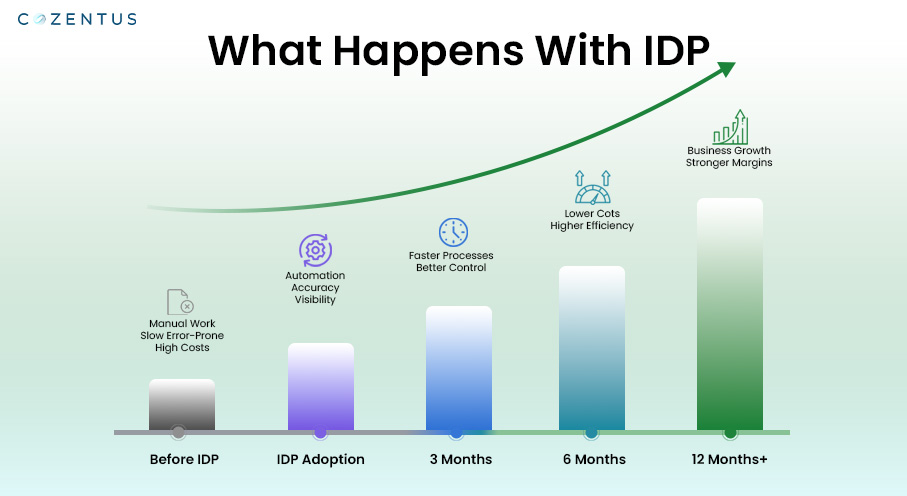
By automating document capture, extraction, validation and routing, AI-powered Intelligent Document Processing (IDP) helps logistics businesses reduce critical operational bottlenecks.
As a result, logistics companies can see improvements such as:
- Faster shipment processing and booking
- Lower operational costs through reduced manual effort
- Higher data accuracy and fewer costly errors
- Faster invoicing and improved cash flow
- Reduced compliance and audit risks
- Better customer response times
- Better visibility across logistics operations
- More productivity without adding headcount
One of the biggest financial benefits is scalability. As shipment volumes grow, manual work also grows with them. You also need more hands-on resources to handle the growing documentation. Automated document processing solves this easily. The same system/solution can process significantly more documents without increasing resources.
As per a recent study, Deutsche Post DHL Group increased processing efficiency by 70% after implementing Intelligent Document Processing and RPA to automate document classification and extraction.
The exact ROI may vary depending on document complexity, shipment volumes and existing processes, but the principle remains consistent: the more repetitive the document workflow, the greater the return from automation. For logistics businesses processing thousands of invoices, bills of lading, packing lists and customs documents every month, even small efficiency gains at each step compound into substantial savings.
Cozentus' AI-Powered IDP – Built for Logistics
Every logistics operation is different. Customers use different document formats, carriers follow different processes, and every business has its own validation rules and system landscape. That's why a one-size-fits-all document automation solution won’t deliver long-term value.
At Cozentus, we tailor our AI-powered IDP solution as per your workflows. This ensures that it integrates seamlessly with your existing operations and scales as your business grows.
Key Capabilities:
- Multi-document type support
- AI-powered data extraction
- Business rule validation
- Exception and duplicate detection
- TMS, ERP and finance system integration
- Email, API, SFTP and portal-based document ingestion
- Human-in-the-loop workflows
Whether you're processing hundreds or hundreds of thousands of documents every month, Cozentus helps you automate repetitive document-intensive processes, improve
Final Thoughts
The documents used in logistics haven't changed very much over the last twenty years. The expectations around speed, accuracy and customer service have.
With AI and IDP available, if you still continue to process thousands of logistics documents manually, it will be a competitive disadvantage. Businesses that automate document processing can move information faster, reduce manual effort and allow experienced teams to focus on solving exceptions instead of performing repetitive administrative tasks.
AI document processing isn't about replacing people. It's about ensuring the right people spend their time on the work that actually creates value.
FAQs:
1. What is AI document processing in logistics?
Ans: AI document processing uses Intelligent Document Processing (IDP) to automatically capture, extract, validate and route data from logistics documents such as bills of lading, invoices, packing lists and customs documents. It reduces manual work and improves processing speed and accuracy.
2. How is Intelligent Document Processing (IDP) different from OCR?
Ans: OCR only converts documents into digital text. IDP combines OCR with AI, Natural Language Processing (NLP) and Machine Learning (ML) to understand document context, validate data and automate end-to-end document workflows.
3. What are the benefits of AI-powered document processing in logistics?
Ans: AI-powered document processing helps logistics companies reduce manual effort, improve data accuracy, speed up shipment processing, lower operational costs, accelerate invoicing and scale operations without increasing headcount.