From Prediction to Action: AI Agents in Logistics
Imagine a container shipment that is two days late. Your predictive analytics system flags the delay early, giving the operations team enough time to respond.
But someone still needs to check alternative routes, contact carriers, calculate additional costs, and decide how to protect the delivery commitment. That takes time, especially when information sits across different systems.
Predictive analytics and AI agents can work together to close this gap. Predictive analytics helps teams understand what is likely to happen. Prescriptive analytics helps identify what they should do about it. AI agents can then automate parts of the workflow, helping teams move from a recommendation to action.
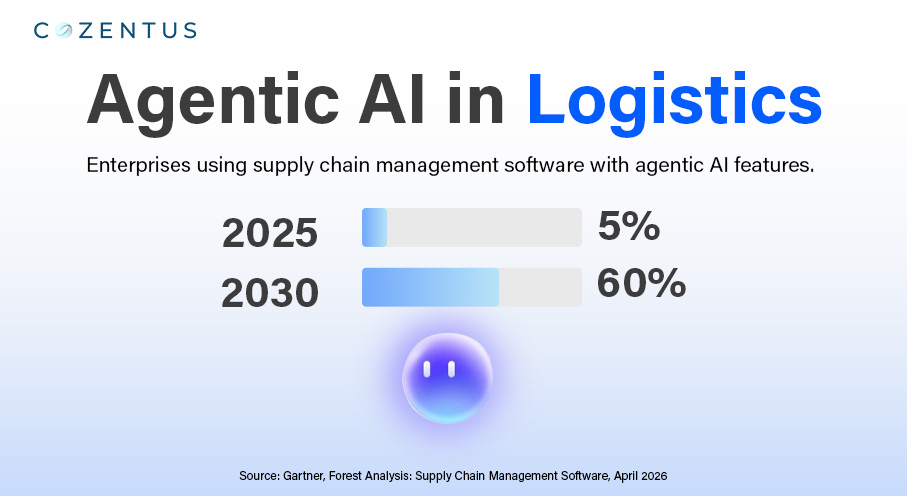
Gartner's 2026 supply chain survey found that 56% of chief supply chain officers consider integrating AI with legacy systems and processes a major challenge.
The next step for logistics AI is to connect predictions with recommendations and appropriate action. How does it do? That’s what this blog is about.
Predictive Analytics in Logistics: A Good Starting Point
Predictive analytics uses historical and current data to estimate what is likely to happen. In logistics, it helps teams predict shipment delays, calculate estimated arrival times (ETA), forecast demand, and identify potential equipment failures.
For example, a predictive ETA system may flag a shipment that is likely to miss its delivery window. This gives the operations team an early warning and more time to prepare.
But the alert still leaves several questions unanswered:
- Which alternative route makes sense?
- Is another carrier available?
- Will rerouting increase freight costs?
- Can the customer still receive the shipment on time?
Answering these questions usually requires people to check several systems and compare different options. The prediction helps, but the final decision still takes time.
Predictive analytics provides the insight that something may go wrong. Prescriptive analytics and AI agents can help teams work out what to do next.
Prescriptive Analytics: Choose What to Do
Prescriptive analytics uses data, business rules, and optimization techniques to recommend actions that can improve an outcome.
Consider a container facing a delay at its planned port of arrival. A predictive model identifies the risk. A prescriptive analytics system can compare alternative ports or transport arrangements and recommend an option based on factors like:
- Freight costs and additional handling charges.
- Expected transit time and delivery commitments.
- Carrier availability and service reliability.
- Customs requirements and port congestion.
The system can help the operations team understand the impact of each option before making a decision.
The best recommendation depends on the business priority. If the shipment contains urgent goods, delivery time may matter more than cost. For a less urgent shipment, avoiding expensive changes may be the better choice.
Prescriptive analytics can generate recommendations, but those recommendations still need to be put into practice by AI agents.
Looking for Custom AI Solutions?
AI Agents in Logistics: From Decisions to Action
Once a suitable action has been identified, the next question is how to carry it out without making the operations team handle every step manually.
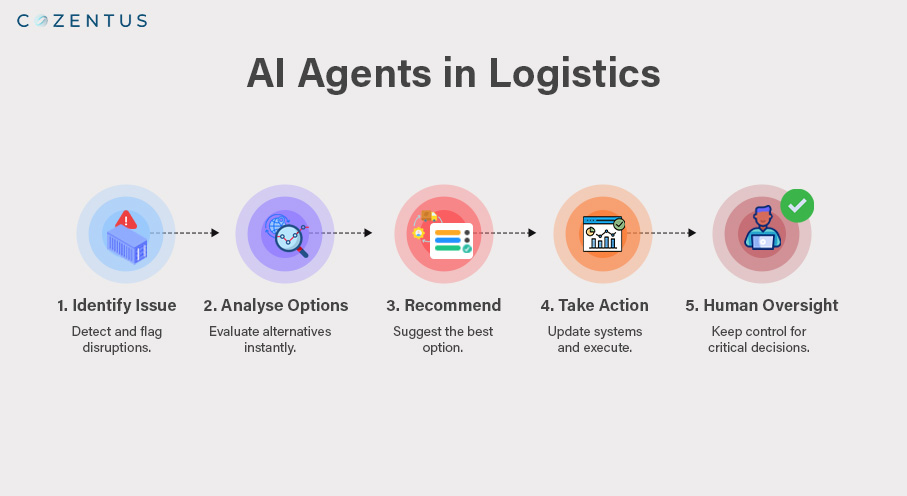
AI agents can automate multi-step tasks and workflows using connected systems, instructions, and defined business rules. They can also improve how they perform a task through feedback, evaluation, and refinement, depending on how the solution is designed.
For example, an AI agent handling a delayed shipment could:
- Check which orders and deliveries are affected.
- Retrieve available carrier options and revised ETAs.
- Compare alternatives against cost limits and delivery commitments.
- Prepare a recommendation for the operations team.
If authorized, update shipment records, initiate a booking change, or send status updates to relevant teams.
Predictive analytics can provide the warning, and prescriptive analytics can help determine the best response. The AI agent can then coordinate and automate the steps needed to carry out that response. The exact workflow depends on the available data, system integrations, and permissions.
However, AI agents do not automatically make every decision or improve simply by being used. Their performance depends on the models, instructions, feedback mechanisms, and controls built into the system.
Not every decision should be fully automated, either. Updating an internal shipment status may be low risk. Rerouting an expensive shipment or changing a customer delivery commitment may require human approval.
The aim is to reduce repetitive work while keeping people involved in crucial decisions that need experience and judgement.
How Predictive Analytics & AI Agents Work Together in Logistics
The practical benefit comes from combining these capabilities, not treating them as competing technologies. Here are some examples of how they can support everyday logistics operations.
- Shipment visibility: Predictive analytics flags a likely delay. Prescriptive analytics compares possible responses, while an AI agent can retrieve carrier options, prepare a rerouting request, and update shipment records when authorised.
- Freight audit: AI in freight audit automation can help extract invoice data and identify unusual charges. Rules and analytical models validate charges against contracts and rate cards, while AI agents can coordinate checks, flag discrepancies, and route invoices for approval.
- Demand planning: Predictive models estimate future demand. Prescriptive analytics helps teams decide how to adjust inventory, capacity, and replenishment plans. AI agents can then support routine updates and coordinate approved tasks across connected systems.
- Customer communication: Predictive analytics can flag a potential delivery delay. Once the latest shipment information and revised ETA are available, AI agents can prepare customer updates and send them through approved channels.
These use cases can reduce the time teams spend gathering information and handling routine exceptions. They also give operations managers more time to focus on problems that need human judgement.
The level of automation will vary. Some workflows may only generate recommendations, while others can complete routine tasks with limited human involvement.
Good Data Quality and System Integration Matter
Actionable AI needs reliable logistics information. A recommendation may look sensible on a dashboard but cause problems if the underlying data is outdated or incomplete.
For example, a transport management system (TMS) may show a shipment status that has not been updated by the carrier. A rate card may contain old pricing, or an order management system may hold a delivery commitment that is missing from the planning tool.
These gaps can lead to poor recommendations and incorrect actions. An AI agent can automate a workflow, but automation cannot make unreliable data accurate or remove the need for sound business rules.
Before scaling AI across logistics workflows, companies should focus on three important areas:
- System integration: Connect relevant TMS, ERP, WMS, carrier, and order management systems so the right information is available when needed.
- Data quality: Keep shipment statuses, rates, schedules, and business rules accurate and consistent.
- Decision controls: Define which tasks AI can complete independently and which require human approval.
These foundations help predictive models produce useful insights, prescriptive analytics recommend suitable actions, and AI agents execute approved tasks reliably.
FAQs
1. What is the difference between predictive and prescriptive analytics?
A: Predictive analytics estimates what is likely to happen. Prescriptive analytics recommends actions based on predicted outcomes, business rules, costs, and operational constraints.
2. How can AI agents be used in logistics?
A: AI agents can automate multi-step tasks such as shipment exception handling, carrier option checks, booking updates, freight invoice validation, and customer notifications. Their ability to execute tasks depends on system integrations, permissions, and human approval rules.
3. Can AI agents replace predictive analytics in supply chain management?
A: No. Predictive analytics and AI agents serve different but complementary purposes. Predictive analytics estimates future events and risks, while AI agents can use available insights and business rules to coordinate tasks and automate approved actions. Together, they can support better operational decisions and faster responses.