Why Both Visibility & Orchestration Are Important in Freight
Most supply chain control towers can tell you what is going wrong, like delayed shipments, missed milestones, and containers approaching their free-time limits. The information is useful, but the bigger question is: “What happens after these alerts appear?”
For many logistics teams, the process remains the same. Someone checks the dashboard, sends an email, calls a carrier, updates a spreadsheet, and tries to fix the problem manually. Meanwhile, the clock keeps ticking, and the cost of the delay continues to grow.
Now, supply chain visibility alone is no longer enough. Logistics businesses need AI-powered systems that connect real-time data with operational decisions and actions. The upcoming generation of control towers will focus on intelligent orchestration, which uses AI to respond to disruptions before they become expensive problems.
Visibility Is Not Enough Anymore
Real-time visibility gives logistics teams better information, but information does not automatically change an outcome. Someone still needs to manually interpret the alert, decide what to do, contact the relevant parties, and follow through.
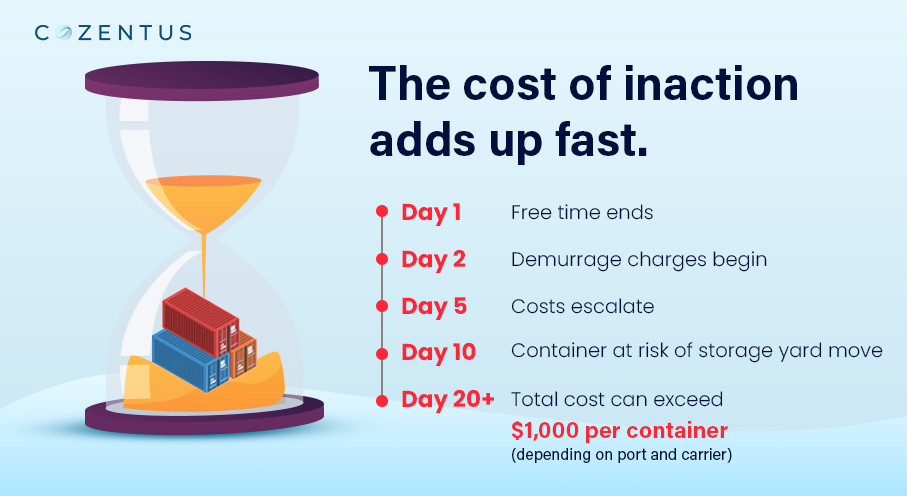
Consider a container approaching the end of its free time at a port or terminal. A visibility platform may display the remaining free time and highlight the container in red. The operations team can see the risk, but the charge may still occur if nobody acts quickly enough.
The same problem appears in everyday freight operations. A delayed truck can cause a missed warehouse slot. A late vessel can disrupt onward transport. A shortage of chassis can hold up container collection.
When teams depend on manual intervention for every exception, three problems emerge:
- Slow response: Alerts wait in queues while employees handle other tasks.
- Disconnected decisions: Teams work across separate systems, emails, and spreadsheets.
- Rising operational costs: Detention, demurrage, waiting time, and missed delivery commitments add up.
The job of a control tower should help teams manage these situations, not simply give them a better view of the damage.
Looking for Custom AI Solutions?
What Is Supply Chain Orchestration?
Supply chain orchestration connects visibility with decisions and operational execution. Instead of stopping at an alert, an orchestration-enabled system uses AI, business rules, live data, and pre-defined workflows to determine the next step.
Depending on the system's integrations, permissions, and automation rules, it can recommend an action, trigger a workflow, or even execute an approved change.
For example, during a shipment delay, an orchestration system could:
- Identify the affected shipment and assess its delivery risk.
- Check alternative transport options and available capacity.
- Recommend a reroute or revised delivery slot.
- Notify the relevant operations team or carrier.
- Update connected systems and track whether the action resolved the issue.
Human approval may still be necessary for high-cost changes or decisions involving customer commitments. But the goal here is to reduce manual work while keeping people involved where their judgment matters.
Real-Time Data Must Trigger Real-Time Action
Orchestration depends on reliable, timely data. If shipment milestones, carrier updates, inventory records, and transport capacity information are outdated or inconsistent, even a truly sophisticated system can make poor decisions.
A good control tower needs to connect operational data with clear decision rules and execution workflows for it to work best.
Key capabilities include:
- Real-time data integration: Connect TMS, ERP, WMS, carrier platforms, and tracking systems through APIs, EDI, and other integration methods.
- Predictive ETA and risk monitoring: Use shipment events, historical performance, and current conditions to identify potential delays.
- Exception management: Prioritise issues according to urgency, financial impact, and service commitments.
- Automated workflows: Trigger notifications, escalations, booking changes, or approval requests based on defined rules.
- Feedback and tracking: Confirm whether an action was completed and whether the shipment returned to plan.
AI and machine learning can improve ETA predictions, identify patterns, and help prioritise exceptions. However, automation still needs reliable data, sensible business rules, and clear accountability.
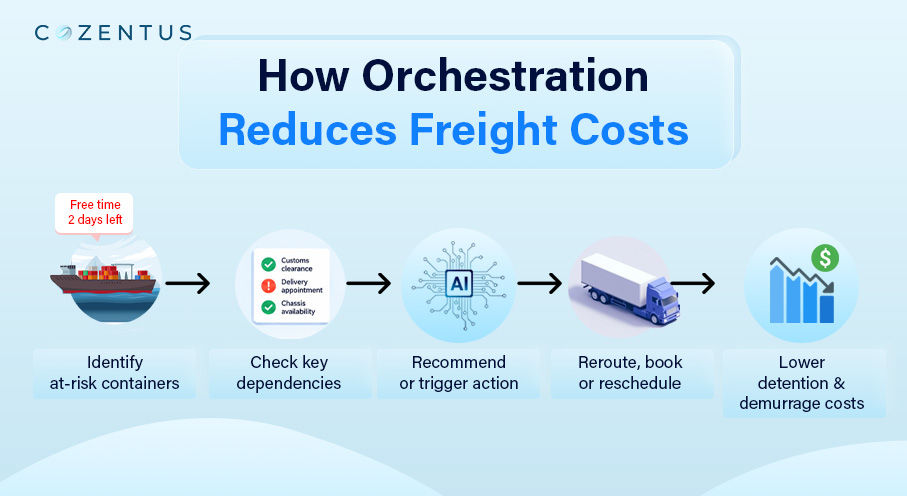
Orchestration Reduces Detention & Demurrage
Demurrage generally means keeping a container inside a terminal beyond the allowed free time. Detention generally means keeping a carrier's container outside the terminal beyond the permitted period. Exact definitions and charging rules depend on the carrier, contract, and location.
A visibility system can track free time and display approaching deadlines. An orchestration-enabled system can connect that information to operational workflows.
For example, it could identify a container at risk, check customs clearance status, flag a missing delivery appointment, notify the responsible team, and escalate the issue before free time expires.
Where integrations and permissions allow, it could also initiate a transport booking or request a change to the collection plan. The system cannot eliminate every charge, particularly when external disruptions are unavoidable. It can, however, help teams identify preventable delays earlier and act before costs escalate.
The same approach applies to chassis allocation, carrier selection, warehouse appointments, and shipment rerouting. Better coordination helps logistics teams use available resources more effectively.
Conclusion: What Logistics Leaders Should Expect
When evaluating a supply chain control tower, logistics leaders should look beyond the number of dashboards, alerts, and data sources it supports.
Ask practical questions about what the system can do when an exception occurs.
- Can it identify the operational and financial impact of a delay?
- Can it recommend the next action based on defined business rules?
- Can it trigger workflows across connected systems?
- Can it distinguish routine exceptions from issues requiring human intervention?
- Can it track whether the action was completed and measure the outcome?
These questions help separate visibility platforms from orchestration capabilities. They also make it easier to evaluate the business case through measurable outcomes such as response time, detention and demurrage costs, on-time delivery, and manual exception-handling effort.
Not every operation needs fully autonomous execution. You can start with automated escalation and recommendations before allowing systems to execute approved actions.
For expert consultation, book a session with us.
FAQs
1. What is a supply chain control tower?
Ans: A supply chain control tower is a platform that combines data from systems such as TMS, WMS, ERP, carrier platforms, and tracking devices to provide visibility into shipments, inventory, transport operations, and supply chain disruptions.
2. How can a supply chain control tower reduce logistics costs?
Ans: A control tower can help reduce costs by identifying delays, improving shipment planning, monitoring detention and demurrage exposure, and helping teams respond to disruptions earlier. The greatest operational benefit comes when visibility is connected to workflows that enable timely action.
3. How does AI improve supply chain control towers?
Ans: AI can improve supply chain control towers through predictive ETA, risk detection, exception prioritisation, demand forecasting, and recommendations for corrective action. When integrated with operational systems and approved workflows, these capabilities can help teams make faster decisions and automate appropriate responses.