The Biggest Bottleneck in Logistics AI: Data Quality
Logistics companies are investing in AI to do a lot of things, like reduce manual work, improve shipment visibility, forecast delays, and make faster decisions. The possibilities are exciting, but there is a problem that most people ignore. The quality behind these solutions.
Shipment details are buried in PDFs. Invoice data sits in spreadsheets. Carrier updates are scattered across multiple portals. Important information lives in systems that barely talk to each other. Now, try building an AI solution on top of that.
Even the best AI model will struggle when the information feeding it is incomplete, inconsistent, or outdated. Before asking what AI can do for your logistics operation, ask: “Is your data ready for it?”
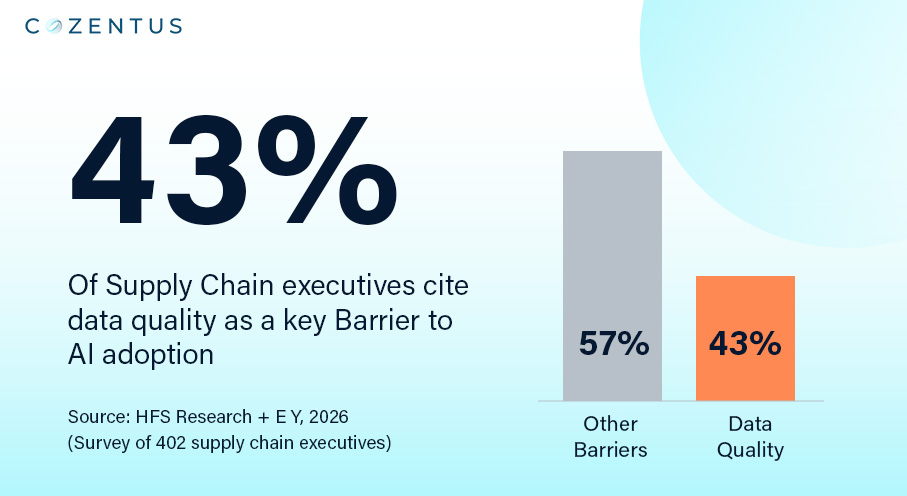
Why Data Quality Holds Back AI in Logistics
Logistics companies generate huge amounts of data every day. This data contains information that helps teams run daily operations.
The problem is that this information usually arrives in different formats and sits across disconnected systems.
A shipment reference in a carrier portal might not match the reference in a transport management system (TMS). An invoice might use a different description for a charge listed in the rate card. A delivery update might arrive late, while the operations team maintains a separate spreadsheet to keep everyone informed.
These gaps create problems for AI applications across the business.
- Predictive ETA: Missing shipment updates and incorrect timestamps make it harder to predict arrival times accurately.
- Freight audit automation: Incorrect shipment details and different charge names make invoice checking difficult.
- Demand forecasting: Missing past shipment data makes it harder to predict future demand.
- Shipment visibility: Disconnected carrier systems make it difficult to track shipments at every stage.
- AI agents: Missing information and incorrect records can lead to wrong suggestions or actions.
The AI might process information in seconds. But that doesn't mean the information is accurate.
Looking for Custom AI Solutions?
A Better AI Model Won't Fix Bad Data
When an AI project does not deliver the expected results, upgrading the AI model may seem like the best solution. A different model might help, but it will not fix missing shipment records, outdated rate cards, or systems that cannot share data properly.
Take freight audit automation as an example. An AI solution checks freight invoices against contracted rates, purchase orders, shipment records, and agreed surcharges to identify billing errors. If the rate card is outdated or shipment details do not match, the system might flag a correct charge as an error or miss an actual overcharge.
The same applies to large language models (LLMs). They can read documents, understand questions, and generate useful responses. But when they work with incomplete or incorrect business data, they can give answers that sound right but are wrong.
The problem is not always the AI model. Sometimes, the data it uses is unreliable.
That is why logistics companies need to improve data quality before scaling AI across their operations.
What Does AI-Ready Data Look Like in Logistics?
AI-ready data does not mean every record must be perfect or every legacy system needs replacing. It means the information required for a specific task is accessible, sufficiently complete, consistent, and reliable enough to support that task.
For logistics companies, getting there usually involves four areas.
- Data extraction: Optical character recognition (OCR), Intelligent document processing (IDP), and natural language processing (NLP) help extract information from invoices, bills of lading, packing lists, and other shipping documents.
- Data validation: Extracted values are checked against business rules, master data, purchase orders, shipment records, and rate cards.
- System integration: TMS, enterprise resource planning (ERP), warehouse management system (WMS), carrier, and finance applications are connected through APIs, electronic data interchange (EDI), or integration services.
- Data governance: Teams have clear ownership, access permissions, data standards, and processes for correcting errors.
These activities may not be the most exciting part of an AI project. But they help ensure that the system works with information the business can trust.
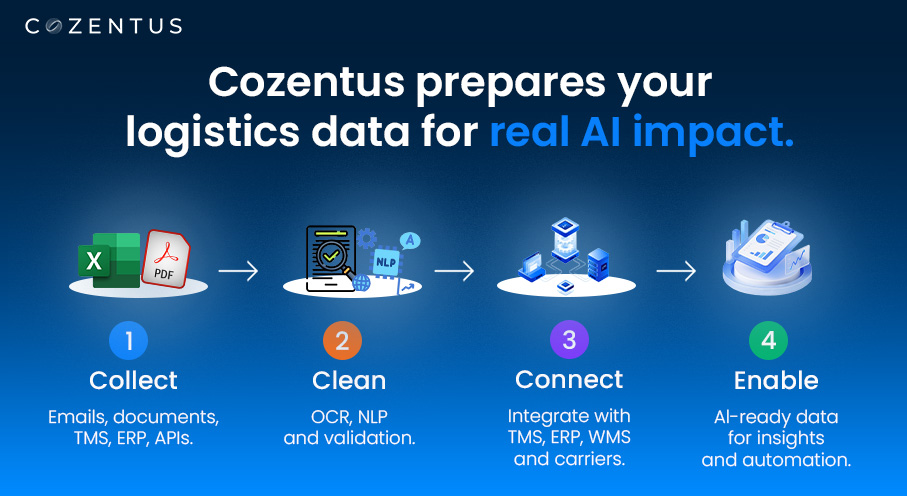
How to Prepare Logistics Data for AI
Trying to clean up every data source before starting an AI project can become a project of its own. Logistics companies do not need to wait until every system is perfect. They need to understand which data problems could prevent a specific use case from working.
Start with one operational problem where poor data is already costing time or money. Freight invoice reconciliation, for example, provides a clear starting point because the process depends on matching information across invoices, shipment records, purchase orders, and rate cards.
Here’s how you can approach it:
- Map the data sources. Identify where the required invoice, shipment, and rate information currently lives.
- Find the gaps. Look for missing fields, duplicate records, inconsistent references, and outdated information.
- Set validation rules. Define which values must match and which discrepancies require human review.
- Connect the systems. Make sure the relevant information can move between applications reliably.
- Measure the results. Track matching accuracy, processing time, exception rates, and manual intervention.
This approach gives the team a clear way to test data readiness and measure the value of automation. Once the process works reliably, the same data foundation can support predictive analytics, shipment visibility, and more advanced AI agents.
Better Data Makes Logistics AI Useful
There are a lot of benefits of AI in logistics. It can identify unusual freight charges, predict delays, and spend less time chasing information across systems. But these benefits do not come from just adding a new model.
The quality of the data underneath matters just as much. If shipment records are incomplete, carrier updates are disconnected, or business rules are unclear, those problems will follow the AI project into production.
The answer is not to delay every AI initiative until the entire technology landscape is perfect. It is to identify the data gaps that matter, fix them for the use case at hand, and build from there.
The model may get all the attention. But the data does the heavy lifting.
AI is the last mile. Data is the road you drive it on. If you want your AI to deliver reliable results, improve the data quality first.
FAQs
1. Why is data quality important for AI in logistics?
Ans: Data quality affects how accurately AI systems forecast demand, predict shipment arrival times, reconcile freight invoices, and recommend operational actions. Missing, inconsistent, or outdated information can lead to unreliable results and incorrect decisions.
2. What are the biggest data quality challenges in logistics?
Ans: Common challenges include fragmented systems, inconsistent shipment references, duplicate records, missing milestone updates, unstructured documents, outdated rate cards, and limited integration between carrier platforms, TMS, ERP, and finance systems.
3. How can logistics companies make their data ready for AI?
Ans: Companies can identify the data required for a specific use case, extract information from documents, validate records, standardise key fields, and integrate relevant systems. Clear data ownership and regular quality checks help maintain reliable information.