When Tariffs Hit – Outdated Technology Cracked
The tariff shocks of 2026 pushed supply chains into a level of pressure many leadership teams had not fully prepared for. At the same time, customers still expected reliable service despite changing costs and longer lead times.
Most of the supply chain operations made it through the disruption. But survival is not the real story here.
Some logistics operations regained their stability within days and protected margins despite growing complexity. While others spent weeks stuck in reactive decision-making, manual reporting, and constant firefighting.
The companies that adapted fastest had already built supply chain technology around how their network operated. Those who struggled were trying to manage modern supply chain complexity using systems designed for a much more predictable environment.
This blog explores how tariff disruption exposed weaknesses in traditional supply chain technology, why adding more platforms didn’t fix the problem, and what leaders are doing differently.
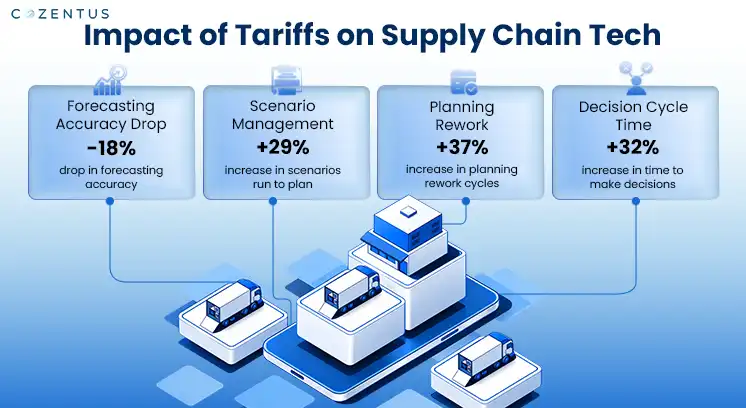
Why Logistics Technology Failed During Tariff Disruption
The disruption itself is usually not the first problem. The real challenge is getting a clear and reliable picture of what is happening fast enough to make decisions.
As tariff conditions changed, many freight and supply chain businesses found themselves dealing with the same chain of events:
- Finance needed updated landed-cost impact
- Customers wanted revised delivery commitments
- Procurement teams looked for alternative suppliers
- Operations tried to match conflicting information across multiple systems
The issue was not a shortage of data. Most businesses already had access to important data like shipment milestones, carrier updates, etc.
The problem was that this information lived in disconnected systems that were never designed to work together as a single operational environment.
Many mid-market logistics businesses entered 2026 with years of layered technology, including:
- An off-the-shelf TMS for execution
- Separate visibility platforms
- Reporting systems sitting outside daily workflows
- Spreadsheet-based processes
- Manual workarounds
During stable periods, this setup can seem manageable because experienced teams keep things moving through manual effort and operational knowledge. But disruption removes that safety net very quickly.
Teams start rebuilding reports manually because systems cannot provide better visibility. Customer communication slows down while shipment updates are checked across multiple platforms. Decisions take longer because every operational change depends on people coordinating between disconnected workflows.
The cost of fragmentation didn’t look like a technology problem. Instead, it shows up in ways operations leaders deal with every day, such as:
- Slower response times
- Margin leakage
- Customer frustration
- Higher operational overhead
- Teams working longer hours simply to maintain service levels
The tariff shock did not create these weaknesses. It exposed how heavily many supply chains relied on people to hold fragmented technology environments together.
Looking for Custom AI Solutions?
More Logistics Technology Doesn't Fix Broken Systems
When operations become unstable, you can usually predict the response.
Businesses start exploring new logistics technology platforms. Leadership teams discuss adopting AI. Vendors promote visibility upgrades, predictive analytics, and automation tools that are designed to improve responsiveness.
The challenge is that many of these investments improve the surface, but it doesn’t change the underlying operational architecture.
- A newer interface does not solve disconnected workflows.
- An AI engine does not remove fragmented data pipelines.
- A visibility platform does not automatically improve execution.
This matters even more as businesses use AI-driven operations. However, AI only performs as well as the operational environment supporting it.
If systems contain fragmented shipment events, inconsistent master data, and manual intervention points, automation can increase instability instead of reducing it.
The same principle applies to visibility investments. Seeing disruption earlier only creates value if teams can respond quickly through connected workflows. Many businesses today can identify problems faster than before but still struggle to act because execution remains fragmented.
This is why many transformation programmes fail to deliver meaningful operational improvement. Companies modernize interfaces but leave the operational foundation underneath disconnected.
How Leading Businesses Build Better Supply Chain Technology
The strongest logistics operations handled disruption differently because they approached technology differently long before disruption arrived. Instead of choosing software first, they started by understanding how their network operated.
That included:
- Where operational decisions slowed down
- Which exceptions created the most manual effort
- Which customer commitments required flexibility
- How data moved between teams and networks
They built supply chain technology around these operational realities instead of forcing their operations to fit generic one-size-fits-all platforms.
For example:
One freight operator dealing with recent tariff disruption had already connected sourcing adjustments, shipment execution, and landed-cost analysis inside a unified operational environment.
When tariffs affected several major trade lanes, this business searched for alternative sourcing scenarios within hours. Additionally, it updated routing strategies immediately and informed customers about revised delivery expectations the same day.
Competitors who faced similar conditions needed several days to achieve the same response.
The difference was not leadership quality or workforce capability. The difference was that one environment supported coordinated decision-making and the other relied heavily on manual work.
During disruption, that gap grows quickly because operational responsiveness directly influences:
- Customer confidence
- Freight cost exposure
- Inventory pressure
- Margin protection
- Commercial competitiveness
This is why adaptable logistics technology matters more than software with long feature lists. Businesses that want long-term advantage are building environments where workflows, data movement, and operational execution work together as one connected structure.
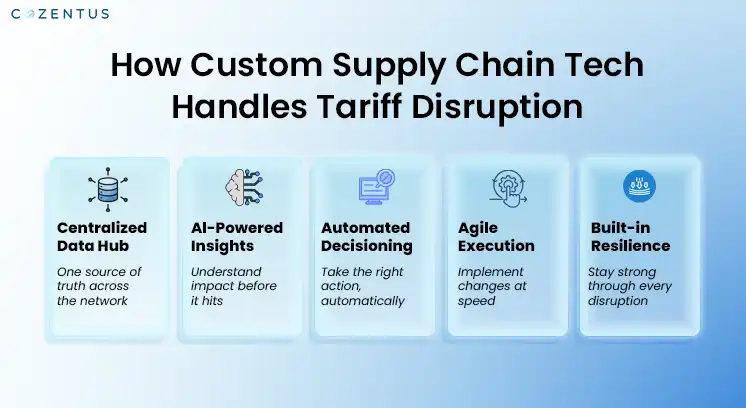
Custom Supply Chain Logistics Tech is the Solution
When tariff conditions changed, most of the supply chain teams already knew what needed to change. The challenge was how fast you could move. Standard off-the-shelf systems slowed that process because workflows, integrations, and change requests depended on software limitations.
That is why most leaders are now choosing Cozentus for custom supply chain and logistics technology.
They want technology that can support:
- Real-time data integration across TMS, ERP, WMS, and partner systems
- Gen-AI and AI agents for better workflow management
- Predictive analytics and risk monitoring
- Automated workflows and exception handling
- Customer-specific execution and configurable workflows
- Digital control tower and real-time visibility
- Intelligent document processing (IDP) and AI-driven data extraction
This approach is not necessary for every business. But for logistics companies that want speed, flexibility, and customer-specific execution, custom technology is a must for competitive advantage.
FAQs
Q: Why did supply chain technology struggle during tariff disruption?
A: Most problems were caused by fragmented systems. Data and workflows were spread across multiple platforms, so teams had to manually match information before making decisions. That slowed response times when speed mattered most.
Q: Is custom logistics technology better than off-the-shelf software?
A: It depends on how the business operates. Off-the-shelf software works well for standard processes. Custom logistics technology works when businesses need more flexibility, customer-specific workflows, stronger integrations, or better AI adoption.
Q: What is the biggest challenge with logistics technology today?
A: For many logistics businesses, the biggest challenge is fragmentation. Different systems, manual workarounds, and disconnected workflows slow visibility, decision-making, and day-to-day operations. The solution is connected logistics technology that brings data, workflows, and operational processes into one coordinated environment.