AI is Automating the Entire Freight Documentation Process
When it comes to AI in logistics, people usually think of visibility platforms, route optimization, or forecasting. But the most practical use of AI is happening at a place where freight teams deal with every single day – "Documentation."
Freight forwarders are now using AI-powered IDP to automate the process of bills of lading, freight invoices, customs declarations, and shipment paperwork faster and with far less manual effort. Not only that, but AI is also helping them capture, classify, extract, validate, and route freight documents more intelligently.
This is a bigger shift in the world of freight forwarding. In fact, as per The Wall Street Journal, C.H. Robinson's CEO says, AI and automation are helping the company earn better profits, even when revenue is under pressure.
In this blog, we break down how IDP in logistics and AI document processing supply chain technologies are helping freight forwarders cut processing time and build smarter freight operations.
What Is IDP and Why Freight Forwarders Are Adopting It
The short answer is: "Speed".
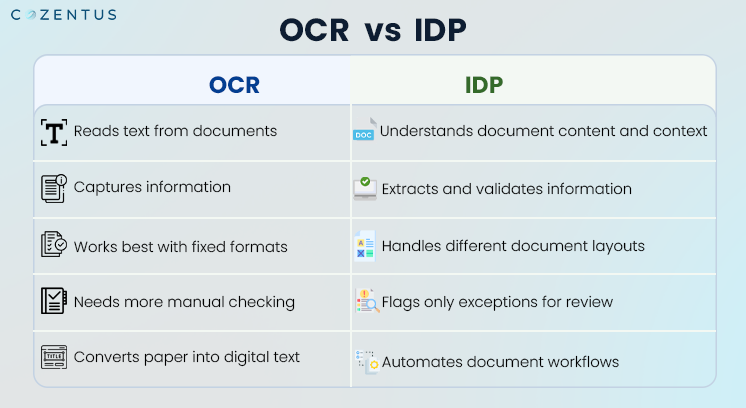
Earlier logistics teams relied on OCR tools to digitize their paperwork. OCR (Optical Character Recognition) helped scan the text from the uploaded copy and converted them into machine-readable information, which was a major step forward.
But freight documentation doesn't usually follow clean templates. Carriers use different formats. Customs paperwork varies as per the geography. Freight invoices might have inconsistent terminology and layouts. This is why freight companies are now investing in IDP (Intelligent Document Processing).
IDP combines multiple AI technologies to process complex logistics documents automatically and more intelligently.
A modern AI document processing supply chain platform usually combines:
- OCR engines
- Computer vision
- Natural language processing (NLP)
- Machine learning
- Large language models
- Workflow validation rules
This combination creates document AI logistics systems that go beyond reading text. They understand the context.
For freight forwarders, this means documents can be classified, data extracted, and information validated automatically before entering operational systems. That is a major leap from traditional automation.
Looking for Custom AI Solutions?
IDP vs OCR in Logistics: Why IDP Took Over
The conversation around IDP vs OCR in logistics is now more relevant because many freight companies still treat both technologies as the same thing.
They are not the same.
OCR freight documents technology focuses primarily on text recognition. It identifies words and numbers from scanned files and converts them into digital text.
This capability is very useful. However, freight forwarding documents are not predictable enough for OCR alone.
- A freight invoice and a bill of lading may contain completely different structures.
- Customs declarations may include handwritten notes or inconsistent layouts.
OCR can capture text, but it cannot reliably understand the exact meaning of the document or validate the business logic. This is where IDP logistics becomes more valuable.
How AI Works in Modern Freight Documentation
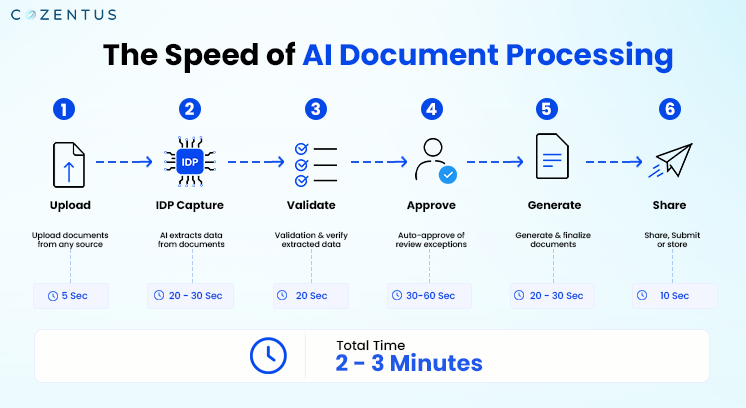
The most effective freight document AI systems work through a connected automation workflow.
The first stage is automated document capture logistics. Documents enter the workflow through multiple channels, including:
- Email attachments
- Customer portals
- Scanned PDFs
- Mobile uploads
- APIs and system integrations
AI captures these files automatically and routes them for processing without manual sorting.
The second step is intelligent classification. Using computer vision and language models, AI identifies document types such as:
- Bills of lading
- Freight invoices
- Customs declarations
- Packing lists
- Proof of delivery
Once classified, the extraction layer begins.
This is where AI document processing supply chain platforms pull shipment data, which includes:
- Shipment numbers
- Container references
- Consignee details
- Freight charges
- Customs references
- Delivery timelines
But the extraction alone is not the real innovation. The real value comes from supply chain document intelligence.
AI validates extracted information against shipment records and business rules. If invoice amounts differ from the agreed freight rates or if the shipment references are incomplete, the system flags exceptions automatically.
This creates a more practical workflow where teams focus on exceptions rather than reviewing every document manually.
How Freight Forwarders Are Cutting Processing Time by 80%
Freight forwarders are adopting logistics document automation because it creates improvements that are easy to see.
Organizations that are using IDP and intelligent AI automation are now seeing:
- Faster document turnaround
- Lower administrative effort
- Higher data accuracy
- Less exception handling
- Faster invoicing cycles
- Better shipment visibility
AI is already helping freight companies process documents much faster, with some workflows seeing time savings of up to 80%. The biggest gains usually come from high-volume paperwork.
Freight invoices are moving faster because checks and validations happen automatically. Customs documents are becoming easier to review before filing. Bills of lading are processed more quickly because AI can classify and extract information almost instantly.
At Cozentus, we see the top logistics companies are thinking beyond simple automation. The focus is shifting toward smarter, connected operations where document processing works along with visibility and shipment workflows. That is when AI becomes part of how freight teams operate and scale more efficiently.
Conclusion: IDP is Bigger than you Think
Freight documentation is changing fast, and honestly, this may be one of the most practical AI shifts happening in logistics today.
What started as logistics document automation is quickly becoming something bigger. Modern AI document processing supply chain systems are not just digitizing paperwork anymore. They are helping freight teams process the entire documentation with far less manual effort.
The next step looks even more interesting. Future-ready freight document AI and supply chain document intelligence platforms may soon predict missing fields, trigger workflows automatically, and support faster operational decisions.
For freight forwarders, the opportunity is bigger than saving time. It is about building smarter, more scalable operations where documents stop slowing freight down and start helping it move faster.