Is Your TMS Built for Modern Freight Operations?
That standard transport management system (TMS) worked when logistics operations were simpler, and customer expectations were easier to manage. But freight operations today look very different.
Customers expect real-time visibility. Teams manage shipments across multiple systems. Documentation, compliance, communication, and reporting have become more demanding. At the same time, AI and automation are also being heavily adopted by logistics companies.
This is exactly why the build vs buy TMS discussion is getting serious in freight technology 2026.
For those with off-the-shelf TMS, replacement is not just a software upgrade. It is a business decision that affects their efficiency, customer experience, scalability, and even future AI readiness.
In this blog, you will get a clear idea of whether buying or building a TMS is better for you.
Build vs Buy TMS: What Does It Mean?
The logistics software build or buy question sounds technical, but the idea is pretty straightforward.
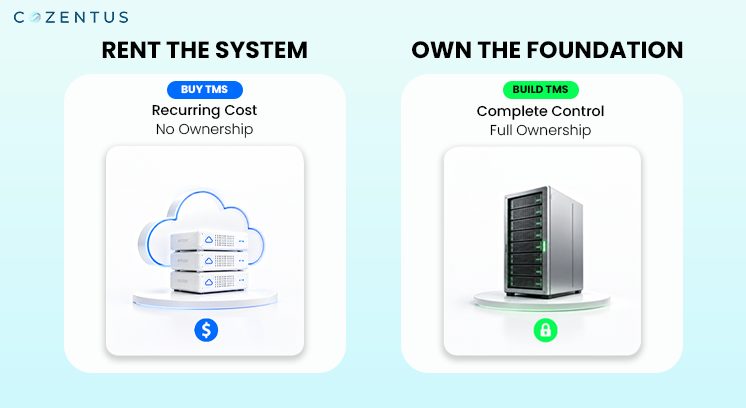
- Buying means selecting ready-made freight management software from a software provider. These systems come with pre-built features, standard workflows, and faster deployment timelines.
- Building means investing in custom TMS development and creating a bespoke TMS solution designed around your own business processes.
Both approaches can work. The real difference comes down to how closely your software matches the way your business operates. That is where many freight forwarders begin to see the challenge.
So, the question remains: "Should freight forwarders build or buy a TMS?"
Looking for Custom AI Solutions?
Buying a TMS: Faster Setup, But with Trade-Offs
There are good reasons why many businesses still buy TMS for freight forwarders.
An off-the-shelf transport management system usually offers faster implementation and lower upfront costs. Vendors provide support, maintenance, and pre-configured features that can help operations get started quickly.
Typical capabilities often include:
- Shipment execution
- Carrier management
- Rate handling
- Customer tracking
- Documentation workflows
- Reporting dashboards
- Basic integrations
For companies with standard operating processes, buying can be an effective solution.
However, the challenge usually appears later.
As freight businesses grow, they often develop customer-specific workflows, unique pricing structures, and specialized requirements. This is where a standard one-size-fits-all TMS software falls short.
They may find themselves dealing with:
- Limited workflow flexibility
- Expensive customizations
- Integration complexity
- Dependence on vendor roadmaps
- Manual workarounds
- Delays in feature requests
Many freight operators know this feeling really well. The software technically works, but teams start adjusting their processes to fit the platform rather than the platform supporting the business.
That is often the first sign that the conversation should move beyond software licensing and toward TMS total cost of ownership.
TMS Total Cost of Ownership Is Bigger Than You Think
Companies often compare software based only on subscription fees or implementation pricing. But TMS's total cost of ownership has hidden costs that can build gradually over time.
These often include:
- Add-on modules
- Integration expenses
- Third-party development support
- Upgrade-related disruptions
- Internal workaround costs
- Vendor dependency
A platform that looked affordable during procurement may become more expensive as operational complexity increases.
This is particularly relevant for mid-market TMS buyers. Mid-sized freight businesses often sit in a difficult position. Their operations are too complex for basic systems, but they may not want the heavy enterprise software model either.

Custom TMS Development: More Control and Full Ownership
Custom TMS development was something that only large enterprises could afford. This is not the case anymore.
Modern cloud infrastructure, APIs, modular development, and AI-enabled tools have made a bespoke TMS solution far more achievable than it ever was before.
The biggest advantage of building is "control."
A custom platform is designed around your business logic, customer requirements, and operational workflows. Teams do not need to force processes into predefined software structures.
This matters for freight forwarders who manage:
- Customer-specific SOPs
- Complex pricing models
- Multi-party coordination
- Specialized documentation
- Unique visibility requirements
- Proprietary operational workflows
When you own your TMS, you get more control and flexibility over how your technology evolves.
The flexibility of custom TMS supports:
- Faster process improvements
- Better integration ownership
- Stronger data visibility
- Easier automation adoption
- Better AI readiness
This does not mean building a custom TMS is automatically easier. Any custom platform still requires planning, governance, and ongoing improvement. Without clear ownership and technology direction, custom systems can become very difficult to manage.
So, you need to have great technological expertise and ongoing maintenance plans to keep up the growth.
So, Should Freight Forwarders Build or Buy TMS in 2026?
There is no universal answer.
Buying usually works best when operations are relatively standardized and you need to deploy fast. Many companies can still get good value from ready-made freight management software if their requirements are clear.
Building becomes more attractive when logistics processes are highly customer-specific or when differentiation matters. This is more relevant in freight technology 2026, where data, automation, and AI are the competitive advantage.
AI solutions rely heavily on clean operational data and connected workflows. If systems remain fragmented or heavily restricted by software limitations, automation delivers less value than expected.
That is one of the reasons some freight businesses, including those working with partners like Cozentus, are revisiting their mid-market TMS strategy and evaluating whether standard platforms still support their long-term goals.
The objective is not simply to build software. The objective is to choose a technology that supports growth.
Conclusion: Your TMS Decision will Define the Next 5 Years
If you are using an off-the-shelf TMS, take some time and think before replacing it. Take a closer look at how your business operates today and where it is headed next.
The smartest freight companies are evaluating their workflows, understanding the total cost of TMS ownership, and asking whether their technology supports long-term growth.
Because in 2026, the right TMS does more than manage shipments. It supports automation, improves visibility, strengthens customer experience, and creates a stronger foundation for AI and future scalability.
Technology decisions made today will influence how competitive and adaptable your freight business becomes tomorrow.
Book a freight tech audit and see whether your TMS is built for what's coming next.