Why Freight Forwarding SOPs Are Your Biggest IP in the AI Era
Two companies having the same Transport Management System (TMS), working with the same carriers, and serving similar customers can have different ways of getting things done
The difference comes from the knowledge their teams have built over years of handling shipments, managing exceptions, negotiating rates, and dealing with customer requirements.
Most of this knowledge usually lives in employees' heads, emails, spreadsheets, and informal instructions.
As AI agents become part of daily logistics operations, this knowledge will become even more valuable. Companies that document their processes and retain control over the software that runs them will have a stronger advantage over competitors.
This blog explores why freight forwarders must document and protect their operational knowledge, and how owning their SOPs can create a lasting competitive advantage as AI agents rise.
The Hidden IP in Freight Forwarding
The real IP of a freight forwarder lies in the operational knowledge its teams build through years of experience.
Freight forwarding involves hundreds of small decisions every day. Some follow standard procedures, while others depend on experience and customer-specific requirements.
The decisions come from experience. Over time, operators develop their own ways of handling recurring problems, managing exceptions, and keeping shipments moving.
This knowledge covers areas such as:
- Customer-specific SOPs: Special handling instructions, reporting formats, communication preferences, and delivery requirements.
- Exception management: How to handle rolled bookings, customs holds, missed cut-offs, and shipment delays.
- Rate management: How to select carriers, negotiate rates, apply surcharges, and manage customer-specific pricing.
- Documentation: How to identify discrepancies in commercial invoices, packing lists, and Bills of Lading.
- Approval workflows: Which decisions require customer approval, management review, or financial authorisation.
These processes are valuable business knowledge. If they remain undocumented, they become difficult to transfer, automate, and protect.
Why AI Agents Need Your Logistics SOPs
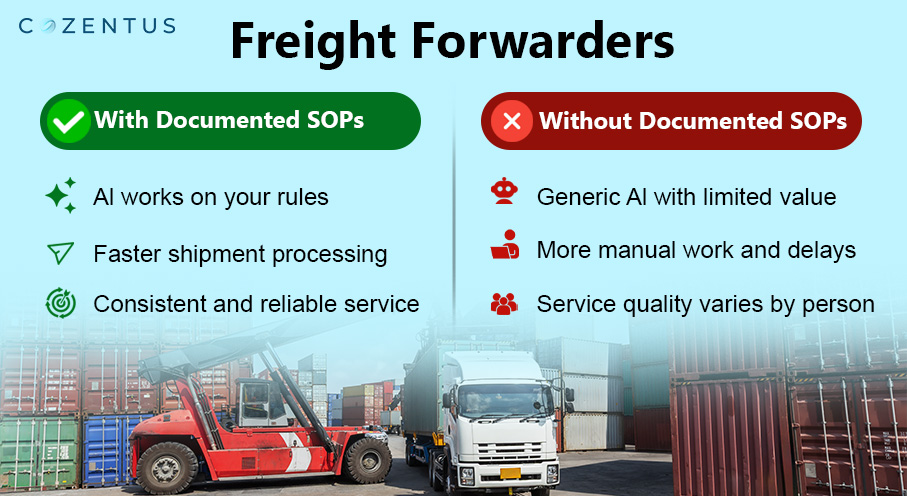
AI agents need clear, documented business processes to handle logistics operations accurately and consistently. They can now perform multi-step tasks, interact with business systems, retrieve information, and execute defined workflows.
However, these agents need clear instructions to perform tasks correctly.
For example, a standard shipment update might be easy to automate. But what happens when a particular customer requires updates every four hours? What if a shipment crosses a certain cost threshold and needs management approval? What if a carrier changes the estimated arrival date?
These situations require business context.
AI agents need access to:
- Documented Standard Operating Procedures (SOPs).
- Customer-specific instructions and service agreements.
- Rate cards, pricing rules, and approval limits.
- Exception-handling procedures and escalation paths.
- Historical shipment records and operational decisions.
Without this information, agents will follow generic workflows but will struggle with the situations that make each freight forwarder's operations different.
The Problems of Using the Same AI Platforms
Many logistics companies are investing in the same enterprise platforms and AI solutions. These systems offer everything they need.
There is nothing wrong with using established platforms.
The problem starts when companies depend entirely on a vendor's software, workflows, and AI roadmap to define how their business operates.
If multiple freight forwarders use the same AI agents with similar default configurations, they may end up automating similar processes in similar ways.
Their software might be different in terms of configuration, but the underlying operational knowledge may be limited.
A freight forwarder's real advantage comes from their processes. Their rules, decisions, customer requirements, and exception-handling methods are what they have developed over the years. These are difficult for competitors to reproduce when they are properly documented and controlled by the business.
Custom AI-powered software are the ones that will give freight forwards their unique edge over others.
Looking for Custom AI Solutions?
Why Freight Forwarders Need Control Over Their SOPs and Software
Documenting SOPs gives companies control over how their operations run. It also creates a foundation for building AI solutions around their actual business requirements.
This means companies should focus on two important areas.
- 1. Capture and protect process knowledge
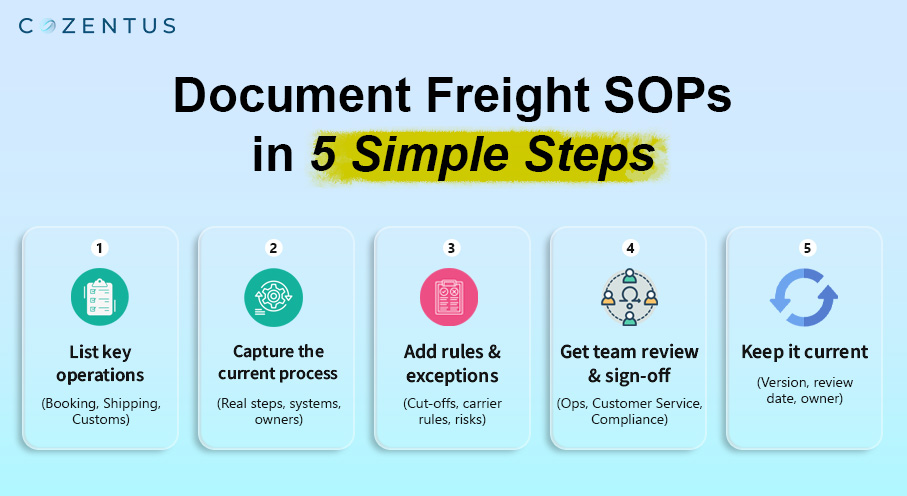
Start by documenting how teams handle everyday operations. Include the standard steps, decision points, exceptions, approval requirements, and customer-specific instructions.
Make sure this knowledge is reviewed and updated when processes change. It should be accessible to authorised employees and connected to the systems that need it.
- 2. Retain control over your software and workflows
Choose platforms that support your business requirements, but make sure your organisation retains control over its operational rules, workflow logic, integrations, and business data.
This gives you the flexibility to update processes, introduce new AI agents, and change technology providers without rebuilding your entire operating model.
The objective is to make technology work around your business processes, rather than forcing your teams to depend on a vendor's standard workflows.
Documented SOPs Improve Freight Operations
Well-documented processes deliver practical benefits in daily operations.
- Less dependency on individual employees: Operational knowledge becomes accessible to the wider team, reducing the impact of employee turnover and absences.
- Faster employee onboarding: New employees can understand shipment workflows, customer requirements, and escalation procedures more quickly.
- Better AI automation: AI agents can follow defined business rules and handle customer-specific workflows with greater consistency.
- Fewer operational errors: Documented instructions reduce confusion around approvals, documentation, and shipment handling.
- Greater business flexibility: Companies can modify workflows, integrate new technologies, and expand automation without losing control of their processes.
- Stronger customer relationships: Consistent execution of customer-specific requirements helps maintain service quality and customer confidence.
Most importantly, companies can build on their existing operational experience instead of starting from scratch every time they introduce new technology.
FAQs
1. What is an SOP in freight forwarding?
Ans: An SOP (Standard Operating Procedure) is a documented set of instructions that explains how specific freight forwarding activities should be completed. It covers processes such as shipment booking, customs documentation, carrier coordination, shipment tracking, invoicing, and exception handling.
2. Why are SOPs important in logistics?
Ans: SOPs help logistics companies maintain consistent operations, reduce errors, improve employee training, and manage customer-specific requirements. They also make it easier to automate repetitive tasks and ensure employees follow approved business processes.
3. How can AI agents improve freight forwarding operations?
Ans: AI agents can automate multi-step activities such as processing booking requests, extracting shipment data, checking rates, monitoring shipment milestones, managing exceptions, and updating business systems. They can work more effectively when they have access to accurate SOPs, business rules, and customer-specific instructions.