What Most Retail Leaders Get Wrong About AI Readiness
If you ask ten retail executives whether AI is part of their supply chain strategy, most will say yes. If you ask those same leaders whether their supply chain is truly ready for AI, they may seem less confident.
This is where many retail organizations struggle today.
Across the retail industry, especially in mature markets like the United States, AI is seen as the next step in improving forecasting, inventory planning, logistics visibility, and decision-making. Yet many leaders quietly feel that AI has not delivered the value they expected.
The issue is not AI. The issue is its readiness.
AI readiness is often misunderstood as a technology purchase or a data science project. But in reality, it is the ability of your organization to consistently use data and intelligence to make faster and better supply chain decisions.
In this blog, we’ll walk through the five most common mistakes retail leaders make when assessing AI readiness in supply chain operations, and what to think about instead.
Mistake 1: Believing AI Readiness Starts with Buying Tools
One of the most common assumptions is that AI readiness starts with selecting the right platform or vendor.
Many retailers invest in AI-powered forecasting tools, optimization engines, or control tower solutions, expecting quick results. When those results do not show up, the conclusion is often that the tool did not work.
The real problem usually sits elsewhere.
- AI does not fix broken processes.
- AI does not compensate for unclear ownership.
- AI does not resolve conflicting metrics.
If your planning teams still operate in silos, if logistics teams rely on manual follow-ups, or if store operations and supply chain do not share a common view of demand, AI will simply automate confusion faster.
True readiness starts with clarity.
- Clarity on how decisions are made today.
- Clarity on which decisions matter most.
- Clarity on who owns outcomes across the supply chain.
In many successful retail organizations, teams simplify and align their processes first. Only then do they introduce AI. The technology supports the way the business works, not the other way around.
Mistake 2: Assuming More Data Automatically Means Better AI
Retailers generate enormous amounts of data regularly. This includes POS data, inventory data, supplier data, transportation data, and customer behavior data. It is easy to assume that having more data means they are ready for AI.
However, practically, data quality and usability matter more than data volume.
Many supply chains struggle with inconsistent master data, late updates, and disconnected systems.
Inventory data may not align with transportation data. Forecasts may not show real-time demand shifts. Logistics events may arrive too late to support proactive decisions.
AI systems depend on reliable signals.
When data is noisy, incomplete, or delayed, AI outputs become difficult to trust. When teams stop trusting recommendations, adoption drops quickly.
- AI readiness requires disciplined data foundations.
- Clear definitions.
- Timely updates.
- Shared visibility across planning, execution, and logistics.
Retail leaders who win treat data as a business asset, not an IT concern. They invest in making data usable before making it intelligent.
Mistake 3: Treating AI as a Replacement for Human Judgment
Another subtle but damaging misconception is the idea that AI will replace human decision-making.
This belief often creates resistance within supply chain teams. Planners worry about losing control. Operations teams fear being overruled by algorithms. Leadership expects automation without considering a change in management.
But in reality, the most effective AI-driven supply chains use AI as a decision support system, not as a decision maker.
- AI is excellent at identifying patterns, highlighting risks, and simulating outcomes.
- Humans are excellent at context, tradeoffs, and accountability.
For example, in logistics operations, AI can flag shipment delays or anticipate risks early. But deciding whether to expedite, reroute, or absorb the delay often requires business judgment, customer impact understanding, and cost awareness.
Retail leaders who use AI as an assistant rather than a replacement see higher adoption and better outcomes.
Mistake 4: Not Training Staff with AI Before Adopting
AI readiness is often discussed as a system capability. But it is rarely discussed as a people capability.
Many retailers deploy advanced tools without investing in training or role evolution. Planners receive AI recommendations but do not know how they were generated. Managers get real-time dashboards but don’t know how to interpret those insights.
True readiness means:
- Preparing teams to work with AI.
- Understanding what AI can and cannot do.
- Knowing when to trust recommendations and when to challenge them.
- Learning to ask better questions using AI insights.
In strong retail organizations, especially those operating complex national supply chains in the US, AI literacy is becoming part of leadership development. Not everyone needs to be technical, but everyone needs to be comfortable working with intelligent systems.
Mistake 5: Expecting Immediate ROI Without Creating Value First
AI is a trendy buzzword, and most of the time, sellers promise bold outcomes: faster forecasts, lower inventory, fewer stockouts, and improved service levels.
While these outcomes are achievable, they rarely happen all at once.
Many retail leaders expect AI initiatives to deliver enterprise-wide value within days or months. When early results are limited, confidence drops, and programs are stalled.
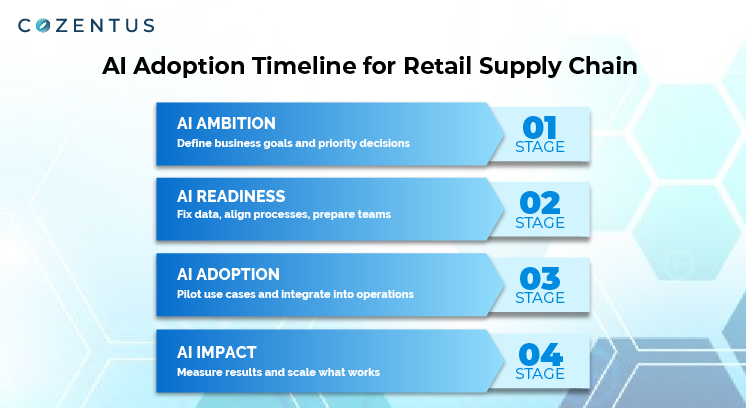
The reality is that AI maturity develops in different stages.
- First comes visibility.
- Then comes prediction.
- Then comes optimization.
- Finally comes autonomous decision support.
In logistics and supply chain operations, early wins often come from better visibility and exception management. Predictive and prescriptive capabilities follow as trust builds.
Leaders who succeed set realistic expectations and measure progress one by one. They treat AI as a long-term capability, not a one-time project.
What AI Readiness Really Looks Like in Retail Supply Chains
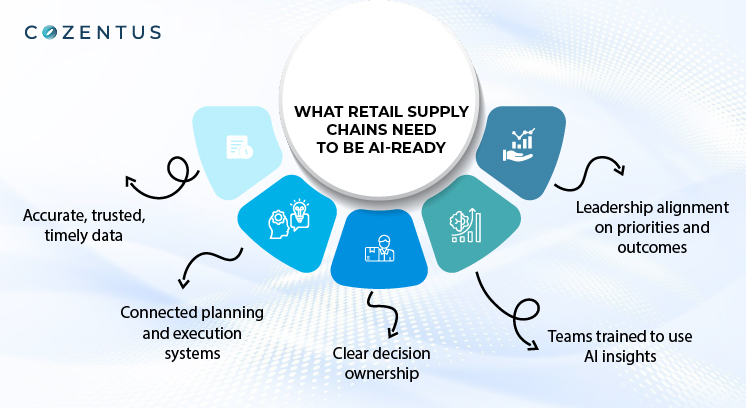
When you step back, AI readiness is less about complex algorithms and more about getting the basics right. It comes down to alignment.
- Data that tells the same story across teams.
- Processes that connect planning with execution.
- Incentives that push teams to work toward the same goals.
- Leaders who are aligned on priorities and expectations.
When this alignment exists, AI does not feel complicated or disruptive. It simply helps teams do their jobs better. People spend less time debating numbers and more time making decisions. Issues are identified earlier, and responses are quicker and more confident.
In the most mature retail supply chains, AI works quietly in the background. It reduces confusion, highlights what matters, and helps teams respond to change faster. In a market where customers expect products to be available all the time, delivered on time, and handled reliably, this matters more than ever. Retailers that get AI readiness right are not just running more efficiently. They are earning and protecting customer trust every day.
Conclusion: The Real Question Leaders Should Ask About AI
If you are a retail leader thinking about AI in your supply chain, the most important question is not which tool to buy. The real question is whether your organization is truly ready to use intelligence effectively.
AI readiness is a leadership topic. It requires patience, clarity, and an honest assessment of how decisions are made today.It rewards leaders who focus on strong fundamentals before chasing ambitious outcomes.
Across retail supply chains, many organizations making steady progress are those working with partners like Cozentus, where the focus stays on practical alignment of data, processes, and decision workflows rather than technology for its own sake. This approach helps AI fit naturally into daily operations and deliver value where it matters most.
Speak with our team to check your AI readiness and assess which custom AI supply chain solutions suit you the best. Book a meeting.