AI in Retail Supply Chains Is Now A Competitive Standard
Retail supply chains handle thousands of daily decisions related to demand, inventory, and logistics. Even small errors in these decisions can lead to stockouts, excess inventory, or delayed deliveries. As data volumes increase and supply chains become more complex, retailers are using AI to improve decision accuracy while keeping existing systems stable.
Artificial Intelligence (AI) in the retail supply chain has emerged as a powerful tool to manage this complexity. Yet most retailers are cautious, as they have invested heavily in ERP platforms, planning systems, warehouse tools, and transportation systems that already run daily operations.
The retailers moving ahead today are not replacing these systems. They are using AI in practical ways that improve decisions while keeping operations stable. This approach is quickly becoming a competitive standard in modern retail.
As per NVIDIA’s report, 69% of retailers saw higher annual revenue after adopting AI, while 72% reported lower operating costs. This blog explains how retailers can use AI in their complex and daily operations without breaking what already works.
Why Top Retail Leaders Are Adopting AI in Supply Chains
Retail supply chains is an unpredictable environment. Demand changes faster, disruptions occur more often, and omnichannel fulfillment adds complexity to planning and execution. Traditional planning methods and manual analysis are no longer sufficient to manage this level of variability at scale.
AI helps retail supply chains by continuously analyzing large volumes of data across demand, inventory, and logistics. It identifies patterns and risks early, enabling teams to respond faster and plan with greater accuracy. This improves overall supply chain stability and resilience.
Retail leaders are adopting AI to:
- Improve demand forecasting accuracy across channels and regions
- Respond faster to demand shifts and supply disruptions
- Reduce excess inventory while protecting product availability
- Gain early visibility into logistics and fulfillment risks
- Support planners with data-driven insights instead of manual analysis
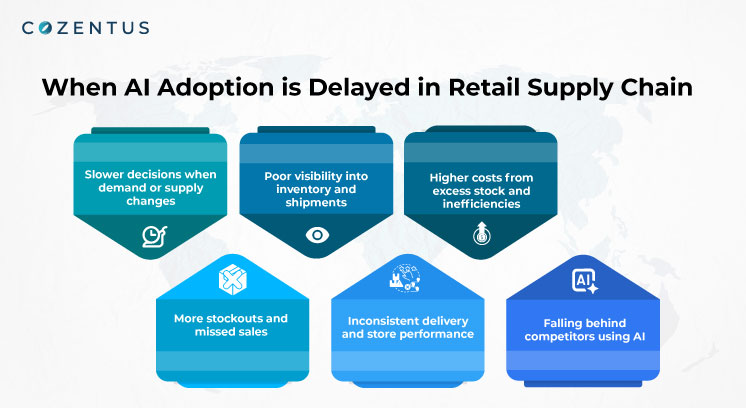
Retailers that are not adopting AI are facing slower decision-making, higher operating costs, and high stockouts. As more retailers use AI to strengthen their supply chains, the performance gap continues to increase, which makes AI adoption a high strategic priority.
How Retailers Adopt AI Without Disrupting Existing Supply Chain Systems
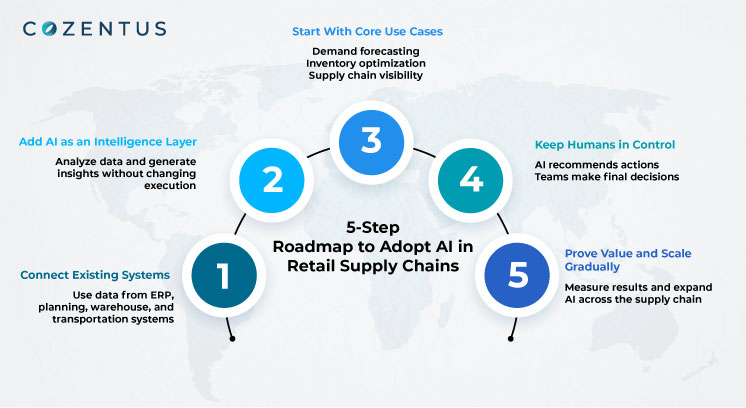
One of the most important trends in retail AI adoption is the layered approach. Retailers keep their existing supply chain systems intact and add AI as an intelligence layer.
- AI connects to current data sources
- AI analyzes patterns
- AI provides recommendations
Execution remains within the systems that the teams already trust. This approach allows retailers to improve decision quality without disrupting daily operations. Planning, inventory, and logistics teams continue working in familiar environments while benefiting from smarter insights and earlier risk detection.
This method offers less operational risk, faster time to value, and higher adoption across different teams. By avoiding large system replacements, retailers gain confidence, protect operational stability, and create a scalable foundation for future AI use across the supply chain.
Automate Retail Supply Chain Documents Using AI
Retail supply chains generate huge amounts of documents every day. These documents move between suppliers, carriers, warehouses, finance teams, and stores. Manual handling slows down operations, increases errors, and limits visibility.
AI helps retailers automate the creation, processing, validation, and analysis of supply chain documents. This reduces manual effort and improves data accuracy without changing core systems.
Common retail supply chain documents that can be automated include:
- Purchase orders and purchase order confirmations
- Sales orders and order acknowledgements
- Advance shipment notices
- Invoices and credit notes
- Bills of lading
- Packing lists
- Delivery receipts and proof of delivery
- Freight bills and carrier invoices
- Customs and compliance documents
- Supplier contracts and rate cards
AI reads both structured and unstructured documents using intelligent document processing (IDP). It extracts key data, validates it against system records, and flags discrepancies early.
Retailers benefit in several ways:
- Document processing becomes faster and more consistent.
- Errors caused by manual entry reduces significantly.
- Data becomes available in real time for planning, finance, and logistics teams.
AI Demand Forecasting and Demand Sensing in Retail
AI demand forecasting is often the first use case retailers implement because it has an immediate and measurable impact. Traditional forecasts rely heavily on historical sales and static assumptions.
AI enhances forecasting by analyzing a broader set of signals such as promotions, seasonality, regional behavior, weather patterns, and near real time sales trends.
Retailers do not need to change their planning workflows. AI-enhanced forecasts feed directly into existing demand planning systems and support planners with more timely and reliable inputs.
Key benefits retailers see include:
- Better forecast accuracy
- Faster reaction to demand shifts
- Reduced excess inventory
- Better alignment between planning and execution
As forecast reliability improves, downstream decisions across inventory, replenishment, and logistics become more predictable, creating a stronger foundation for the entire supply chain.
AI Inventory Optimization Across Stores and Distribution Centers
Inventory optimization is one of the highest value applications of AI in retail supply chains. Retailers manage inventory across multiple locations, including stores, distribution centers, and in transit.
Without AI, inventory decisions are often delayed or based on partial information. AI analyzes inventory positions across the entire network and identifies risks early.
It highlights potential stockouts, excess inventory buildup, and rebalancing opportunities before they impact sales or customer experience. This allows retailers to improve inventory turnover, as well as protect service levels.
Planners get better visibility into where inventory should move and when. This helps in making decisions more consistent, proactive, and aligned with overall demand patterns.
AI-Powered Supply Chain Visibility and Risk Management
Supply chain visibility remains a top priority for retail leaders. As supply chains become more complex, knowing where inventory and shipments are at any given time is critical for reliable operations.
AI-powered real-time shipment visibility also predicts delays, identifies bottlenecks, and flags risks before they impact operations.
By analyzing historical shipment data, carrier performance, and external signals, AI helps retailers move from reactive to proactive management.
Teams gain earlier alerts and clearer context, allowing them to adjust plans, inform stakeholders, and protect service levels.
Planners and logistics teams can focus on high-impact risks instead of reviewing every exception manually. This improves coordination across teams and reduces last-minute decisions that often increase costs or disrupt store operations.
AI in Retail Logistics and Transportation Operations
AI plays an important role in retail logistics and transportation management.
Retail logistics networks are affected by congestion, weather, labor availability, and carrier reliability. AI analyzes these variables to identify risk patterns and support better decision-making.
Logistics teams use AI insights to:
- Anticipate shipment delays
- Improve carrier performance management
- Adjust routes and schedules early
- Reduce last-minute disruptions
Automation is applied selectively. Human oversight remains central to logistics execution.
Human-in-the-Loop AI Works Best for Retail Supply Chains
Retail supply chains operate in dynamic environments where experience and judgment matter. Conditions change quickly with demand, inventory, and logistics, and not every situation can be handled through AI or automation.
Most retailers prefer human-in-the-loop AI models. AI provides recommendations, highlights risks, and gives insights. Humans make final decisions based on context, priorities, and operational realities.
This approach builds trust across teams and ensures accountability. It also improves adoption because teams see AI as a support rather than a controlling tool.
Planners remain responsible for outcomes while benefiting from faster analysis and clearer visibility. Retailers that balance intelligence with human decision-making consistently achieve better results in their day-to-day operations.
Conclusion: How to Successfully Use AI in Retail Supply Chain
Successful AI adoption depends not only on technology, but on how that technology is applied. Retailers benefit most from those AI solutions that integrate with current ERP, planning, warehouse, and transportation systems through flexible data connections.
Coznetus helps retailers by focusing on practical, system-compatible AI capabilities. This includes AI-driven demand forecasting and sensing, network-level inventory optimization, predictive supply chain visibility, logistics risk monitoring, and intelligent document processing (IDP).
These capabilities are designed to work with real-world data variability and support human-in-the-loop decision models. Cozentus also prioritizes scalability, security, and enterprise readiness, which helps retailers to start with targeted use cases and expand AI adoption gradually across the supply chain.
As AI becomes a regular part of retail supply chains, retailers that adopt it with the right systems and the right partners are better prepared to handle complexity, respond to change, and stay competitive.
For custom AI-powered retail supply chain tech, talk to our experts.