Why Some Retailers Win While Others Struggle
Retail success today is shaped long before a customer clicks “Buy Now” or walks into a store.
Customers may see shelves, apps, and checkout counters. What they do not see is the complex supply chain working behind the scenes to make that experience feel simple. When that supply chain works well, everything feels easy. When it fails, the trust is also gone.
Retail leaders are now sensing that supply chain technology is no longer just an operational support tool. It is now more of a strategic advantage.
Smarter supply chain technology helps retailers operate with clarity, speed, and confidence. It turns fragmented operations into connected systems. It transforms reactive teams into proactive decision makers.
This blog breaks down seven clear advantages of smarter supply chain technology in retail, explained in simple and practical terms, with real business impact in mind.
Advantage 1: End-to-End Visibility In Retail Operations
You cannot manage what you cannot see.
One of the biggest challenges retailers face is limited visibility across inventory, shipments, and orders. Data often sits in separate systems, owned by different teams, and updated at different times, making it difficult to understand what is really happening across the supply chain.
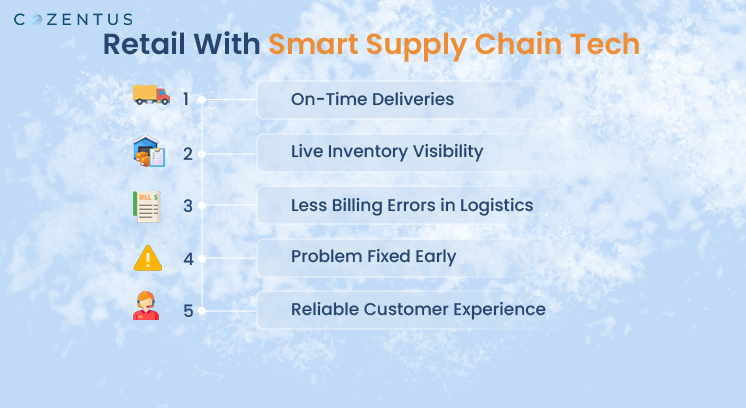
Smarter supply chain technology solves this by connecting data from warehouses, transportation partners, order management systems, and suppliers into a single, unified platform. It continuously updates this information in real time, so teams are always working with the latest and most accurate data.
With real-time visibility and control tower capabilities, retailers get:
- Live tracking of inbound and outbound shipments
- Clear inventory visibility across warehouses, distribution centers, and stores
- Early alerts for delays, shortages, or exceptions
- One version of truth for all teams
For retail leaders, this means less surprises and faster responses. Visibility creates confidence. It allows teams to move from doing guesswork to knowing what to do.
Advantage 2: Faster and Smarter Decision Making
Retail operations generate massive amounts of data every day. The problem is not a lack of data. The problem is knowing what to do with it.
Smarter supply chain technology solves this by continuously collecting data from shipments, inventory systems, carriers, vendors, and financial systems, and then organizing it into a single, reliable view. Advanced analytics and AI models analyze this data in real time, filtering out noise and highlighting what needs attention.
Instead of static reports that explain what happened last week, leaders receive prioritized insights that focus on what is happening now and what should be done next. This includes clear answers to practical questions such as:
- Which shipments need attention right now
- Where are logistics costs increasing
- Which vendors or carriers are underperforming
- What actions will reduce risk or cost today
With AI analytics and Gen-AI dashboards, decision-making becomes faster and more confident. Teams no longer wait for weekly reports. They act in real time.
Advantage 3: Better Control Over Logistics and Freight Costs
Logistics costs are one of the largest and most complex expense areas in retail.
Manual freight audits, delayed invoice processing, and limited cost visibility often lead to overpayments, disputes, and missed savings opportunities. Smarter supply chain platforms address this by digitally capturing shipment, contract, and invoice data in one place, removing manual handoffs and data gaps.
By automatically matching freight invoices against agreed rates, shipment details, and service levels, the system identifies discrepancies in real time. Built-in workflows route exceptions to the right teams for quick resolution, instead of long email chains and delays.
With freight audit and invoice automation, retailers can:
- Detect billing errors automatically
- Reduce overpayments and leakage
- Speed up invoice approvals
- Improve compliance with carrier agreements
This type of control provides more benefits than reducing costs. It also improves trust between finance, operations, and logistics teams as everyone works from the same accurate data.
Advantage 4: Prevent Problems Before They Affect Customers
Every retail supply chain faces disruptions like weather delays, vendor delays, capacity constraints, and system issues.
The difference between average and high-performing retailers is how early they detect issues and how fast they respond. Smarter supply chain technology enables this by continuously monitoring shipments, inventory, and carrier performance in real time, instead of relying on delayed updates or manual checks.
Using predefined rules, AI-driven analytics, and historical patterns, the system automatically flags potential risks before they turn into service failures. It prioritizes issues based on impact, so teams know exactly where to focus first.
Instead of discovering problems after customers are impacted, teams receive early alerts along with recommended actions. This allows them to:
- Reroute shipments before delays escalate
- Adjust inventory plans early
- Communicate clearly with stakeholders
- Protect service levels
Proactive control reduces stress on teams and improves consistency for customers.
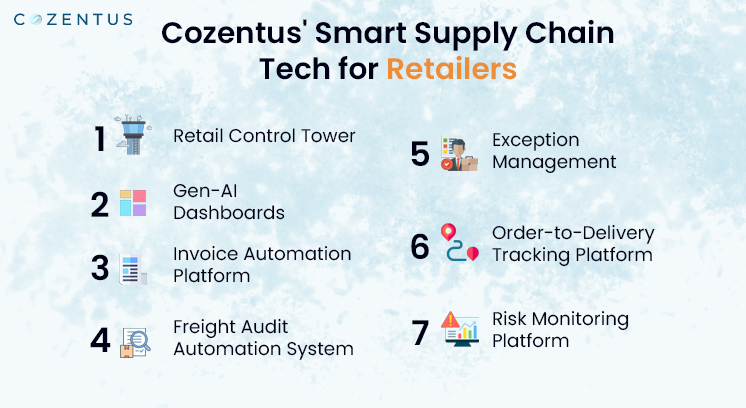
Advantage 5: Better Customer Experience and Brand Trust
Customers may not think about supply chains, but they feel the impact of every delay, error, and stockout.
Smarter supply chain technology improves customer experience by tightly connecting order, inventory, and shipment data, so promises made to customers match what the supply chain can actually deliver. It continuously tracks orders from fulfillment to final delivery. This ensures that issues are identified and corrected before they affect customers.
By using real-time visibility, intelligent alerts, and coordinated workflows, retailers can execute more reliably across channels. This directly leads to:
- More reliable delivery timelines
- Better product availability
- Fewer order errors
- Faster issue resolution
When products arrive on time and as expected, customers trust the brand more. That trust drives repeat purchases and long-term loyalty.
In many retail segments, customer experience has become the strongest differentiator. Supply chain performance plays a central role in that experience.
Advantage 6: Built-In Resilience Against Disruptions
Recent years have shown how fragile retail supply chains can be. Global disruptions, regional events, and operational bottlenecks can quickly impact service levels.
Smarter supply chain technology builds resilience by continuously monitoring internal operations and external signals that can affect supply chain performance. It brings together data from shipments, suppliers, carriers, inventory, and historical patterns to identify risks before they turn into disruptions.
Using predictive analytics and scenario-based insights, retailers can understand where vulnerabilities exist and what impact they may have on service, cost, and inventory. This allows teams to plan alternatives in advance, such as securing backup routes, adjusting inventory positioning, or changing fulfillment strategies.
With risk monitoring and predictive capabilities, retailers can:
- Identify potential disruptions early
- Understand the impact of different risk scenarios
- Take preventive actions before issues escalate
Advantage 7: Stronger Collaboration Across Teams and Partners
Retail supply chains involve many stakeholders, including merchandising, logistics, finance, vendors, and carriers.
When systems are disconnected, collaboration breaks down. Teams rely on emails, spreadsheets, and manual updates, which often lead to partial information, delays, and conflicting decisions.
Smarter supply chain technology improves collaboration by bringing all stakeholders onto a single, shared platform. It centralizes data from orders, shipments, inventory, and invoices, so everyone sees the same information at the same time. Role-based access ensures each team focuses on what matters most to them, while still staying aligned with others.
With unified platforms, teams can:
- Align on priorities
- Share accurate, real-time data
- Reduce manual communication and follow-ups
- Work together to solve problems faster
Closing Thoughts: Where Retail Supply Chain Leaders Go from Here
Stores, online channels, and customers all depend on the supply chain working smoothly every single day. When inventory is visible, shipments move as planned, and issues are handled early, retail operations stay stable, and customers stay satisfied.
The next step for retail leaders is to simplify how supply chains are managed. This starts with having a clear, real-time view of inventory, orders, and shipments across the network. From there, teams need systems that help them spot delays, cost issues, and risks early, so they can act before problems grow. Just as important is giving operations, finance, and logistics teams access to the same accurate data.
Retailers that take this approach are not just solving current challenges. They are building reliable operations that support growth, protect margins, and strengthen customer trust.
For custom supply chain tech, contact us.