You Are Now Entering A New Era of Retail Supply Chains
If you are reading this, you already know that the world of retail supply chains has changed in a big way. What used to be a simple, linear supply chain has now become a connected, real-time ecosystem powered by data, technology, and customer expectations.
Retail leaders are rethinking their entire supply chain technology strategy so they can build long-term advantage, improve resilience, and create a smarter and more agile retail supply chain that supports their business growth.
Across global markets, especially in the U.S., many leading retailers and retail logistics companies are investing in modern supply chain tech, such as visibility solutions, predictive analytics, automation, and AI-driven platforms. They are doing this not just to respond to disruptions, but also to improve customer experience, reduce costs, and strengthen operational performance.
This blog explores the five key ways senior leaders are rethinking retail supply chain technology for long-term advantage with clarity and a futuristic mindset.
Real Reason Retail Leaders Are Rethinking Supply Chain Tech
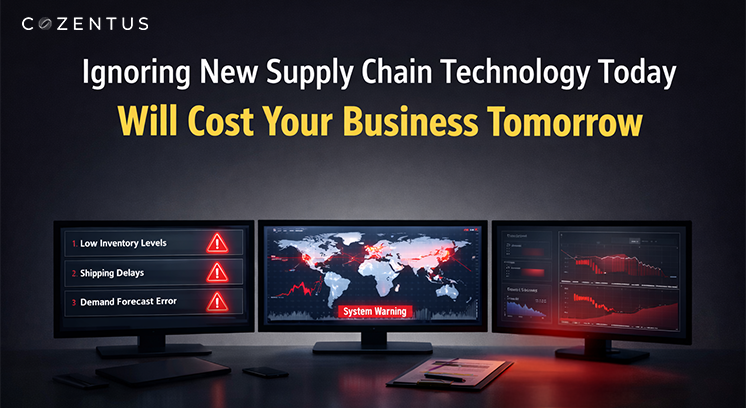
For many leaders, the real change happens when they notice that supply chain problems are no longer small or occasional. Higher logistics costs, changing demand, scattered data, manual reports, and less visibility begin to affect business decisions, customer experience, and overall performance.
At the same time, customer expectations are much higher than before. People today want:
- Faster delivery and better product availability
- A smooth and consistent experience across every channel
- Simple returns and reverse logistics
- Clear updates and real-time order visibility
These are no longer special features. They are basic expectations from the customers.
Because of this, supply chain technology is now discussed at the leadership and board level as well, along with the IT department.
Earlier, the focus was on selecting tools. Today, leaders want technology that helps them make better decisions, improve control, and support long-term strategy.
Future-ready organizations are now building supply chains that are informed, predictable, scalable, partner aligned, and environmentally responsible. This approach separates reactive operations from truly modern supply chains.
5 Ways Retail Leaders Are Transforming Supply Chain Tech
Retail leaders today are prioritizing technology investments that strengthen their business performance. These five areas are the ones where organizations are creating real impact across operations, logistics, and enterprise decision-making.
1. Turning Visibility into Competitive Advantage
One of the most common pain points executives hear from supply chain and operations teams is this: “We don’t see what we need until it’s too late.”
Modern consumers expect products to always be in stock and delivered on time. Yet global disruptions, labor shortages, and fragmented data systems can keep supply chain leaders guessing.
Visibility is now the ability to see inventory, shipments, exceptions, and demand signals in real time. That too, without manual data pulls or siloed systems.
What Leaders Are Doing Differently
Today’s leaders are investing in platforms that unify data across:
- Inventory systems
- Transportation and logistics partners
- Supplier networks
- Demand data from stores and eCommerce
By consolidating this data into a single source of truth, teams can spot bottlenecks early, share insights across various functions, and respond with absolute precision.
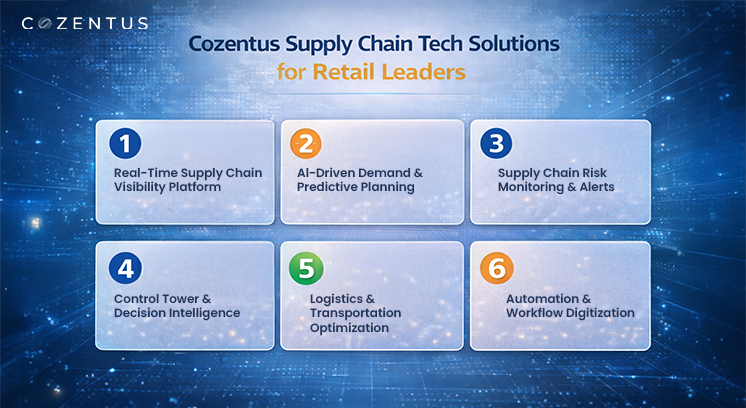
At Cozentus, we help our clients add real-time visibility technologies with advanced analytics, which helps leaders get accurate data for proactive decision-making.
2. Predictive Tech and AI for Smarter Planning
Forecasting earlier was mainly a quarterly spreadsheet activity. But in today’s retail environment, leaders need forecasting that can adjust daily or even hourly, based on demand changes and supply challenges.
AI and predictive analytics are helping make this possible. With machine learning and intelligent algorithms, companies can forecast demand more accurately, optimize inventory across locations, and identify potential supply disruptions before they occur.
Impact in U.S. Retail Logistics
Across the United States, many retail and logistics companies are testing and adopting AI-based planning tools that combine internal business data with broader market trends such as weather patterns and customer behavior. This approach helps improve forecast accuracy, reduce waste, lower stockouts, and improve inventory turns, which ultimately leads to better customer experience and stronger business performance.
3. Automation That Scales Operations
Automation is not only about robots in warehouses. It is about reducing manual work across the entire supply chain. From planning and procurement to warehousing, fulfillment, and transportation. Workflow automation tools help retail operations scale efficiently, all while controlling costs and improving process accuracy.
Automation technologies, especially in warehouse management and fulfillment operations, are consistently recognized as key trends that reshape the industry and improve operational productivity.
Leaders mostly focus their automation investments here:
- Warehouse robotics and conveyor systems to speed order fulfillment
- Process automation to remove repetitive and manual tasks
- Automated carrier scheduling and route planning to reduce delivery costs and turnaround time
When automation works together with real-time data and operational intelligence, it creates a supply chain that scales smoothly with demand.
4. Smart Collaboration with Partners and Suppliers
No matter how strong your internal technology stack is, long-term success depends on how well you collaborate with the entire ecosystem, which includes the suppliers, 3PLs, carriers, and even customers.
Retail leaders are now implementing collaborative planning frameworks and technology that keep partners aligned across:
- Forecasting data
- Production schedules
- Inventory levels
- Returns and exceptions
Collaborative technology tools help teams and partners work on the same plan, see the same information, and respond quickly when business conditions change.
Companies that involve suppliers in planning reduce blind spots, improve replenishment speed, and deliver products to customers more reliably.
5. Sustainability as a Tech-Driven Strategy
Consumers and B2B partners are mostly holding brands accountable for environmental and social impacts. A retail supply chain that ignores sustainability technology finds itself at a competitive disadvantage.
AI and analytics help companies track emissions, identify waste areas, and optimize logistics routes for both cost and carbon efficiency.
The Strategic Advantage
- Lower transportation and inventory costs
- Better ESG performance reporting
- A more resilient supply chain ecosystem
Closing Thoughts: What Should Retail Supply Chain Leaders Do Next
The retail supply chain is one of the most important strengths a business has. It directly influences cost, customer experience, business growth, and overall competitiveness. When the supply chain is strong, the business becomes stronger with it.
Retail leaders who focus on real-time visibility, predictive analytics, automation, partner collaboration, and sustainability are not just fixing short-term challenges. They are building supply chains that will support long-term growth and future expansion.
At Cozentus, we help organizations bring their data together, automate key workflows, and enable smarter decision-making across operations. Our goal is to help teams run their supply chains with more confidence and clarity, so technology becomes a real business advantage.
For highly productive custom supply chain tech, Talk to our experts.