Every Leader Wants AI in Their Supply Chain Operations
Imagine waking up one day and seeing your supply chain running itself. Orders are filled before inventory runs low. Logistics routes adjust automatically to weather and congestion. Procurement risks are flagged weeks ahead. That is the promise of Artificial Intelligence (AI) in enterprise supply chain technology. But for most enterprises, especially in logistics and supply chain functions, the reality is not that simple yet.
AI is often discussed as if it will completely automate planning, remove uncertainty, and make supply chains self-driven. Yes, AI can significantly improve efficiency, decision-making, visibility, and responsiveness. But it also brings constraints, real operational costs, and dependencies on data, engineering, and governance.
This blog is for the leaders who are evaluating AI as a strategic investment in their digital transformation and supply chain modernization journey. We will make AI in supply chain tech easy to understand and actionable.
AI Education – What It Really Means to Have AI in Tech
The first step in understanding AI in supply chains is to define what it actually means in your technology stack.
At its core, AI refers to systems that can learn from data, spot patterns, predict outcomes, and in some cases recommend or automate decisions. Unlike traditional rule-based software, AI is built around algorithms that improve with exposure to more data.
In supply chain terms, AI can help with forecasting demand, optimizing inventory, planning logistics, managing routes, improving supply chain efficiency, and providing real-time risk insights.
What AI Can Do in Supply Chain Operations
AI brings tangible capabilities that business leaders care about, especially in digital supply chain transformation and logistics operations:
-
Better Forecasting and Predictive Analytics
AI can analyze vast amounts of historical and real-time data to forecast demand, inventory requirements, and even supply disruptions. This reduces guesswork and improves service levels across the network, supporting more resilient and data-driven supply chain planning.
-
Route and Logistics Optimization
AI models can optimize delivery routes by considering real-time conditions like traffic, weather, and carrier performance. This means lower fuel costs, faster delivery times, and better logistics efficiency.
-
Enhanced Visibility Across Supply Chain Nodes
With AI-powered supply chain visibility, leaders can get a clearer picture of inventory, shipments, and supplier performance across the ecosystem. These are not just snapshots, but predictive trends and operational insights.
-
Automated Repetitive Tasks
AI can automate repetitive processes like invoice processing, order matching, data entry, and shipment status notifications, freeing teams to focus on higher-value work, process optimization, and strategic initiatives.
-
Proactive Risk Detection and Exception Management
AI can identify early warning signals across shipments, routes, suppliers, and inventory movements before they turn into operational disruptions. By analyzing patterns such as recurring delays, route instability, supplier variability, and demand spikes, AI helps teams act sooner instead of reacting later.
What AI Cannot Do (Yet)
Despite the hype around AI in supply chain automation, AI is not magical. It has clear limits:
-
It Does Not Replace Human Judgment Entirely
AI outputs are only as good as the data and rules behind them. Complex negotiations, strategic decision-making, and supplier relationships still require human leadership and business context.
-
AI Must Be Trained and Governed
AI needs carefully curated data, model governance, and responsible AI oversight. Poor data quality or unmanaged models can lead to errors and risky outcomes.
-
Not All Use Cases Are Equally Valuable
Deploying AI blindly everywhere doesn’t always work. Some use cases offer efficiency gains. Others can transform operations, but only when they are aligned with the right business goals and enterprise supply chain priorities.
-
AI Cannot Fix Broken Processes or Poor Data Discipline
AI cannot deliver meaningful results if core supply chain processes are inconsistent, undocumented, or manually driven. If data is fragmented across systems, entered inconsistently, or not governed properly, AI insights will be unreliable.
What Type of Costs Are There for AI?
Implementing AI is more than flipping a switch. There are real transactional and ongoing costs to consider when adopting AI in supply chain technology.
1. Initial Implementation Costs
This includes:
-
Software and Licensing:
Leading AI platforms or custom enterprise AI models come with subscription or development costs. These can range from moderate to significant depending on scale and deployment approach.
-
Data Engineering and Integration:
AI needs clean, accessible, and standardized data from across ERP, TMS, WMS, and other enterprise systems. Data preparation often represents a sizable upfront investment in digital infrastructure.
-
Infrastructure:
Cloud compute, storage, and security frameworks to host AI models and ensure responsiveness and reliability.
-
Talent Acquisition or Third-Party Partners:
Building or buying AI expertise is expensive. Data scientists, machine learning engineers, and AI architects command premium salaries. Some firms also choose to work with AI implementation partners for strategy and buildout.
2. Ongoing Transactional Costs
AI requires continuous investments with:
-
Model Training and Retraining:
AI models must be updated with fresh data to stay relevant and accurate.
-
Support and Maintenance:
You will need ongoing technical support, monitoring, and performance tuning to ensure AI systems deliver consistent business outcomes.
-
Governance and Compliance Costs:
As AI decisions influence operations, enterprises need frameworks to manage bias, explainability, security, and regulatory compliance across the supply chain.
3. Hidden or Operational Costs
These costs are often overlooked:
-
Change Management and Training:
Teams must learn new workflows and trust AI outputs to effectively leverage AI-driven supply chain intelligence.
-
Downtime During Adoption:
Implementing AI across core processes may temporarily slow operations as teams adapt and processes stabilize.
What Does AI Mean for Engineering Teams? Are They Still Needed?
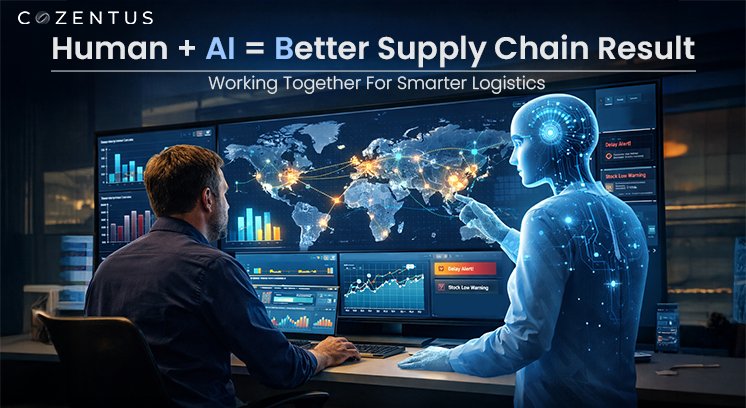
Many leaders worry that AI might replace technical teams. But the reality is the opposite. Engineering teams are still essential, and in an AI-driven organization, their role actually becomes more strategic.
1. Engineers as Enablers
Engineering teams will:
-
Design and integrate AI systems: AI does not plug into legacy systems by itself. Engineers ensure the right data flows, the right models run, and the right APIs connect systems to support scalable enterprise AI adoption.
-
Build custom solutions or tailor platforms: Even pre-built AI tools need customization to your workflows and enterprise architecture.
-
Ensure reliability, performance, and security: Engineers build resilience and safety structures so that AI tools deliver consistent business outcomes across supply chain operations.
2. The Role Shifts from Routine to Strategic
Rather than maintaining manual pipelines or mundane code, engineers become enablers of innovation. They focus on:
Data strategy and architecture: Cleaning, governing, and activating data for AI insights and enterprise analytics.
Model evaluation and ethics: Assessing model performance, bias, governance, and operational risk.
Monitoring and optimization: Ensuring AI systems continue to deliver expected business results.
So, while AI may automate specific tasks, it amplifies the need for experienced engineers who can guide, monitor, and scale it effectively across complex supply chain environments.
How Supply Chain Enterprises Should Use AI
1. Use AI to Lower Costs
Your AI initiatives should map to measurable outcomes such as:
-
Reduced stockouts and better service levels: AI demand forecasting can reduce buffer stock and holding costs.
-
Lower logistics costs through optimization: Smart routing and carrier selection decisions with AI can reduce transportation costs.
-
Greater supply chain resilience: AI can signal risk early before disruptions hit operations and customer service.
2. Start Small and Scale Quickly
Most successful implementations start small with focused pilot projects before rolling out AI across different functions and geographies. For example, improving demand forecasting in a specific region, or rerouting logistics in a high-variability lane, before rolling out AI across functions and geographies.
3. Manage Risk with Governance
Establish frameworks for model testing, performance monitoring, and ongoing human oversight. AI should inform decisions but not control critical workflows without accountability.
4. Focus on Data Readiness Before Advanced AI Adoption
AI works best when the underlying data is clean, consistent, and accessible across systems. Before scaling AI initiatives, enterprises should strengthen data quality, integration, and governance. When master data, transaction data, and operational events are structured well, AI insights become more reliable and easier for teams to trust and use in day-to-day decisions.
5. Keep Humans in the Loop for Critical Decisions
Even when AI provides predictions or recommendations, final judgment should remain with business and operations teams. Human oversight ensures decisions are aligned with commercial priorities, market conditions, and customer commitments.
Conclusion – The Future of AI in Enterprise Supply Chain Tech
AI is real, powerful, and delivering measurable results in supply chain technology today. But it works because of an effective strategy, quality data, skilled engineers, and business leadership that sets clear goals.
When you treat AI as a strategic tool (not a magic wand), it becomes a competitive advantage that improves resilience, efficiency, visibility, and insight. The key is to understand both its capabilities and its limits. Budget properly and scale your organization along on the AI journey.
AI will shape supply chains for years to come. But the most successful leaders will be those who use it thoughtfully, with people and business outcomes at the center.
For next-gen AI-driven supply chain tech solutions, talk to our expert.