Generic AI is Slow for Changing Logistics
Every logistics leader today is under pressure to operate faster, cleaner, and more predictably, even when the world is anything but predictable. On one side, you have disruptions that are becoming normal. On the other side, you have customers who expect perfection.
So naturally, the market rushed toward AI.
The promise was simple: More automation, less surprises.
But somewhere along the way, leaders realized something important. “AI is only as good as its understanding of the domain it operates in.”
And most AI today does not understand freight. It understands words. It understands patterns.
But it does not understand the difference between an appointment delay and a customs hold, or how a small error in freight billing can multiply across thousands of shipments.
This gap is exactly what is shaping the next major leap in logistics technology. Domain-specific AI models trained on supply chain data, rules, patterns, and real-world freight behaviour.
Why Generic AI Cannot Solve Logistics Problems
Generic AI is trained on broad business content. It does not know how logistics operates in the real world.
So, when it analyzes shipment data, it may miss:
- The reason a delay code matter
- The context behind an exception
- The pattern behind repeated accessorial charges
- The interaction between weather and lane performance
Without domain knowledge, AI cannot help with decision-making.
It cannot differentiate noise from signal
- A missed scan might be normal on one lane.
- A missed scan on another lane might be the first sign of a service failure.
Only domain-trained AI can identify the difference. Generic AI treats everything equally.
It does not help the team take action
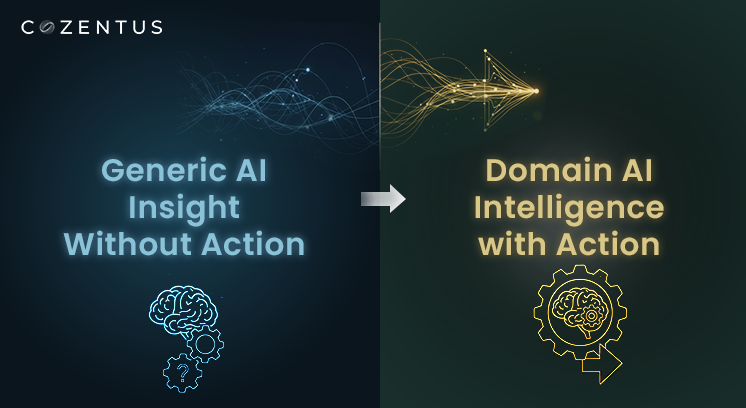
Leaders today want AI that removes manual effort. But most AI stops at telling you what happened. It does not tell you what to do next.
Domain-specific AI instead recommends:
- When to rebook
- When to escalate
- Which carrier to shift volume to
- Which invoice line item is incorrect
- Which supplier risk needs immediate attention
That is the difference between insight and intelligence.
Why Domain-Specific AI Is the Future of Logistics Intelligence
Generic AI can describe data, but logistics teams need systems that can interpret it and act on it. This shift is pushing the industry rapidly toward domain-specific models that are built for real freight challenges.
-
Industry Data is too Complex for Generic Tools
Supply chains generate enormous data volume. But more importantly, the data is messy. Carrier statuses. Supplier files. Port updates. GPS events. Tariffs. Audit rules. Exception codes.
Generic tools cannot interpret these. Domain AI learns from them.
-
The Future Requires Predictive Operations
Visibility is no longer enough. Leaders want to know what will go wrong before it goes wrong.
Domain AI predicts:
- High-risk shipments
- Delays based on lane patterns
- Supplier performance dips
- Cost anomalies
- Capacity shortages
-
AI Must Learn from Tribal Knowledge
Your most experienced team members know your lanes, your carriers, and your bottlenecks. Domain AI captures this intelligence and scales it. This is how companies become resilient, even when talent shifts.
-
Logistics Decisions Depend on Real-World Nuance
In logistics, no two shipments follow the exact same pattern. Weather, lane habits, carrier behaviour, cut-off times, and even local handling practices all influence outcomes. Domain-specific AI understands these day-to-day nuances and gives recommendations that feel realistic, not theoretical. This leads to decisions teams can actually trust and act on.
-
Supply Chains Move Fast, So Intelligence Must Move Faster
Problems like delays, rate errors, or capacity shortages escalate quickly. Generic AI often spots them too late or misinterprets the signal. Domain-trained AI recognizes early signs of trouble, guides teams on the next steps, and helps prevent issues before they disrupt customers. It upgrades operations from reactive firefighting to proactive control.
What Logistics Leaders Get with Domain AI
-
Faster Decision Making
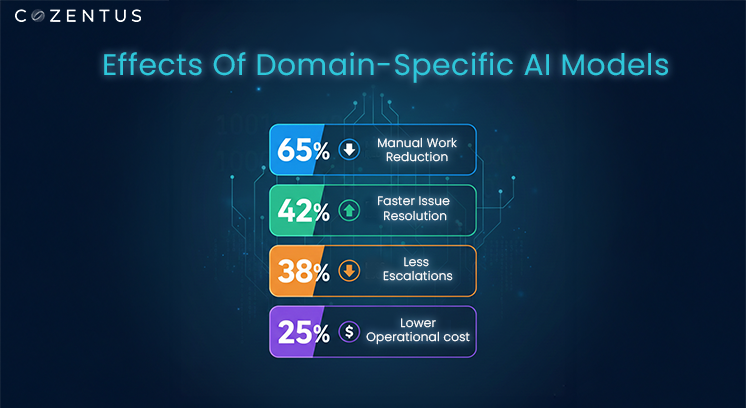
Teams no longer spend hours interpreting complex logistics data because domain-specific AI analyzes, prioritizes, and explains insights instantly. This allows leaders to make confident, accurate decisions in far less time.
-
Less Exceptions Escalate
Predictive intelligence identifies early warning signals across lanes, carriers, and shipments. This helps teams act before issues grow, reducing firefighting and preventing exceptions from turning into customer-facing problems.
-
Lower Operational Cost
With accurate billing checks, better carrier performance insights, and reduced manual intervention, domain AI eliminates hidden leakage and unnecessary spend. This creates measurable cost savings across freight, operations, and service.
-
Better Customer Experience
Shipments reach customers on time more consistently because risks are predicted in advance and resolved early. When issues do occur, teams respond quickly with clear, informed actions that protect the customer relationship.
-
Competitive Advantage
The market will not reward organizations that simply adopt AI quickly. It will reward those who adopt logistics-focused intelligence that improves decisions, strengthens resilience, and drives operational excellence ahead of competitors.
Cozentus Domain AI Models Create Real Impact
With decades of deep domain knowledge, Cozentus builds custom AI solutions that are trained on real logistics behaviour. Each platform is designed to solve the exact challenges shippers face every day.
-
Real-time Shipment Visibility
Many visibility tools show statuses. But Cozentus’s custom-made shipment visibility platform interprets them.
It understands the difference between:
- Normal dwell time
- Risky dwell time
- Carrier reliability patterns
- Seasonal variation
- Port congestion triggers
Instead of simply sending alerts, it prioritizes what truly needs attention.
-
Freight Audit that Reduces Manual Work by at Least 60%
Billing accuracy is a major challenge for shippers. Generic tools catch basic errors. Cozentus freight audit platform identifies deeper patterns.
It understands:
- Tariffs
- Accessorial contracts
- Freight classes
- Minimum charge rules
- Rate logic
This is how companies save millions without touching operations.
-
Risk Monitoring that Predicts Issues Before They Happen
Risk is not just disruption. Risk is predictability.
Cozentus’ risk monitoring platform tracks:
- Lane volatility
- Supplier reliability
- Weather impact
- Geopolitical alerts
- Inventory exposure
It connects these signals to operational decision-making. And leaders gain the foresight they always wanted.
-
Testing-as-a-Service to Ensure AI-enabled Systems Actually Work
AI delivers value only when the systems behind it operate reliably across real-world conditions. Cozentus Testing-as-a-Service simulates complex logistics workflows, integrations, and edge cases.
It validates:
- End-to-end system behaviour
- Exception handling logic
- High-volume transaction performance
- Integration stability
- AI model output consistency
This approach prevents failures before deployment and ensures your digital ecosystem performs flawlessly when your operations depend on it most.
-
Strong Data Engineering Foundation
Every advanced AI needs clean, structured, logistics-ready data. Cozentus builds robust data pipelines, harmonizes fragmented datasets, and enforces the standards needed for accurate insights.
Our teams handle:
- Event normalization
- Carrier data standardization
- Multi-region data mapping
- Master data management
- Scalable data architecture
This foundation ensures every AI model learns from high-quality inputs and produces reliable predictions and insights that teams can trust across global operations.
The Future: AI That Speaks Freight Will Redefine Logistics
The next wave of logistics innovation will not be driven by tools that do everything. It will be driven by tools that understand one thing deeply.
The companies that win will be the ones that adopt AI models that:
- Understand logistics
- Learn from shipment behaviour
- Predict disruptions
- Automate decision making
- Eliminate cost leakage
- Scale expertise
Cozentus is committed to building this future. A future where AI truly understands your world.
A future where logistics intelligence is not optional, but essential.
For further details, book a quick meeting.