

Why Retailers Are Rebuilding Supply Chain Technology
For many years, retail supply chains were managed mainly to control costs. Technology helped move products from suppliers to stores and warehouses, and that was usually enough. Systems focused on basic operations like tracking, reporting, and execution, with limited flexibility or intelligence built into them.
But retail has changed significantly over the last decade. Customers now expect fast delivery, accurate inventory information, and constant order updates across multiple channels. Retailers now operate across physical stores, eCommerce platforms, marketplaces, and regional fulfillment centers. At the same time, disruptions in logistics and transportation are common and unpredictable.
To grow and stay competitive, retailers are heavily investing in modern supply chain technology. These investments help improve visibility, speed up decision-making, reduce operational risk, and support better customer experiences. Supply chain technology is becoming a key driver of retail growth, profitability, and long-term resilience.
Traditional Retail Supply Chain Technology Challenges
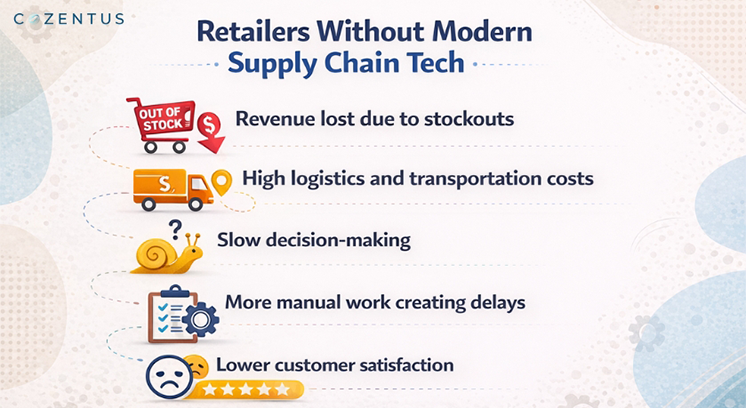
Many retailers still rely on older supply chain systems that were not designed for today’s retail environment. These systems often operate in silos and depend heavily on manual coordination between teams and partners.
Common challenges include:
- Limited supply chain visibility across shipments and inventory
- Delayed data that arrives after issues have already occurred
- Manual coordination with carriers and logistics providers
- Difficulty managing exceptions, delays, and disruptions
- Lack of integration between inventory, transportation, and order systems
These challenges slow down operations and increase costs. They also make it harder for retailers to respond quickly to changes in demand, supplier performance, or transportation capacity. Over time, they limit a retailer’s ability to scale efficiently and compete with more agile players.
Why Retailers Are Investing in Supply Chain Digital Transformation
Retail supply chain transformation is driven by clear and growing business needs. Retailers face pressure from customers, competitors, and internal stakeholders to perform better across every channel.
Key drivers include:
- Growing customer expectations for fast and reliable delivery
- Expansion of omnichannel and distributed fulfillment models
- Increasing transportation, warehousing, and logistics costs
- Higher demand volatility and supply chain risk
- Competitive pressure from digitally advanced retail brands
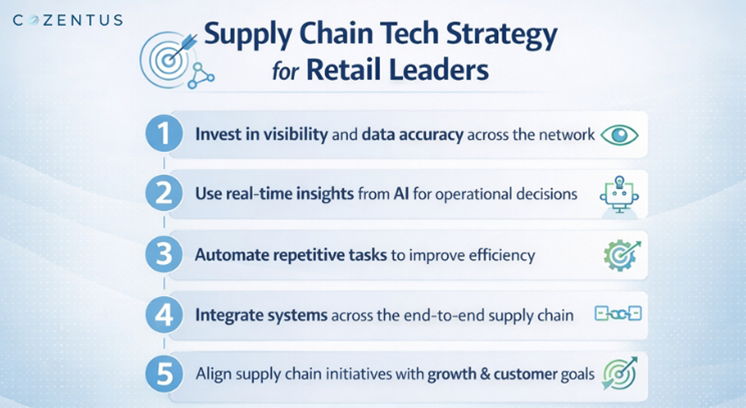
Modern supply chain technology helps retailers manage these pressures through better data, automation, and control. Retailers that invest early in tech build stronger foundations for growth, scalability, and long-term performance across their operations.
Supply Chain Visibility Technology for Retail Operations
Supply chain visibility is one of the most important capabilities for retail operations. Visibility tools help retailers to see what is happening across the supply chain at any given moment.
Core visibility capabilities include:
- Real-time shipment tracking across carriers and transport modes
- Inventory visibility across warehouses, stores, and fulfillment centers
- Order status updates across multiple systems
- Early detection of delays, risks, and exceptions
- Centralized dashboards for supply chain and logistics teams
With better visibility, retail teams can respond faster to issues, reduce delays, and improve coordination with logistics partners. Visibility also gives leadership teams confidence in decision-making and planning during peak seasons and times of disruption.
Using Real-Time Supply Chain Data for Better Decisions
Retail supply chains generate high volumes of data every day. The challenge is turning this data into insights that teams can use immediately.
Modern supply chain platforms provide:
- Real-time alerts for shipment delays and disruptions
- Early warnings for inventory shortages and imbalances
- Prioritization of high-value, time-sensitive orders
- Performance insights across transportation and fulfillment operations
Real-time data helps retail teams to act while outcomes can still be changed. This improves service levels, reduces escalation effort, and helps teams stay focused on the most critical issues that affect customers and revenue.
Automation in Retail Supply Chain and Logistics Operations
Automation helps retailers manage scale and complex operations. As order volumes grow and networks expand, manual processes become highly difficult to maintain.
Retailers use automation to support:
- Shipment status updates and milestone confirmations
- Exception management and workflow routing
- Inventory reconciliation across systems and locations
- Carrier performance and transportation analytics
Automation reduces repetitive work and improves accuracy across supply chain operations. It also frees up skilled supply chain professionals to focus on planning, optimization, and continuous improvement initiatives that support long-term growth.
Supply Chain and Logistics Documents That Can Be Automated
Retailers can automate a wide range of operational and compliance-related documents to reduce manual data entry, minimize errors, and speed up information flow across the supply chain. The documents that can be automated using tech like the intelligent document processing (IDP) are:
- Purchase orders and order confirmations
- Advanced shipping notices
- Bills of lading and shipping manifests
- Delivery notes and proof of delivery documents
- Invoices and freight bills
- Carrier contracts and rate cards
- Customs and trade compliance documents
- Inventory movement and transfer documents
- Exception and incident reports
- Performance and service-level reports
Integrated Supply Chain Systems for Retail Growth
Retail supply chains rely on multiple systems for inventory management, transportation management, order processing, and planning. When these systems are not integrated, data becomes fragmented and unreliable.
Integrated supply chain systems offer:
- A single source of truth across retail operations
- Better coordination between planning and execution teams
- Faster response to changes in demand, supply, or capacity
- Improved collaboration across supply chain, merchandising, and customer service
Integration supports scalability and ensures that supply chain decisions align with the retail business goals. This includes growth, service performance, and profitability.
Supply Chain Technology and Retail Customer Experience
Supply chain performance directly affects customer experience at every point. Availability, delivery reliability, and communication shape how customers see a retail brand.
Modern supply chain technology supports:
- Accurate product availability and delivery promise dates
- Improved order fulfillment reliability
- Better communication during delays or disruptions
- Higher on-time delivery performance
When supply chain data is connected to customer-facing systems, retailers improve transparency and trust. This leads to higher customer satisfaction, stronger loyalty, and more repeat purchases.
Predict Risks Early with Modern Technology
Disruptions across transportation, sourcing, and demand are now part of everyday retail operations. Technology helps retailers prepare for and respond to these challenges effectively.
Resilience is supported through:
- Early risk detection and proactive alerts
- Scenario planning and impact analysis tools
- Flexible fulfillment and routing options
- Strong coordination with logistics and supply partners
Resilient supply chains recover faster and continue maintaining their services even during unexpected events. This type of capability protects revenue, reduces customer impact, and strengthens brand reputation over time.
How to Measure Retail Supply Chain Performance
Retailers are changing the way they now evaluate supply chain performance. Cost control remains important, but it is measured along with service and growth metrics.
Key performance indicators include:
- On-time and in-full delivery performance
- Inventory availability, accuracy, and turnover
- Order fulfillment speed and accuracy
- Customer service and satisfaction metrics
- Overall supply chain responsiveness
These metrics provide a clearer view of business value and help retailers justify ongoing investment in supply chain technology initiatives.
Conclusion: Choosing the Right Tech Partner is More Crucial Than the Tech Itself
Retail supply chains are becoming more complex and more critical to business success. Retailers that invest in modern supply chain technology get better visibility, faster decision-making, stronger resilience, and improved customer experiences. Those that delay face increasing operational risk and competitive pressure.
Cozentus helps retailers modernize and strengthen their supply chain operations with custom technology designed for real-world retail challenges. Our solutions focus on supply chain visibility, real-time data, automation, and system integration across logistics, inventory, and fulfillment.
Cozentus combines deep retail domain expertise with strong technical capabilities. We work closely with retail teams to improve operational control, reduce risk, and support scalable growth.
For retailers looking to stay ahead of competitors and turn supply chain operations into a strategic advantage, Cozentus is the partner they can rely on. Book a meeting.