The Decisions That Keep Leaders Awake
Every senior leader in the supply chain faces the same question in different forms.
- What if we change this?
- What if we reroute shipments?
- What if we reduce inventory?
- What if we choose a greener option?
- What if we promise faster delivery?
Each decision looks simple individually. But in reality, every change creates ripple effects across cost, service levels, and environmental impact. Improving one of them can highly disturb the others, and in ways you might not anticipate.
For years, businesses relied on static reports, spreadsheets, and experience to answer these questions. That worked when systems were slower and networks were simpler. It does not work anymore.
Today, networks are dynamic, global, and deeply interconnected. Small disruptions can create large consequences. This is where AI-driven “what if” scenario analysis is changing the game.
AI does not just show you what happened. It helps you explore what could happen. And more importantly, it helps you choose the best path forward.
What Is AI-Based “What If” Scenario Planning
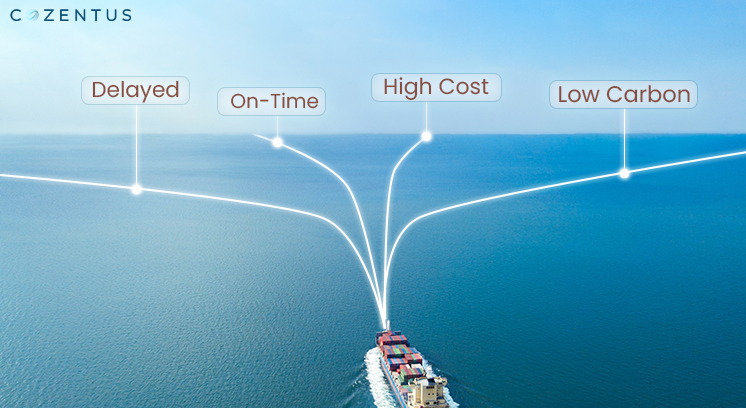
AI-based scenario planning is the ability to simulate multiple future outcomes before making a decision. Instead of relying on a single forecast, AI models create thousands of possible situations based on real data, patterns, and probabilities.
For example, a traditional system might say: “Delivery will take 5 days.”
An AI-powered system says:
- There is a 70% chance it will take 5 days.
- A 20% chance it will take 7 days due to port congestion.
- A 10% chance it will be delayed further due to weather conditions.
Now put this thinking across cost, service commitments, and carbon emissions.
AI can simulate:
- Different routing options
- Different suppliers
- Different inventory strategies
- Different transportation modes
Each scenario comes with its own impact on cost, service levels, and sustainability. This allows leaders to make decisions with better clarity rather than vague assumptions.
Why Traditional Planning is not Effective Anymore
Most organizations still rely on tools that were not designed for uncertainty. Static planning systems assume stable conditions, which is why they struggle when:
- Demand fluctuates
- Supply is unpredictable
- Transportation networks face disruptions
- Sustainability goals add new constraints
These systems typically provide one answer. But in reality, there is never just one outcome. This creates three major challenges:
- Limited Visibility: Leaders cannot clearly see how one decision affects the entire network. Many impacts stay hidden and only show up later as unexpected problems.
- Delayed Response: By the time issues appear on dashboards, it is often too late to act in the right way. Teams end up reacting instead of preventing, which increases cost and pressure.
- Trade-Off Blindness: Improving cost can hurt service, and improving service can increase carbon emissions. These trade-offs are not always obvious up front and usually become clear only after the damage is done.
AI addresses all three challenges by turning planning into a dynamic, predictive process.
How AI Runs “What If” Scenarios
AI uses a combination of machine learning, optimization algorithms, and simulation techniques to evaluate multiple possibilities.
Here is how it works in simple terms.
Step 1: Data Integration
AI systems bring together data from the entire ecosystem, including:
- Demand patterns
- Supplier performance
- Transportation data
- Weather and external signals
- Cost structures
- Emission factors
The more connected the data, the more accurate the scenarios.
Step 2: Pattern Learning
Machine learning models study historical behavior and identify patterns.
They understand:
- Where delays typically occur
- How costs fluctuate
- Which routes are more reliable
- What conditions increase carbon emissions
This creates a strong foundation for prediction.
Step 3: Scenario Simulation
AI generates multiple scenarios by changing variables.
For example:
- What if we shift from air to ocean freight
- What if we source from a different region
- What if demand spikes by 20%
Each scenario is evaluated in seconds.
Step 4: Multi-Objective Optimization
This is where AI becomes powerful. Instead of optimizing only cost, AI balances multiple objectives at once, such as:
- Minimize cost
- Maximize service levels
- Reduce carbon emissions
It identifies solutions that offer the best possible balance across all three.
Step 5: Decision Recommendations
AI provides clear options with possible outcomes, such as:
- Best cost-efficient option
- Best service-focused option
- Best sustainability-driven option
- Balanced option across all metrics
This allows decision-makers to choose based on their business priorities.
How AI Balances Cost, Service, and Carbon Emission
This is the core challenge for modern enterprises. Let’s break it down.
Cost Optimization
AI helps identify:
- Lower-cost routes
- Efficient load planning
- Better supplier combinations
- Reduced penalties and delays
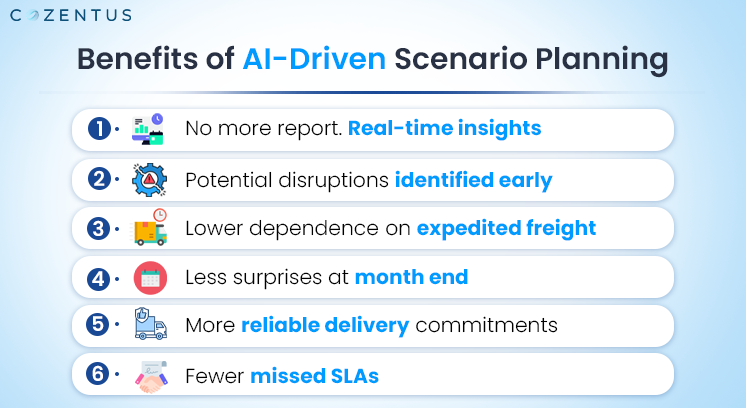
It ensures that cost savings do not come at hidden risks.
Service Level Improvement
Service is about reliability and speed. AI improves service by:
- Predicting delays early
- Suggesting alternative actions
- Ensuring commitments are realistic
- Aligning inventory with demand
This leads to fewer surprises and stronger customer trust.
Carbon Reduction
Sustainability is not optional anymore. AI calculates carbon emissions across different scenarios and highlights sustainable options, such as:
- Switching transport modes
- Optimizing routes
- Reducing empty miles
- Improving asset utilization
It makes sustainability measurable and actionable.
Real-World Application in Supply Chain and Logistics
Here’s a practical context that most leaders will relate.
Imagine a global supply chain network. A company needs to ship goods from Asia to North America.
Scenario “Without” AI
- Decision is based on lowest cost route
- Shipment faces unexpected port congestion
- Delay leads to missed delivery commitments
- Expedited shipping is used later, increasing cost and emissions
Scenario “With” AI
- AI evaluates multiple options before shipment
- Route A is the cheapest but has a high congestion risk
- Route B is slightly more expensive but more reliable
- Route C reduces emissions but adds one day to transit
AI presents a balanced recommendation: Route B offers the best combination of cost, service, and carbon impact.
The company avoids delays, controls costs, and reduces environmental impact.
How to Start Your AI Scenario Journey
For organizations considering this approach, the path does not need to be complex. What matters is starting with the right focus and building capability step by step. AI-driven scenario planning works best when it is applied to real decisions, not as a standalone experiment.
1. Start with a High-Impact Use Case
Begin with decisions that have a clear cost, service, or operational impact. This could be routing, inventory positioning, or supplier selection. These areas generate enough data and variability for AI models to learn patterns and simulate meaningful scenarios. Starting here also helps validate the model against real business outcomes.
2. Ensure Data Readiness
AI models depend on structured and connected data. This includes historical transactions, operational events, and external signals such as delays or disruptions. Data does not need to be perfect, but it must be consistent and integrated across systems. This allows the model to capture dependencies and generate reliable scenario outputs.
3. Choose Scalable AI Solutions
This is where Cozentus can help. Use platforms that support continuous learning, simulation, and optimization at scale. As more data flows in, the models should update and improve automatically. The system should also be able to handle increasing complexity without redesigning.
4. Align Teams and Objectives
Scenario planning involves multiple trade-offs. Cost, service, and sustainability need to be evaluated together. This requires shared metrics and a common decision framework across teams, so that outputs from the AI model translate into actionable decisions.
5. Measure and Iterate
Track how decisions perform against predicted outcomes. Feed this data back into the models to improve accuracy. Over time, the system becomes more precise, which will allow faster and more confident decision-making.
Conclusion: Using AI Effectively is the Key
Cost pressures continue to rise, customer expectations are higher, and sustainability is now a board-level priority. In this kind of environment, relying on static planning or past experience is no longer enough.
AI-driven “what if” scenario planning gives leaders the ability to see beyond a single outcome and understand the full impact of their choices before acting. Instead of reacting to disruptions, organizations can now predict them.
Planning becomes dynamic. Decisions become data-driven. And outcomes become more predictable.
In supply chain and logistics, where even small decisions can affect cost, service, and carbon emissions across the network, this capability creates a real advantage.
The organizations that are moving ahead are not necessarily making bigger changes. They are making better decisions, consistently.
And in the end, using AI effectively is what sets them apart.