The Cost That Doesn’t Show Up in Reports
If you are responsible for logistics operations, finance, or technology, you most likely spend your time reviewing dashboards that show costs, service levels, delays, and efficiency metrics. You might be monitoring fuel spend, carrier performance, turnaround times, and margins closely.
However, there is one cost that rarely (almost never) shows up clearly in these reports, even though it touches every part of the organization. That cost is “manual document handling.”
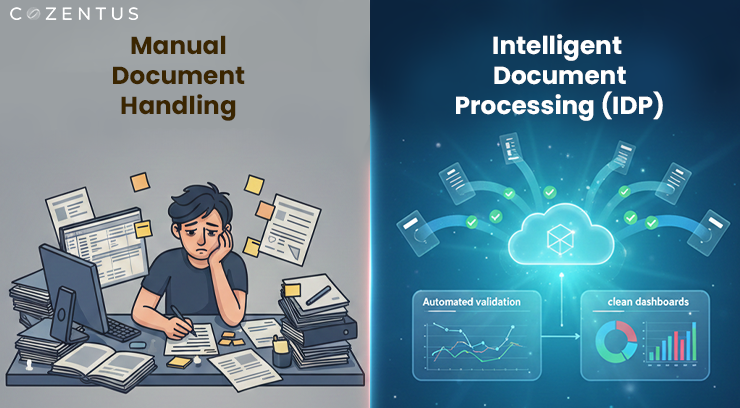
Invoices processed by hand, shipment documents reviewed manually, data copied from PDFs into systems, and corrections made after errors surface have all become part of daily operations. Because this work has existed for years, it feels normal and unavoidable.
What often goes unnoticed is how much this manual effort quietly drains time, money, and attention across logistics and enterprise operations.
This blog explores the true cost of manual documentations and explains how intelligent document processing (IDP), especially through platforms made by Cozentus, is helping organizations address this challenge in a practical and sustainable way.
Why Manual Document Handling Is Still Going On
Manual document processing does not exist because organizations prefer inefficiency. It exists because documents are inherently complex and unpredictable.
Documents:
- Arrive from multiple internal and external sources
- Come in different formats and layouts
- Change frequently based on vendors, carriers, and regions
- Contain both structured and unstructured information
Most traditional systems were designed to handle clean, structured data. They struggle when documents vary in layout or quality. When systems fail to interpret documents accurately, people step in to bridge the gap.
Over time, these manual steps become embedded in workflows. Teams adapt processes around human effort instead of system intelligence, and what started as a temporary workaround becomes the default way of working.
The Real Business Cost of Manual Documents
1. Time Lost to Repetitive Work Every Day
Manual document handling involves various repetitive tasks that occur across teams and departments. These tasks may seem small individually, but together they consume a significant amount of productive time.
Common activities include:
- Opening emails and downloading attachments
- Reading documents line by line
- Entering data into ERP, TMS, or finance systems
- Verifying and correcting information
- Following up on missing or unclear details
This effort takes skilled employees away from work that requires judgment, analysis, and experience. Over months and years, the opportunity cost becomes substantial.
2. Errors That Create Ongoing Rework and Delays
Manual processes introduce errors, irrespective of how careful teams are. This is not a reflection of capability but a natural outcome of repetitive, high-volume work.
Typical issues include:
- Incorrect rates or charges
- Missing shipment references
- Duplicate invoices
- Inconsistent data across systems
Each error causes additional work, including internal reviews, external communication, and dispute resolution. In logistics, where documents directly impact billing, compliance, and customer trust, these errors can delay payments and damage client relationships. Preventing errors early is always more efficient than correcting them later.
3. Slower Decision-Making and Limited Visibility
When documents are processed manually, data enters systems much later than it should. This delay reduces visibility into costs, performance, and risks.
Leaders may not see issues until after they have already affected service levels or margins. Teams are forced to react instead of anticipate, which limits the organization’s ability to operate proactively.
In fast-moving logistics environments, if information is delayed, it often results in missed opportunities.
4. Hidden Compliance and Audit Risks
Documents are not only paperwork. They are financial and legal records that are used for audits, compliance checks, and contractual obligations.
Manual handling increases the risk of:
- Missing or misplaced documents
- Inconsistent versions
- Incomplete audit trails
When audits occur, teams often spend valuable time searching for files across emails, shared drives, and local folders. This creates stress and uncertainty, especially when information is needed quickly.
5. Manual Processes That Do Not Scale with Growth
As shipment volumes increase, document volumes also increase with them. Manual processes, however, struggle to keep pace.
Scaling manual document handling typically involves:
- Hiring additional staff
- Increasing overtime
- Accepting slower turnaround times
Costs rise faster than revenue, making growth harder to sustain and margins harder to protect.
How Intelligent Document Processing (IDP) Helps
Rather than simply converting documents into text, Cozentus’ IDP platforms understands the content, context, and purpose of documents. They are designed to handle real-world business and logistics complexity without disrupting existing operations.
1. Document Ingestion from Real-World Sources
The platform ingests documents automatically from multiple channels, including:
- Emails
- File uploads
- FTP and SFTP
- APIs from ERP, TMS, and carrier systems
- Scanned images and PDFs
Supported document types include:
- Freight invoices
- Bills of lading
- Proof of delivery
- Rate sheets and contracts
- Shipment and compliance documents
This removes the need for manual downloading, sorting, or routing of documents.
2. Intelligent Document Classification Without Manual Sorting
The platform identifies:
- Document type
- Carrier or vendor
- Layout or format
- Language
AI-based models allow the system to adapt even when document formats change. Even if a carrier changes their invoice format, the system adapts.
3. Accurate Data Extraction Using AI and ML
Examples:
- Identifies invoice number vs shipment number
- Differentiates base freight from accessorial charges
- Extracts dates, amounts, weights, and references
It handles:
- Multi-page documents
- Tables and line items
- Poor-quality scans
- Mixed layouts
Key fields such as invoice numbers, shipment references, charges, accessorials, dates, weights, and amounts are identified correctly and consistently.
4. Business Rule Validation and Exception Detection
Extracted data is validated against:
- Business rules
- Contracts and rate cards
- Shipment and order data
- Historical patterns
Typical validations include:
- Rate mismatches
- Duplicate invoices
- Invalid accessorial charges
- Missing mandatory fields
Only documents with exceptions are flagged for review, while clean documents move forward automatically.
5. Human-in-the-Loop Review (Only for Exceptions)
Instead of reviewing every document, users review only flagged exceptions.
The review interface:
- Highlights incorrect fields
- Shows the source document for context
- Allows quick corrections
- Feeds learning back into the system
This approach continuously improves accuracy while reducing manual effort.
6. Workflow Automation and Approval Management
- Invoice approvals
- Dispute initiation
- Compliance checks
- Exception escalation
Workflows can be tailored based on amount thresholds, customer rules, or risk levels, ensuring consistency and control.
7. Seamless Integration With Enterprise Systems
- ERP
- TMS
- Finance and accounting platforms
- Analytics and reporting tools
This removes the need for manual data re-entry and ensures data consistency across systems.
8. Built-In Audit Trails and Compliance Support
Every action within the platform is logged, including:
- Document versions
- Validation decisions
- User actions
- Approval timelines
This creates a strong audit trail and improves compliance handling.
9. Operational Analytics and Insights
The platform provides insights into:
- Document processing times
- Exception trends
- Carrier or vendor error patterns
- Cost leakage indicators
These insights help leaders identify improvement opportunities and act proactively.
10. Performance, Testing, and Scalability by Design
Cozentus places strong emphasis on reliability. The platform is tested to:
- Handle peak volumes
- Maintain accuracy under load
- Scale without performance degradation
Testing and performance assurance ensure stability in production environments.
How Cozentus Approaches Intelligent Document Processing
Cozentus takes a business-first approach to intelligent document processing. The focus is not just on automation, but on delivering outcomes that matter.
This includes:
- Supporting real logistics workflows
- Ensuring accuracy and reliability
- Integrating seamlessly with existing systems
- Scaling with business growth
- Providing ongoing testing and performance assurance
Final Thoughts: A Quiet Problem with a Practical Solution
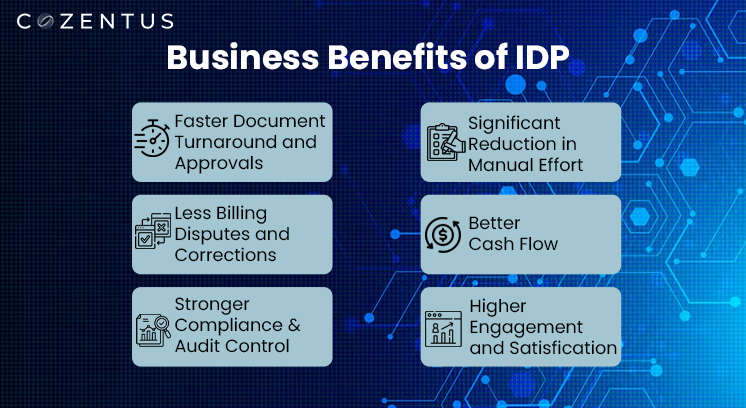
Manual document handling rarely causes immediate failure. Instead, it quietly slows operations, increases risk, and limits growth over time.
Organizations that address this early gain speed, clarity, and resilience. Intelligent document processing is not a distant future capability. It is already helping leading organizations work smarter and more efficiently.
The real question is not whether manual documents are costing your business. Because they definitely are.
The question is how long you want to continue paying that cost.
For a custom document handling solution with IDP, Book a quick meeting.