A Pattern in Every Modern Supply Chain
If there is one feeling shared by almost every supply chain and logistics leader today, it is that uncertainty has become the new normal. Demand changes fast. Inventory positions shift. Partner reliability often fluctuates. External risks appear without warning.
Even with strong planning and experienced teams, leaders often find themselves reacting to problems instead of anticipating them.
This gap is where supply chains lose time, money, and customer trust. And this is exactly where AI is bringing a new level of power into the hands of decision makers.
The industry is going from traditional forecasting to something more advanced. A capability that lets leaders see around corners. A capability known as AI-driven foresight.
Why Traditional Forecasting Is No Longer Effective
Modern supply chains operate in an environment that changes by the hour. Forecasting relies on historical data and patterns. But history is not always a good guide in a world that is influenced by:
- Volatile Consumer Behaviour: Customer demand changes quickly and often without warning. Forecasts cannot keep up with these sudden shifts.
- Global Disruptions: Events in one part of the world can impact your supply chain the same day. Traditional models cannot predict these surprises.
- Geopolitical Uncertainty: Rules, trade policies, and regional tensions change fast. Forecasts based on old information become outdated very quickly.
- Transportation Capacity Swings: Carrier availability and rates move up and down often. Forecasts built on fixed numbers fail when conditions change.
- Supplier Instability: Suppliers can face delays, shortages, or operational issues at any time. You need tools that detect these signs early.
- Weather Events: Storms and extreme weather can slow or stop movement without much notice. Traditional forecasting is not designed for this level of unpredictability.
Traditional forecasting answers: “What it thinks will happen next?”
AI foresight answers: “What is already happening and what will happen next based on real-time signals.”
What is Real-Time Foresight & Its Impact on Supply Chains
Real-time foresight means your supply chain can pick up early signs of change and understand what they mean for your business. It is about seeing the impact before it hits you. AI makes this possible by pulling together data from every part of your supply chain and analyzing it constantly in the background.
This is not about adding more dashboards or more reports. It is about giving leaders a head start so they can act early instead of reacting late. When you have foresight, you stop guessing and start planning with confidence.
With AI-enabled foresight, you can:
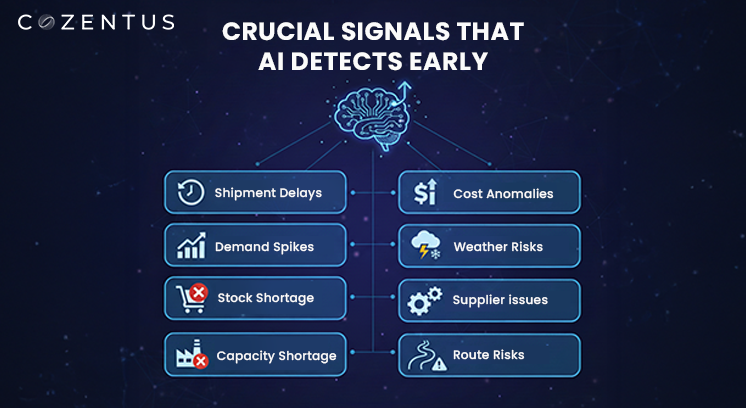
- Sense disruptions before they grow: Small issues show up early, and AI alerts you before they turn into bigger problems.
- Predict delays before they occur: AI learns from patterns like carrier performance, weather, traffic, or port congestion and warns you ahead of time.
- Identify cost anomalies early in freight audit: Unusual charges or billing mistakes get flagged quickly, helping you control spend and avoid leakage.
- Balance inventory more accurately: You can understand where stock will run short or pile up, allowing you to plan smarter and reduce waste.
- Plan labour and capacity ahead of time: With early signals, you can schedule people, transport, and warehouse capacity before pressure builds.
- Understand how one event impacts the rest of the chain: If a supplier delays by a day, AI helps you see how that will affect production, deliveries, and customer commitments.
Companies are embracing real-time visibility platforms and predictive control towers because they turn uncertainty into clarity. Instead of waiting for problems to appear, leaders get the information they need to stay ahead.
Real Time Visibility Is the Foundation of Predictive Decision Making
Visibility is no longer optional. It is the foundation of every predictive capability.
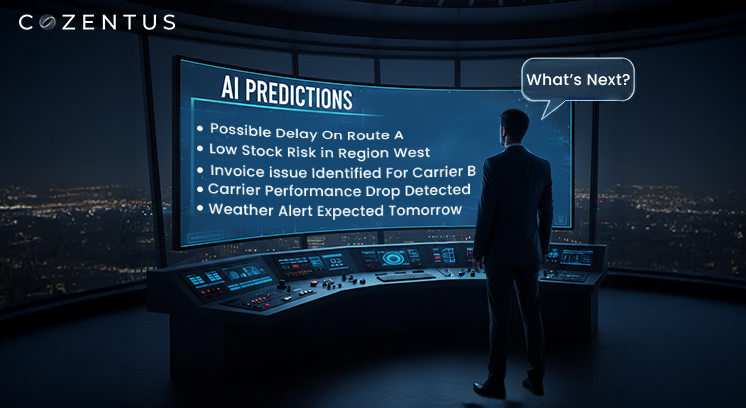
When companies know where shipments are, why delays are happening, and what exceptions are emerging, AI can learn from these signals and detect patterns humans miss.
Cozentus’ real-time shipment visibility platform does this by integrating data from multiple systems and applying intelligence on top of it. This helps leaders not only monitor operations but also understand what will happen if they don’t take any action.
For example:
- Predicted shipment ETA accuracy
- Early detection of dwell time build-up
- Alerts for potential delivery failures
- Predicted impact of congestion and weather
- Automated recommendations for alternate routing
AI Connects Weak Signals Across the Supply Chain
The biggest risks don’t always come from one big event. They usually come from many small events that go unnoticed. AI is very good at connecting those signals.
For example:
- A slight carrier delay pattern
- A slow update from a supplier
- An increase in exceptions in one region
- Invoice mismatches that point to process gaps
- Or a trend in customer complaints that links back to fulfilment
Individually, these signals look normal. But together they are a huge risk. It is intelligence that helps leaders convert such uncertainty into opportunity.
AI Helps You Make Effective Teams
AI does not replace teams. It enhances them.
Instead of spending hours tracking shipments, validating invoices, or searching for root causes, teams can focus on more important things, like:
- Improving service
- Managing customers
- Redesigning processes
- Analyzing cost improvements
- Building resilience strategies
Our solutions automate repetitive work and highlight where human intervention is needed. This is how companies reduce costs without reducing their capability.
Predictive Control Towers Are A Competitive Advantage
Predictive control towers are not a luxury anymore - they are a competitive requirement.
They bring together:
- Real-time visibility
- Predictive insights
- Automated workflows
- Exception management
- Multi-party collaboration
- And scenario planning
This combination allows organizations to act before the customer feels the impact. Cozentus builds and enhances these capabilities for clients who want to move from monitoring the supply chain to orchestrating it.
Additional Role of AI in Freight Audit and Cost Management
With rising logistics costs, businesses cannot afford blind spots by any means.
AI helps:
- Identifies anomalies early
- Predicts cost variances
- Highlights incorrect charges
- Improves audit accuracy
- Offers insights for rate optimization
This reduces leakage and strengthens financial control. Cozentus Freight Audit 2.0 takes this another step by combining audit accuracy with smart analytics that reveal where costs originate and how they can be reduced.
Risk Monitoring Powered by Real-Time Intelligence
Organizations would very much want to know all the possible risks before they happen. With AI, you can identify:
- Supplier delays
- Geopolitical risks
- Capacity shortages
- Port congestion
- Weather patterns
- Compliance issues
Risk monitoring platform of Cozentus, powered by AI, does not just inform. They guide teams on what action to take and when.
Conclusion: Foresight Will Separate the Leaders from the Rest
In the next few years, the leaders who win will not be the ones with more data. They will be the ones with better foresight.
A foresight-driven supply chain:
- Senses change early
- Acts before the disruption
- Learns continuously
- Protects margins
- Delivers consistency to customers
AI is not replacing experience. It is enhancing it. It is giving leaders the power to predict instead of react.
And for organizations ready to move from forecasting to foresight, the journey starts with one decision. To see what is coming next. Not just what is happening now.
For more such solutions, let’s have a quick chat.