


Introduction: Disconnected Systems Cost More Than You Think
You have heavily invested in technology across your retail supply chain. ERP, WMS, TMS, forecasting tools, store systems, ecommerce platforms, analytics dashboards. On paper, it looks strong.
But when you look closer, the reality of the operations is something different. Inventory numbers do not match. Logistics sees one version of shipment status while planning sees another. Stores report stockouts even when the warehouse shows that the stock is available. Teams spend hours reconciling data before they can even start making decisions.
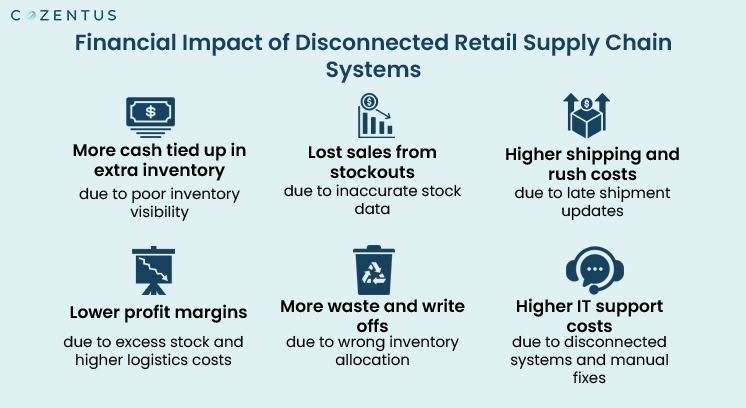
This is not just a system issue. It is a communication gap between the systems. And in retail markets, where speed and accuracy matter a lot, this gap directly affects revenue, working capital, and customer experience.
Let’s walk through why this happens and how experienced leaders fix it in a practical way.
Reason1. Systems Were Added Over Time Without a Unified Architecture
Most retail organizations did not design their supply chain systems as one connected ecosystem. Systems were added gradually to solve specific problems. Finance needed an ERP. Warehouses needed a WMS. Transportation needed a TMS. Ecommerce requires a separate platform.
Each decision made sense at the time. But together, they created fragmentation. Systems operate on different databases, update cycles, and data definitions. Even something as basic as “available” inventory can mean different things in different tools.
This leads to issues such as:
- Conflicting inventory numbers across channels
- Delays in reflecting goods in transit
- Manual data transfers between systems
- High dependence on spreadsheets
How Leaders Fix It
Strong leaders focus on architecture first, before adding more tools. They:
- Map end to end data flow
- Define ownership for each data object
- Invest in integration layers and APIs
- Prioritize real time data synchronization
Retailers who treat integration as a strategic capability usually outperform those who keep adding more and more disconnected solutions.
2. Disconnected Teams Result in Disconnected Systems
System disconnection usually starts with how the company is organized. Planning, logistics, store operations, ecommerce, and IT often focus on their own goals. When each team works toward separate targets, the systems they use also stay separate.
Planning may focus on improving forecast accuracy. Logistics may focus on reducing freight costs. Stores may focus on keeping products available for customers. All of these goals make sense. But when they are measured separately, the systems supporting them also stay separate.
This results in:
- No single owner for end-to-end visibility
- Confusion over data definitions
- Limited cross functional transparency
- Slow response during disruptions
How Leaders Fix It
Experienced retail leaders make sure all teams are working toward the same goals. Instead of separate targets, they use shared metrics like:
- On shelf availability
- End to end order cycle time
- Total cost to serve
- On time delivery across channels
They also create clear processes to manage data across the company. This ensures everyone uses the same data definitions and standards. When teams are aligned on business goals, it becomes much easier for systems to work together.
3. Outdated Systems Reduce Real Time Visibility
Many retail supply chains still use older systems that were designed to process data in batches. Updates often happen overnight. Some data is shared through manual file transfers. Integration depends on basic file exchanges instead of real-time connections.
This worked in the past when retail moved at a slower pace. Today, customers expect fast updates. Logistics issues need to be visible immediately. Inventory decisions must adjust quickly when demand changes.
When systems update only once per day, several risks appear:
- Stores confirm orders for items that have not arrived yet
- Planners notice demand changes after it is already too late
- The company spends more on rush shipments
- Customers become less satisfied
How Leaders Fix It
Leaders upgrade their systems step by step. They focus first on the areas that create the biggest impact, such as:
- Clear inventory visibility across warehouses and stores
- Real time shipment tracking from carriers
- Accurate and consistent order status updates
They move toward cloud-based systems and real-time data connections. Instead of replacing every system at once, they improve the most important data flows first.
4. Weak Master Data Management
System integration works properly only when the basic data is accurate and consistent. If product codes, supplier details, or location IDs are different in each system, the connection between systems becomes weak and unreliable.
Common data problems include:
- The same product listed more than once
- Different product categories across systems
- Store and warehouse codes that do not match
- Incorrect or incomplete supplier information
Even when systems are technically connected, poor data can lead to mismatched reports. Teams start questioning the numbers. They turn to spreadsheets to double-check the information. Once spreadsheets become the main source of truth, system integration becomes more weaker.
How Leaders Fix It
Top leaders treat master data as a core business asset. They:
- Choose one trusted source for product and location data
- Assign clear responsibility for keeping data accurate
- Set up validation controls to prevent mistakes
- Use a standard process for adding or updating data
When master data is managed properly, systems can share information more accurately and consistently. This reduces errors, builds trust in reports, and allows teams to make decisions with more confidence.
5. Technology Decisions Lack Business Alignment
Sometimes new technology is chosen separately by different teams. IT looks at technical features. Operations look at daily usability. Ecommerce wants quick deployment. Integration is discussed only after the purchase.
Over time, this makes the system landscape complicated. More custom connections are needed. Upgrades have become harder. Maintenance costs increase. Teams become hesitant to change anything because it may break another system.
How Leaders Fix It
Strong leaders evaluate technology based on business needs, not just features. Before choosing a system, they ask:
- What business problem are we solving
- How will this connect with our existing systems
- How will this support our future plans
- Who will manage and own the data
They bring logistics, planning, IT, finance, and operations into the same discussion. This helps avoid fragmented decisions and ensures new systems are chosen keeping integration in mind.
Fix Disconnected Retail Supply Chain Systems in 5 Steps
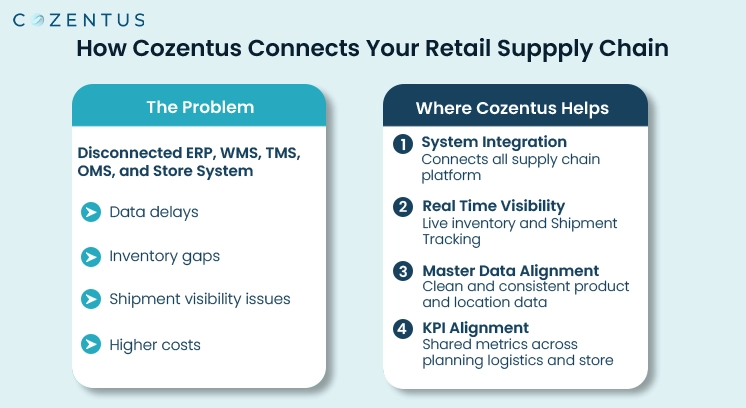
Disconnected systems usually create delays, excess inventory, and unreliable reporting. Fixing the issue requires a structured and business-led approach.
Step 1: Map End to End Data Flows
Document how inventory, orders, products, and shipment data move across ERP, WMS, TMS, and store systems. Identify batch updates, manual uploads, and duplicate records. This reveals where visibility breaks down.
Step 2: Define a Single Source of Truth
Assign one authoritative system for inventory, orders, and product data. When multiple systems “own” the same data, reports conflict and decisions slow down.
Step 3: Align KPIs Across Functions
Planning, logistics, and store operations should share performance metrics such as service level, inventory turns, and order cycle time. Shared KPIs encourage shared systems and reduce siloed decisions.
Step 4: Strengthen the Integration Layer
Use APIs, middleware, or a control tower platform to connect systems in near real time. Focus first on high impact areas like inventory visibility and shipment tracking.
Step 5: Establish Data Governance
Define clear ownership for master data. Standardize how data is created, updated, and validated to maintain consistency across systems.
Final Perspective: Retail Growth Depends Upon Connected Systems
Disconnected systems create delays, higher costs, and unreliable data across planning, logistics, and store operations. Over time, these gaps reduce agility and impact margins.
Customer expectations continue to increase, and disruptions are becoming common. Organizations with connected systems respond faster, manage inventory more accurately, and control logistics costs more effectively.
Cozentus stands at the forefront of retail supply chain integration. With deep domain expertise in logistics, real time visibility, and system architecture, Cozentus helps retailers connect ERP, WMS, TMS, OMS, and store systems into a unified and scalable ecosystem. Our approach combines technical precision with business alignment, ensuring measurable improvements in inventory accuracy, transportation efficiency, and overall supply chain performance.
Book a meeting with Cozentus to connect your systems and improve your retail supply chain performance.