

The Cost & Service Dilemma Every Retailer Faces
If you are leading a retail business today, you might be living in constant tension within the competitive e-commerce logistics landscape.
On one side, your finance team is pushing for cost reduction and stronger supply chain cost optimization. Transportation costs fluctuate. Warehousing costs are rising. Inventory carrying cost keeps increasing. Labor is expensive. Fuel prices change without warning.
On the other side, your customers expect faster delivery, better availability, accurate order tracking, and smooth returns. They compare your service not just with competitors, but with the best retailers in the market.
You cannot choose cost over service. You cannot choose service over cost. You need both.
Leading retailers have found a way to manage this pressure. The most successful brands are not cutting blindly. They are redesigning their supply chains intelligently with smarter supply chain technology. They are reducing structural costs while improving service performance.
This blog walks you through how they are doing it and how you can apply the same principles in your organization to build a more resilient and cost-effective retail supply chain.
1. They Start with Visibility Before Cost Cutting
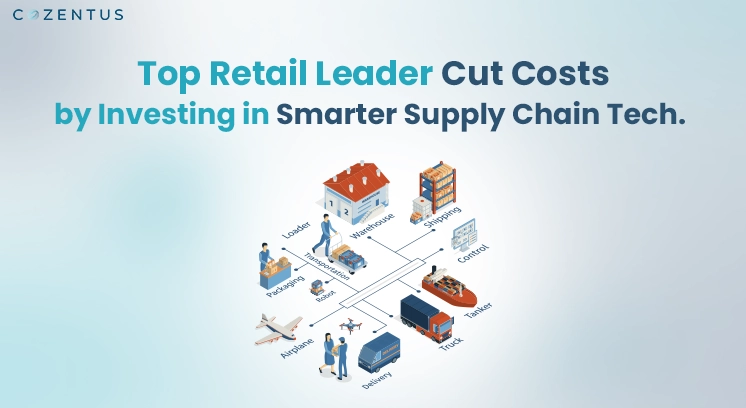
Most companies try to reduce costs before they understand them fully. Leading retailers take a different approach. They invest in end-to-end supply chain visibility.
They know:
- Where inventory sits
- How fast it moves
- Which routes cost more
- Where delays happen
- Which suppliers are inconsistent
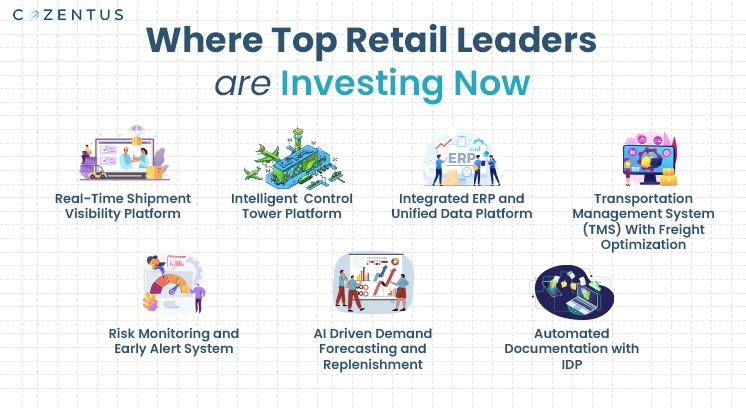
Real-time shipment visibility platforms, control towers, and integrated planning systems allow them to see the full picture. When data flows from suppliers to distribution centers to stores and e-commerce channels, leaders can make decisions based on facts.
For example, instead of expediting shipments blindly, they prioritize high margin or high-demand SKUs (Stock Keeping Units). Instead of holding excess safety stock everywhere, they adjust buffers dynamically based on demand patterns.
2. Smarter Inventory Management Instead of More Inventory
One of the biggest cost drivers in retail is inventory.
Holding too much inventory increases carrying costs, working capital pressure, the risk of outdated products, and storage expenses. Holding too little inventory increases stockouts and lost sales.
Leading retailers balance this with advanced demand forecasting and intelligent replenishment. They use:
- Machine learning based demand forecasting
- Store-level demand planning
- SKU level segmentation
- Dynamic safety stock optimization
The goal is not to cut inventory aggressively. The goal is to hold the right inventory in the right place at the right time.
Many successful retailers, especially from the United States, have shifted from network-wide safety stock models to location-specific strategies. High-performing stores get optimized replenishment cycles. Slower-moving stores get leaner allocations.
This improves availability while reducing total inventory cost. And the result is better cash flow and better customer experience.
3. Network Optimization Instead of More Warehouses
When service levels drop, the first reaction is often to add more distribution centers. That increases fixed costs significantly.
Leading retailers take a data-driven approach before expanding infrastructure. They analyze:
- Order density by region
- Transportation lanes
- Last mile performance
- Customer delivery expectations
- Store and e-commerce demand mix
With network modeling tools, they simulate different fulfillment strategies. Some move toward regional fulfillment centers. Others adopt micro fulfillment centers for urban areas. Additionally, some retailers even leverage stores as fulfillment hubs.
Instead of building new warehouses everywhere, they redesign the flow of goods.
This reduces:
- Line haul costs
- Expedited shipping
- Split shipments
- Last mile inefficiencies
4. Transportation Cost Control Through Data and Planning
Transportation is usually the most volatile cost in retail supply chains. As mentioned above, fuel prices fluctuate a lot, capacity tightens during peak seasons, and carrier rates increase unexpectedly.
Leading retailers manage this proactively. They use transportation management systems (TMS) that provide:
- Load consolidation opportunities
- Route optimization
- Carrier performance tracking
- Freight audit automation
Instead of shipping partial loads, they consolidate where possible. Instead of reactive carrier selection, they use data-driven routing guides.
Some leading players also implement dynamic rerouting when disruptions occur. If a port delay happens, they shift to alternative gateways early.
In the US logistics market, where freight volatility is common, this proactive planning protects both cost and service.
5. Supplier Collaboration Instead of Supplier Pressure
Many retailers try to reduce procurement costs by negotiating harder. That often damages long-term relationships.
Leading retailers focus on collaboration. They share demand forecasts with suppliers. They align production schedules. They agree on service level expectations. They also co-invest in technology integration.
This reduces:
- Lead time variability
- Emergency orders
- Excess safety stock
- Production bottlenecks
When suppliers have better visibility into retail demand, they can plan efficiently. This helps in lowering the total system cost.
Stronger partnerships also improve service reliability. During times of disruption, collaborative suppliers prioritize trusted retail partners.
6. Automation That Reduces Errors and Labor Cost
Manual processes increase cost and reduce service quality. Documentation errors, billing mistakes, shipment mismatches, and inventory inaccuracies lead to delays and rework.
Leading retailers invest in:
- Warehouse automation
- Robotic picking systems
- Automated documentation
- Digital proof of delivery
- AI-based exception management
Automation reduces dependency on manual interventions. It improves speed and accuracy.
For heavy logistics operations, especially those managing high SKU volumes, automation significantly reduces labor cost per order. More importantly, it improves order accuracy, which directly impacts customer satisfaction.
7. Reducing Returns and Reverse Logistics Cost
Returns are a hidden cost driver in retail. Processing returns, restocking, refurbishing, and disposing of goods adds operational burden.
Leading retailers focus on preventing returns, not just processing them.
They improve:
- Product information accuracy
- Inventory visibility
- Delivery time accuracy
- Quality control
They also design smarter reverse logistics networks. Centralized return processing hubs reduce duplication of effort. Data analytics helps identify high-return SKUs and root causes.
By improving product descriptions and delivery accuracy, they reduce unnecessary returns. That protects both cost and service.
8. Using Data to Prevent Disruptions Instead of Reacting
Reactive supply chains are expensive. When disruption occurs, companies expedite shipments, pay premium freight, and overstock inventory.
Leading retailers use smart risk monitoring systems and predictive analytics to identify risks early. They monitor:
- Weather patterns
- Port congestion
- Carrier reliability
- Supplier risk signals
With early warnings, they adjust their plans before disruption escalates.
For example, shifting inventory allocation before a storm or rerouting shipments before congestion builds saves significant cost.
9. Aligning Finance and Supply Chain Teams
One major reason cost reduction efforts fail is misalignment. Supply chain teams focus on service. Finance teams focus on cost.
Leading retailers bring both teams to the same table. They track key metrics such as:
- Cost to serve by channel
- Gross margin impact
- On time in full performance
- Inventory turnover
- Working capital efficiency
When everyone understands the trade-off between cost and service, decisions become balanced.
For example, investing slightly more in inventory positioning may reduce expensive last-minute freight. That improves overall profitability.
Conclusion: Build Cost-Effective Retail Supply Chain with Smarter Tech
Retailers winning today are building resilient, intelligent supply chains designed for long-term performance. They understand that service drives revenue and cost discipline protects margin. They invest in systems that strengthen both areas at the same time. Those who delay face rising logistics costs, inventory imbalance, and declining service consistency.
You do not need to overhaul everything at once. Begin with visibility. Improve forecasting accuracy. Optimize transportation planning. Strengthen supplier collaboration. Build structured performance metrics across finance and operations.
This is where partners like Cozentus add value. With real time shipment visibility, intelligent control tower capabilities, risk monitoring, freight optimization, and supply chain analytics, Cozentus helps retailers reduce costs while protecting service levels. The focus is not on technology for the trend. The focus is on measurable improvement that reduces overall cost.
Reducing supply chain cost without sacrificing service is not theoretical. Leading retailers are already proving it every day.