Supply Chains Have More Risks Now
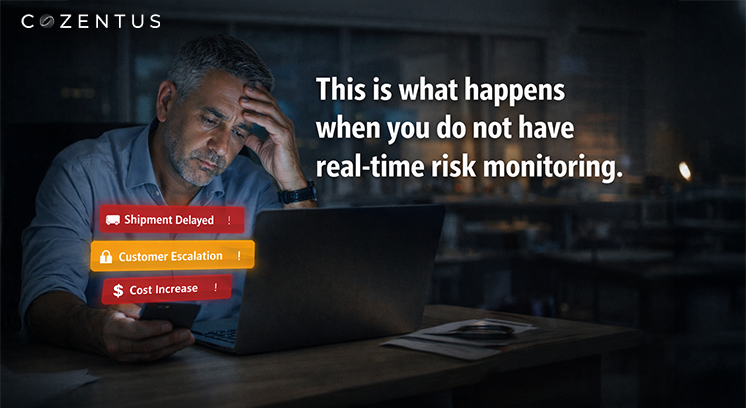
If you run a supply chain today, you do not need anyone to tell you that risk feels higher than ever. Demand shifts overnight. Carriers miss pickups. Ports slow down. Costs change without warning. Weather, geopolitics, and labor issues can turn a normal week into a fire drill.
Retailers and logistics teams across the US face this every day. They are not struggling because people are not working hard. They struggle because the system they use to manage risk was built for a slower world. Spreadsheets, static reports, and delayed alerts cannot keep up with how fast things move today.
This is where Generative AI changes the game. It does not just show what happened. It helps teams understand what is happening, what might happen next, and what to do about it.
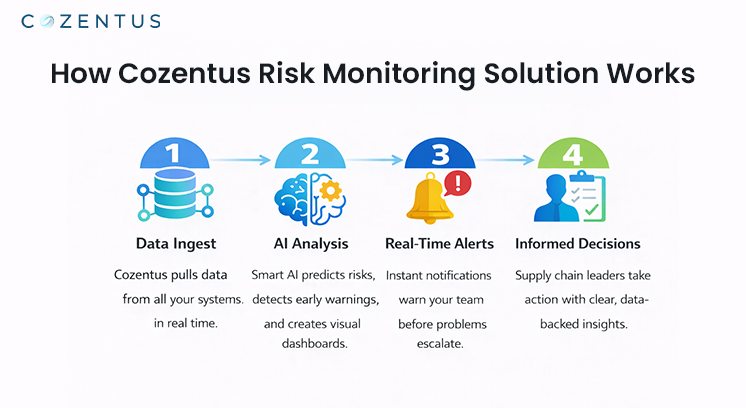
At Cozentus, this is exactly how we think about risk. Our multiple custom supply chain tech solutions, like real-time visibility, control tower, Gen AI dashboards, and risk monitoring tools, all exist for one reason. To help supply chain leaders stay in control when things go bad.
This blog discusses at seven powerful ways Generative AI improves risk management across modern supply chains.
What Generative AI Actually Does in Supply Chains
In enterprise supply chain systems, Generative AI works on top of 3 core layers:
- Real-time data from TMS, WMS, ERP, carrier feeds, IoT, and control towers
- Predictive AI models for delay, demand, and risk
- Business rules and optimization engines
Generative AI does not replace these systems. It connects them and makes their outputs easy to understand for business teams. It turns complex data into clear answers so people can act faster and with more confidence.
Gen AI’s real power is that it can:
- Read live operational data
- Understand patterns across systems
- Reason about cause and effect
- Explain risks in human language
- Recommend actions based on model outputs
That is exactly what Cozentus’ Gen AI dashboards, AI risk monitoring solution, and other Gen AI solutions do. They help supply chain teams see problems early, understand their impact, and take the right action before small issues grow into big ones.
7 Ways Generative AI Reduces Risk in Supply Chains
Generative AI helps supply chain teams identify risks earlier, understand their impact, and take action before disruptions affect customers or costs. By combining real-time data, predictive models, and AI-driven insights, companies gain better visibility and control across their entire supply chain network.
Here are 7 ways generative AI does the trick:
1. It Turns Data Noise into Clear Risk Signals
Supply chains generate massive volumes of data. Shipment scans, EDI feeds, invoices, warehouse updates, carrier emails, and customer tickets all arrive at once.
The challenge is not a lack of data. The challenge is too much data and not enough insight.
Generative AI solves this problem by reading, understanding, and summarizing operational data in real time. It filters out noise and highlights only what creates risk.
With Cozentus' real-time visibility and control tower solutions, Generative AI helps identify:
- Shipments that are likely to miss delivery windows
- Inventory that is running lower than expected
- Orders that are at risk of service failure
- Cost patterns that signal financial exposure
Instead of scrolling through dashboards, supply chain managers see simple, clear risk alerts. This is one of the biggest benefits of AI-driven supply chain visibility.
2. It Predicts Problems Before They Happen
Traditional risk management is reactive, which means teams usually act only when something has already gone wrong.
But Generative AI is predictive. It uses historical trends, live shipment data, carrier performance, weather signals, and inventory movement to predict what is coming next.
For example, it can predict:
- Lane congestion during peak seasons
- Port delays based on traffic patterns
- Inventory shortages caused by fast-selling SKUs
- Carrier performance drops
Predictive risk monitoring and early warning systems allow supply chain logistics teams to act before customers feel the impact. This is what modern supply chain risk analytics is supposed to do.
3. It Gives One True View of Risk Across the Network
One of the biggest problems in supply chains is fragmentation. Logistics teams see shipments. Finance sees invoices. Sales sees service issues. Leadership sees reports after it is too late. No one sees everything at once.
Generative AI connects all these signals into one operational picture. It brings shipment data, cost data, inventory data, and risk signals into one clear picture.
With Cozentus’ Gen AI dashboards and control tower, leaders can see:
- How a shipment delay impacts customer service
- How that delay increases freight cost
- How inventory gaps affect revenue
- How service failures create churn
4. It Helps Teams Decide What to Do Next
Knowing there is a problem is not enough. Teams need to know what action makes the most sense. That gap between seeing a problem and choosing the right action is where Generative AI adds the most value. It turns complex situations into clear choices that teams can act on quickly.
Along with alerts, Generative AI also suggests options.
- If a shipment is delayed, it can suggest alternate routes.
- If costs are rising, it can suggest carriers or modes with better performance.
- If inventory is tight, it can suggest rebalancing stock between locations.
The new AI analytics and control tower systems use this approach. They show trade-offs between cost, service, and risk. That allows leaders to make decisions with confidence.
5. It Reduces Financial Risk Through Better Invoice Control
Risk is not only about delays. It is also about money. Freight invoices are full of errors, duplicate charges, and missed contracts. These mistakes quietly drain budgets.
Generative AI reads invoices the same way a human auditor would, but much faster and more accurately. It compares them against contracts, shipment data, and historical trends.
Cozentus freight audit and intelligent invoice processing systems catch errors that manual teams often miss. With our solutions, companies can reduce:
- Billing errors
- Payment disputes
- Revenue leakage
- Contract compliance risk
This is a critical part of supply chain financial risk management. And for supply chain logistics leaders, especially in the US, this means fewer surprises and better cost control.
6. It Makes Exception Handling Faster and Smarter
Every supply chain has exceptions. A truck breaks down. A document is missing. A warehouse misses a scan. These small issues can quickly turn into delivery delays, cost overruns, and customer complaints if they are not handled quickly.
Generative AI brings all the related data into one clear view. It looks at shipment status, carrier updates, documents, and system records to explain what went wrong and where the problem started. It also highlights the next best steps, so teams know how to properly fix the issue.
Instead of spending hours calling, emailing, and checking different systems, teams see the full picture instantly. This reduces downtime, avoids unnecessary escalations, and helps keep customers informed and satisfied.
7. It Builds Long-Term Supply Chain Resilience
As disruptions keep repeating across the industry, companies need tech systems that learn and improve with every event. Generative AI allows supply chains to become smarter with each delay, shortage, or cost spike. Over time, this creates a network that grows stronger.
Generative AI keeps on becoming better at:
- Predicting disruptions
- Identifying weak links
- Recommending better routes
- Improving inventory strategies
With new gen risk monitoring and AI analytics systems, companies can build a smarter and more resilient supply chain.
Conclusion
Supply chain risk is no longer something teams can review once in a while. It changes every day as demand shifts, shipments move, costs change, and customer expectations grow. To keep up, companies need systems that can see what is happening across the network and help teams act before problems grow.
Generative AI makes this possible. It brings together real-time data, predictive insights, and clear recommendations so teams always know where the risk is and what to do next.
With Cozentus solutions such as real-time visibility, control tower, Gen AI dashboards, risk monitoring, and financial automation, supply chain teams can move from reacting to issues later to staying in control in the present. This is how modern retail and logistics companies protect service levels, manage costs, and build supply chains that are ready for the future.
For custom risk monitoring solutions, talk to our expert.