

Operations are Moving Fast – Systems are Still Slow
Let’s start with a scenario you may recognize.
You sit in a review meeting looking at dashboards filled with alerts, delays and manual exceptions. Your teams are talented and hardworking, but they are drowning in tasks. Every day feels like managing a moving target. And despite years of investments in different types of automation, the pressure has only increased.
Does this sound familiar?
Leaders across industries tell us the same thing. The world has become more unpredictable, but its systems have not kept up.
This is the backdrop for the rise of Agentic AI. And for the first time, businesses have a path to automation that actually keeps pace with the real world.
What is Agentic AI?
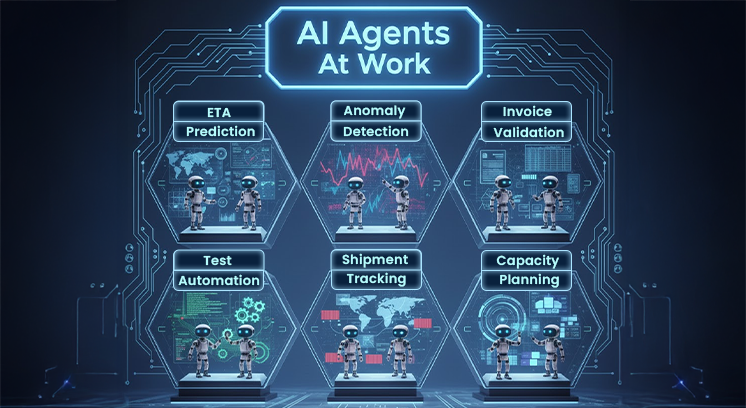
Agentic AI is a form of automation that behaves with purpose and intelligence rather than scripts and rules. Most people imagine AI as a tool that answers questions or automates a few clicks. But agentic AI behaves differently. It observes, reasons, and plans. It takes action based on goals rather than instructions. Instead of telling it how to do a task step by step, you simply tell it what outcome you want.
In logistics, for example, instead of telling a bot to check shipment status every hour, an agentic system will:
- Monitor data from multiple sources
- Detect risk patterns
- Predict delays
- Take proactive actions like notifying stakeholders or re-routing
- Learn from every cycle
This shift is important because global operations today need judgment and adaptability, along with execution.
Why Traditional Automation Is Hitting Its Limits
Many companies already use RPA or workflow automation. These tools brought value when processes were predictable, and data followed a clear pattern. But the reality you manage today is very different. Your supply chain is not a straight line anymore. It is a living environment that changes every hour.
Traditional automation helps, but it often breaks when real-world conditions do not behave the way the script expects them to.
Here is where the cracks start to appear:
-
Data is Unstructured and Scattered
Operations teams deal with emails, PDFs, spreadsheets, rate cards, partner portals, carrier systems and customer notes. Bots cannot interpret this variety. They need clean, structured data to function. When the data looks different, the bot stops.
-
Rules Don’t Fit Every Scenario
A rule-based bot works only when the world stays inside those rules. But supply chains involve exceptions, variations and last-minute changes. The moment a situation falls outside the script, humans are there to intervene in it, which slows everything down.
-
Exceptions have become the New Normal
In logistics, exceptions used to be 5% of the workload. Today, they can be 30 to 40%. A system that is designed for predictability cannot handle this kind of volume. The more exceptions you have, the more manual work you have to do.
-
Businesses Evolve Faster than Scripts
Your markets shift. Customer expectations rise. Carrier performance varies. Every time something changes, your RPA or workflow needs reprogramming. This will always lag behind the business. By the time the script is updated, a new exception appears.
-
People are Still Filling the Gaps Manually
If your teams still chase data in spreadsheets, monitor shipments one by one, or validate invoices line by line, you already know the real issue. Automation has not removed repetitive work. It has only moved it.
Areas Where Agentic AI Benefits Supply Chain and Logistics
-
Real-Time Shipment Visibility
With agentic AI, real-time shipment visibility becomes active rather than reactive. The system does not just show you where shipments are. It tells you what you should care about and why.
It can monitor carrier portals, GPS data, EDI feeds and weather disruptions. It can flag anomalies, predict risks and escalate issues before they impact your customer. This aligns directly with the visibility and control tower capabilities that Cozentus already supports.
-
Freight Audit Intelligence
Many companies still process invoices manually or use partial automation. Agentic AI improves freight audit by validating line items, detecting patterns, identifying billing errors and learning from historical disputes. It reduces leakage, speeds up audits and gives teams space to focus on vendor strategy rather than manual checks.
-
Testing and Quality Assurance
Agentic AI changes testing from a one-time activity to a continuous process, so your systems are checked, monitored and validated all the time. Agents can watch systems, detect anomalies, identify repetitive defects and even execute test cycles without human coordination. Cozentus Testing as a Service already enables this by combining automation, continuous monitoring, and AI-driven insights.
-
Data Engineering and Governance
Agentic AI strengthens data engineering and governance by continuously cleaning, connecting and standardizing data across systems. It identifies errors, fills gaps, understands unstructured information and brings everything into a unified, reliable view. This creates a stronger data foundation so every downstream process can make faster and more accurate decisions.
What Leaders Really Want From AI
When we talk to senior executives across logistics, retail, manufacturing and transportation, the answers are almost the same. They want:
- Less firefighting
- More predictability
- Faster decision making
- Automation that keeps learning
- Better outcomes without increasing headcount
Agentic AI gets them closer to these goals. It becomes a digital team member that works across business functions.
How Agentic AI Works in a Real Business Scenario
Imagine your control tower receives thousands of status updates daily. A traditional system alerts you only when something goes wrong. But an agentic system identifies risk before the event happens.
For example:
- It analyzes weather predictions against your routing history
- It checks carrier performance for similar lanes
- It detects if a client's delivery window is tight
- It flags shipments that need intervention
- It notifies internal teams and customers with recommended actions
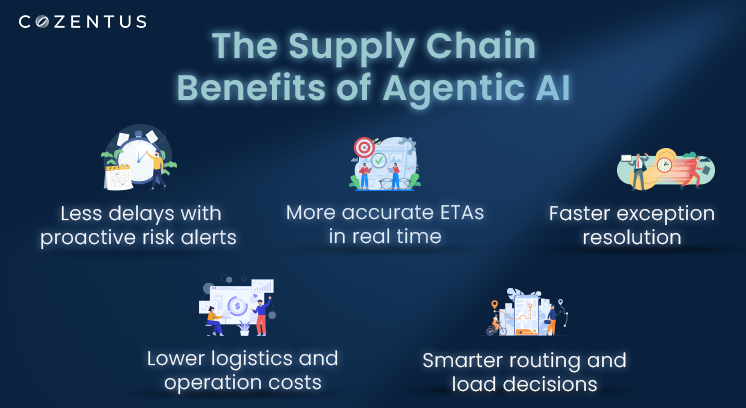
This reduces delays, improves customer experience, and cuts unnecessary costs.
Final Thought: Start Small But Move Fast
The shift from bots to brains is already happening. The question for leaders is no longer whether AI will transform operations. It is who will move first and who will be left managing yesterday’s processes.
Coznetus's approach is simple. You do not need a big bang program. You can start with a single workflow.
We help you:
- Identify the right use cases
- Build high-quality data foundations
- Deploy agentic models safely
- Integrate them with your existing systems
- Scale to enterprise-wide automation
This lets you adopt agentic AI at your own speed and capture benefits early.
Want customized Agentic AI solutions? Let’s discuss your needs