AI POC Is Easy. Production Is Not.
Building an AI proof of concept (PoC) has never been easier. With the rise of generative AI, pre-trained models, and low-code platforms, organizations can validate an idea in days. A quick prototype predicts shipment delays, automates invoice processing, or improves demand forecasting. Now suddenly, AI feels like a solved problem.
But this is exactly where most businesses get it wrong.
An AI POC is not the finish line. It is simply validation that something can work. The real challenge lies in making sure it works reliably, securely, and at scale in real-world supply chain environments. And that transition from PoC to production is where most AI initiatives fail.
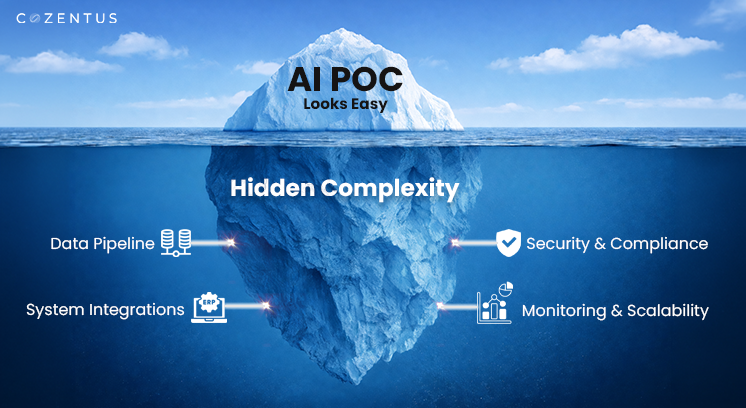
What looks simple in a controlled setup becomes complex when exposed to real-time data, multiple systems, and operational dependencies. This is where engineering, integration, and business alignment start to matter more than the model itself.
This blog explains what it really takes to move from an AI PoC to a production-ready system in supply chain environments.
What Is an AI Proof of Concept (PoC) in Supply Chain?
An AI proof of concept in supply chain is a small-scale implementation designed to test the feasibility of an AI use case. It typically focuses on a narrow problem, such as:
- Predicting delivery delays
- Automating document processing
- Identifying anomalies in logistics data
The goal is simple: validate whether AI can deliver value before investing heavily.
However, PoCs operate in controlled conditions. They use curated datasets, limited integrations, and simplified workflows. This makes them ideal for experimentation, but not for real-world deployment.
They are also built with speed in mind, not long-term stability. Most PoCs do not account for real-time data variability, system dependencies, or user adoption challenges. As a result, while they prove feasibility, they often fall short when exposed to real operational complexity.
Why Most AI POCs Don’t Reach Production
Despite successful demos, a majority of AI PoCs never transition into full-scale deployment. This is often called the “POC-to-production gap.”
The problem is usually not the model. It is the system around the model that is not ready for real-world use. Common challenges include:
- Lack of scalable data infrastructure
- Poor system integration
- Inconsistent or delayed real-time data
- No clearly defined business KPIs
- Limited focus on system reliability and uptime
In supply chain environments, these issues become more serious because logistics networks are complex and the data coming in is often inconsistent and constantly changing.
There is also a significant increase in engineering effort when moving to production. A PoC typically runs in a controlled environment with batch data. A production system must support real-time data ingestion, API-based integrations, data validation layers, and continuous monitoring. It must also handle edge cases such as missing inputs, delayed events, and conflicting data from multiple sources.
The AI POC to Production Gap: What Changes?
The shift from an AI proof of concept to production deployment is not incremental—it is transformational. What works in a controlled setup often struggles in real-world conditions.
1. From Clean Data to Messy Logistics Data
In a PoC, data is structured, labeled, and complete. In production, supply chain data is:
- Fragmented across systems
- Delayed or missing
- Inconsistent in format
- Highly dynamic
AI models must operate despite these imperfections.
2. From Model Accuracy to Operational Reliability
During the PoC phase, success is measured by accuracy and performance metrics. In production, the focus shifts to:
- System uptime and availability
- Consistent performance under load
- Explainability and trust
- Error handling and recovery
A highly accurate model that fails during peak operations doesn’t have much value.
3. From Isolated Models to Integrated Supply Chain Systems
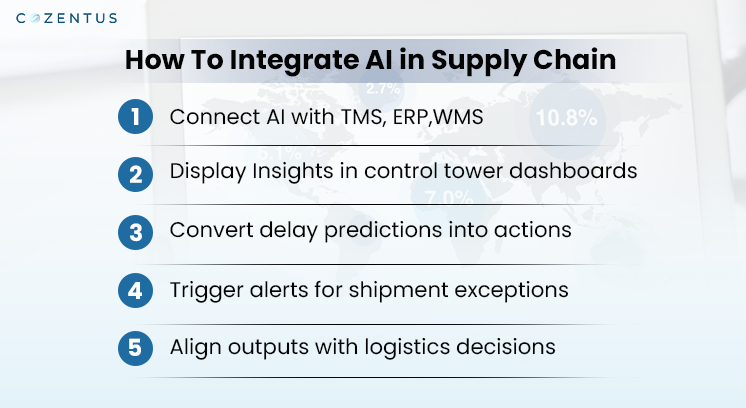
AI PoCs are often built in isolation. Production systems must integrate them with:
- Transportation Management Systems (TMS)
- Enterprise Resource Planning (ERP) platforms
- Warehouse Management Systems (WMS)
- External carrier and logistics APIs
This integration layer is usually complex and often underestimated.
Challenges in Scaling AI in Supply Chain and Logistics
Scaling AI in logistics is very different from controlled environments. It involves both technical and operational challenges.
Supply chains are:
- Multi-party and distributed
- Exception-driven rather than predictable
- Dependent on external factors like weather and regulations
- Data-heavy but often inconsistent
A major challenge is fragmented data. Information comes from different systems in different formats. It must be cleaned and standardized before use. Real-time data is also critical. Delays in data reduce the value of AI outputs.
Another issue is handling exceptions. Delays, missing updates, and disruptions are common. AI systems must manage these without failure.
Scalability also depends on strong infrastructure. Systems must process large data volumes quickly and reliably. Without this, performance drops and business impact is lost.
4 Key Requirements to Build Scalable AI Systems
1. Strong Data Engineering and Data Pipelines
A production-ready AI system requires:
- Real-time data ingestion pipelines
- Data standardization across partners
- Data validation and cleansing mechanisms
- Integration of historical and streaming data
Without robust data engineering, AI models cannot perform consistently.
2. Reliable and Secure AI Infrastructure
Enterprise AI systems must be designed for:
- High availability and uptime
- Fault tolerance and failover
- Model monitoring and performance tracking
- Security and access control
This ensures that AI solutions are not only intelligent but also dependable.
3. MLOps and Continuous Model Improvement
MLOps in supply chain AI plays a critical role in scaling. It includes:
- Continuous model deployment
- Automated retraining pipelines
- Version control for models
- Monitoring for model drift
AI is not a one-time deployment. It is an evolving system that must adapt over time.
4. Seamless System Integration and API Layer
AI systems must integrate with existing enterprise platforms such as TMS, ERP, and WMS. This requires:
- API-based data exchange
- Standardized data contracts
- Low-latency communication between systems
- Error handling for failed integrations
Without seamless integration, even a high-performing model will not be usable in daily operations.
AI Governance, Security, and Business Alignment
As AI systems move into production, governance and security become critical. Organizations must ensure:
- Data privacy and regulatory compliance
- Role-based access control
- Model transparency and explainability
- Auditability of AI-driven decisions
- These factors help build trust across teams and external stakeholders.
At the same time, AI must be aligned with clear business outcomes. Success is not just about model performance but measurable impact. Organizations should define:
- Key performance indicators (KPIs)
- Expected return on investment (ROI)
- Operational improvements like cost, speed, and efficiency
Without this alignment, AI is just an experiment and won’t be able to scale. Strong governance ensures reliability, while clear business goals drive adoption and long-term value in supply chain operations.
Real-World Example: AI in Logistics (ETA Prediction)
Consider the use case of real-time shipment visibility, one of Cozentus’ core supply chain services, powered by AI-driven ETA prediction.
In a PoC:
- The model is trained on historical shipment data
- Predictions show high accuracy in controlled datasets
- Results are visualized in static dashboards
In production:
- The system processes real-time GPS, ELD, and carrier data
- Handles missing, delayed, and inconsistent updates
- Adjusts ETAs dynamically based on disruptions and route changes
- Integrates with control towers and customer communication systems
This clearly shows the gap between feasibility and real-world execution. A working model is only one part of the solution. Delivering real-time visibility requires strong data pipelines, system integration, and continuous monitoring to ensure proper accuracy and reliability at scale.
Conclusion: AI POC Success Is Just the Beginning
Completing an AI proof of concept is a strong start, but it is not a success. It only proves that your idea has potential.
The real challenge is turning that idea into a production-ready system that works with messy data, multiple systems, and constant disruptions. This is exactly where many supply chain teams struggle, and where Cozentus supports organizations by building systems that are designed for real-world logistics conditions from day one.
AI is not judged by demo performance. It is judged by how it performs in daily operations when decisions impact cost, timelines, and customer experience. This is why Cozentus focuses on solutions like real-time shipment visibility and control towers that are built for reliability, integration, and scale.
Companies that move fast from POC to production gain a clear advantage. If your AI is still in the POC stage, you are only getting started. The real value, and the real competitive edge, comes from execution.