

Technology Is Helping Retail Businesses Move Faster
As customers now expect fast delivery, accurate orders, and 24/7 availability, retail has since entered a new era. The days of slow manual processes and delayed data have passed. Today, successful retailers are adopting connected, intelligent, and real-time technologies that help them operate faster, more precisely, and with more confidence during uncertainties.
Retailers who embrace digital transformation are not only meeting customer expectations but are also building businesses that can handle disruptions and grow profitably. This is true across every part of retail operation, from supply chain planning and order fulfilment to store operations and logistics.
In this blog, we have discussed the best ideas from top industry insights and practical examples to show how technology is helping retailers win in speed, accuracy, and resilience. These are the principles that guide market leaders in the US and around the world.
How Technology Helps Retail
Retail has become faster, more complex, and more competitive. Customers expect same-day deliveries, seamless omnichannel experiences, and precise inventory information. At the same time, supply chains span multiple partners, regions, and systems. Disruptions from weather events, transportation delays, or labor shortages can impact services immediately.
To manage this, technology has become the foundation for:
- Real-time visibility into inventory, shipments, and store operations
- Integrated data that prevents errors and gives a single source of truth
- Predictive insights that help teams act before issues become problems
- Automation that reduces manual work and increases execution
The idea is, when leaders and teams have the right information at the right time, they make better decisions that improve speed, accuracy, and resilience.
Real-Time Data and Visibility Increase Speed
Speed in retail is about removing delays and blind spots so teams can act instantly.
Modern technology platforms give retailers real-time data on inventory levels, order status, and transportation movements. This is important because traditional systems often take a whole night to update, or they do after a delay. Waiting for data means decisions are always going to be late.
Real-time visibility helps retailers:
- Track inventory across warehouses, stores, and fulfilment centres
- Monitor shipments and transportation progress
- Detect potential delays before customers feel them
- Adjust sourcing and routing in real time
For example, integrating planning and execution systems allows teams to see demand signals and adjust inventory automatically. This single view replaces siloed data and reduces delays.
This kind of visibility is transforming how retailers respond to customer demand. They no longer wait for daily reports. They can see, in real time, where products are and how they are moving.
Connected Systems and Analytics Increase Accuracy
Accuracy in retail means that the inventory you think you have matches what is actually on the ground. It means customers receive the right items, and forecasts reflect true demand.
Achieving accuracy at scale requires three things:
- Connected systems that share data seamlessly
- Advanced analytics that remove guesswork
- Tools that automate inventory reconciliation and forecasting
When order management, warehouse systems, and fulfillment platforms are linked, retailers can get rid of errors caused by data gaps or manual updates. This eliminates costly mistakes like overselling, lost orders, and misplaced inventory.
AI and machine learning are now being used to improve demand forecasting and inventory planning. These tools analyze historical data, seasonal trends, and real-time sales to provide accurate forecasts. Better forecasting reduces stockouts and excess inventory, which improves both customer satisfaction and working capital.
Many retailers are using predictive insights to place the right products in the right locations and at the right time. This level of accuracy was once only possible for the largest companies with massive IT budgets. Today, cloud platforms and scalable architecture make it accessible to more retailers.
Predictive Planning Builds Resilience
Resilience is about anticipating challenges and adapting quickly when they occur.
Modern retail supply chains are exposed to a wide range of risks, from weather events to supplier delays to transportation bottlenecks. Retailers that build resilience into their planning can respond faster and with less impact on customers.
Resilience today means:
- Predicting disruptions before they happen using analytics and external data
- Simulating multiple scenarios to find the best response path
- Rebalancing inventory based on changing demand patterns
- Automating alerts and workflow triggers for rapid response
AI-driven systems are especially valuable in resilience building because they can spot risk signals that humans may miss. They continuously analyze data from multiple sources and recommend actions long before a problem becomes obvious.
Retail leaders who invest in resilience are able to maintain service levels even when external conditions change rapidly. They build confidence with customers, partners, and internal teams because their operations stay steady even in uncertain times.
Automation and Integration Make Fulfillment Faster
One of the biggest challenges for retailers is scaling fulfilment without creating bottlenecks.
Automation plays a key role here. Robotics in warehouses, automated picking systems, and rule-based fulfilment engines help retailers speed up processes that used to rely on manual labor.
Integration across systems also eliminates friction.
For example, when a customer places an order online, the system automatically checks inventory in the stores and warehouses.
- The best fulfilment location is selected based on speed, cost, and availability.
- Transport and delivery partners are triggered automatically with optimized routes.
This seamless flow reduces delays and manual handoffs. Retailers are able to meet customer expectations for fast, accurate delivery without reducing quality.
Automation combined with real-time data also improves accuracy. When robots handle repetitive tasks with precision and systems are synchronized, errors go down, and speed goes up.
Cloud Platforms Make Retail Operations More Agile
Cloud technology has changed the way retailers run their supply chains and operations. Today, cloud platforms provide:
- Scalability that grows with demand
- Real-time data processing that eliminates data lag
- Better collaboration between teams, suppliers, and partners
- Faster deployment of new services without heavy infrastructure costs
Cloud systems allow retailers to centralize inventory data, transportation schedules, and performance metrics in unified dashboards. This helps leaders make faster decisions and improve operational control.
Cloud also helps retailers tap into advanced analytics and AI without owning the infrastructure themselves. This means smaller retailers can adopt capabilities that are usually reserved for the largest brands.
Retail Leaders Are Using AI to Drive Results
Artificial intelligence is becoming a central piece of modern retail operations. AI helps retailers anticipate customer behavior, optimize inventory, and reduce waste.
Some of the most impactful applications of AI include:
- Demand Forecasting: AI models predict future sales using complex patterns that humans cannot see.
- Inventory Optimization: Systems automatically balance stock levels across locations.
- Route Optimization: Transportation plans are recalibrated in real time to avoid delays and reduce cost.
- Risk Monitoring: AI risk monitoring systems scan weather, transportation data, and supplier performance to detect risks early.
Retailers are finding that AI helps them shift from being reactive to being proactive. Instead of fixing problems after they occur, leaders can prevent many issues from happening in the first place.
AI also supports better customer experiences. When inventory is accurate and delivery is fast, customers shop more often and return less, which directly impacts revenue.
People Still Matter in a Technology-Driven Retail World
Technology is powerful, but it is not about replacing people. The most successful retail organizations use technology to empower their people.
Technology takes care of mundane and repetitive tasks. It provides insights. It highlights risks. But it is human leaders who make judgment calls, set priorities, and build strategy.
Training teams to use technology effectively is a competitive advantage. People who can interpret data, decide quickly, and take the right actions help their organizations win.
Technology combined with human intelligence creates better outcomes.
Conclusion: How Retail Leaders Should Prepare for the Future
The journey to improved speed, accuracy, and resilience starts with clarity and direction. Retail leaders must set these priorities at the core of their strategy and then build systems that support them.
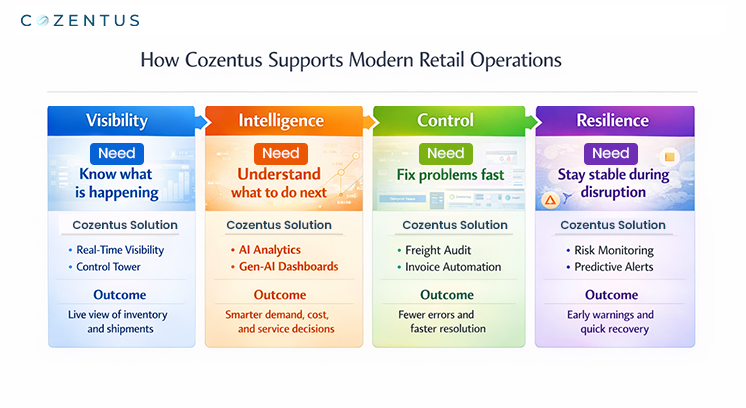
This is where the right technology partners make a real difference. Companies like Cozentus work closely with top retail and logistics organizations to make their goals come true. From real-time shipment visibility and risk monitoring to testing, data integration, and AI-driven insights, Cozentus helps retailers with everything.
Here are the key focus areas for retail executives today:
- Invest in real-time visibility and data integration.
- Build predictive capabilities that help you stay ahead of change.
- Make automation work hand-in-hand with accuracy.
- Use cloud platforms to scale quickly without extra hardware burdens.
- Put people at the center of technology adoption.
With the right technology foundation and the right partners in place, retailers can turn complexity into clarity and uncertainty into opportunity. This is how retailers win today and how they will continue to succeed in the future.
For custom retail supply chain tech solutions,book a quick meeting.