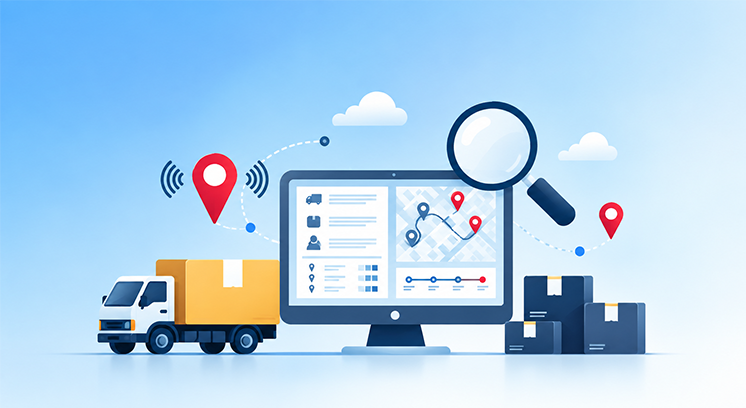
There are Hidden Signals Before Every Delay
Most operational delays never appear suddenly. They build slowly. Small signals start appearing across systems, people, and networks - long before the actual disruption occurs. For example, a carrier starts missing check-ins, a supplier takes slightly longer than usual to respond, a warehouse starts processing orders a little slower than its typical pace, etc.
Individually, these signals may look harmless. But, together, they form patterns. Human teams don’t usually see these patterns early enough. This is because the volume of data is too large and the connections between events are too complex.
This is where AI kicks in.
Modern AI systems can analyze thousands of behavioural signals and network signals simultaneously. These systems identify patterns that indicate an emerging disruption and flag potential delays anywhere between 6 - 48 hours earlier than traditional monitoring systems.
Leaders that are responsible for operations, logistics, and supply chains, this early visibility into possible delays changes the way decisions are made. Instead of reacting after delays occur, teams get time to respond while the situation is still manageable.
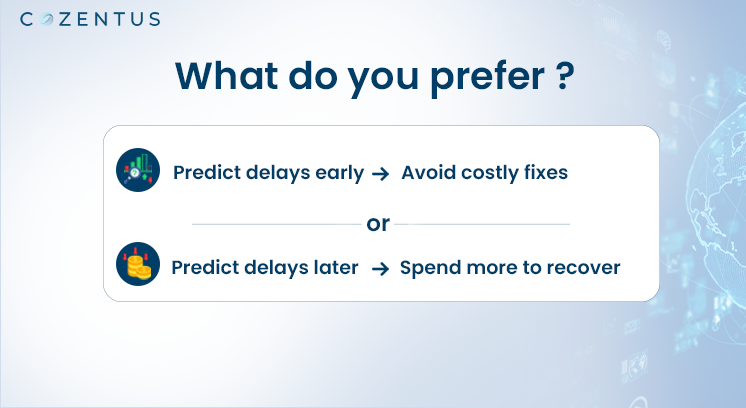
Why Traditional Systems Detect Delays Too Late
Most enterprise systems were built to answer one question: “What happened?”
Transportation systems record shipment movement. Warehouse systems track order processing. ERP systems monitor transactions and planning.
These systems work well for reporting historical performance. However, they struggle when the goal is predicting future risks.
Rule-based alerts usually trigger only after a particular threshold is crossed, such as when a shipment becomes late, inventory falls below a limit, or a vehicle misses a checkpoint.
At that point, the delay has already started.
In complex networks like supply chains, delays rarely originate from a single event. They are the result of multiple signals interacting across the network. External disruptions, operational inefficiencies, supplier performance shifts, and environmental factors all contribute to the outcome.
Human planners simply cannot analyze these signals simultaneously at scale.
AI changes that equation by predicting risks before they occur.
Behavioural Signals in Operational Systems
Behavioural signals in operational systems refer to the patterns of activity that reflect how processes, people, assets, and systems normally behave during day-to-day operations. When these patterns begin to shift or deviate from the norm, they act as early indicators that a delay or disruption may be forming within the operational network.
Every operational network produces thousands of behavioural patterns daily. For example:
- Driver route deviations
- Supplier response times
- Warehouse picking speeds
- Carrier schedule adherence
- System processing latency
- Customer demand fluctuations
AI models study historical patterns across these behaviours and learn what “normal” looks like. Once the baseline is established, the system continuously monitors deviations from that normal behavior.
For example:
- A carrier that usually confirms milestones in 15 minutes starts taking 45 minutes.
- A warehouse that usually processes 1,200 orders per hour begins trending toward 900.
- A driver route shows subtle deviations across multiple shipments in the same region.
None of these signals alone indicates a confirmed delay. But AI systems can detect that the probability of a delay is increasing.
This behavioural pattern recognition is one of the most powerful capabilities of machine learning systems.
Machine learning models are trained to identify subtle patterns across massive datasets, including shipment logs, operational metrics, weather feeds, and route performance data.
Over time, the system becomes better at recognizing which behavioral changes are early warning indicators.
Network Signals Reveal the Bigger Operational Picture
While behavioural signals focus on individual actions or processes, network signals examine how events interact across the broader operational network. Modern operations function as interconnected systems where a delay at one node can quickly spread across multiple downstream activities. By analyzing these relationships, network signals help AI detect potential ripple effects early within the network.
For example:
- Port congestion affecting container availability
- Highway traffic influencing regional delivery schedules
- Supplier production delays impacting downstream inventory
- Weather patterns affecting transportation routes
- Labor shortages influencing warehouse throughput
AI models analyze relationships across these signals simultaneously. For example, an AI system might detect the following combination:
- Increasing congestion at a major port
- Rising transit times across a nearby highway corridor
- Higher than average container dwell times
- Delayed departures from regional distribution centers
Individually, these might appear as minor anomalies. Together, they indicate a strong probability of network disruption.
This type of event correlation allows predictive systems to forecast disruptions before they escalate into operational delays.
How AI Predicts Supply Chain Delays 6 - 48 Hours in Advance
Early delay detection relies on three key technical capabilities.
1. Pattern Recognition Across Large Data Sets
AI models analyze historical operational data across thousands or millions of records. These datasets include:
- Shipment histories
- Route performance data
- Carrier reliability metrics
- Weather patterns
- Traffic flows
- Warehouse performance logs
Machine learning algorithms learn correlations between early signals and eventual outcomes. Over time, the system identifies combinations of signals that consistently precede delays.
This allows the AI to flag similar situations in real time.
2. Anomaly Detection in Real-Time Operations
Once deployed, AI continuously monitors operational data streams. Every new event is compared against historical patterns. When a signal deviates from expected behaviour, the system evaluates the level of risk.
Advanced anomaly detection algorithms such as isolation forests and support vector machines are commonly used to detect irregular patterns in large datasets.
Instead of issuing simple alerts, AI systems assign probabilistic risk scores. This tells operations teams how likely a delay is and how severe the impact may be.
3. Network Impact Modeling
Predicting a delay at one node is valuable. Predicting how that delay will cascade across the network is even more valuable.
Modern predictive systems simulate how disruptions propagate across operational networks.
For example:
- A delayed shipment may impact inventory availability.
- Inventory shortages may delay order fulfillment.
- Fulfillment delays may affect customer delivery commitments.
AI models map these relationships and estimate downstream effects. This allows organizations to intervene before disruptions spread.
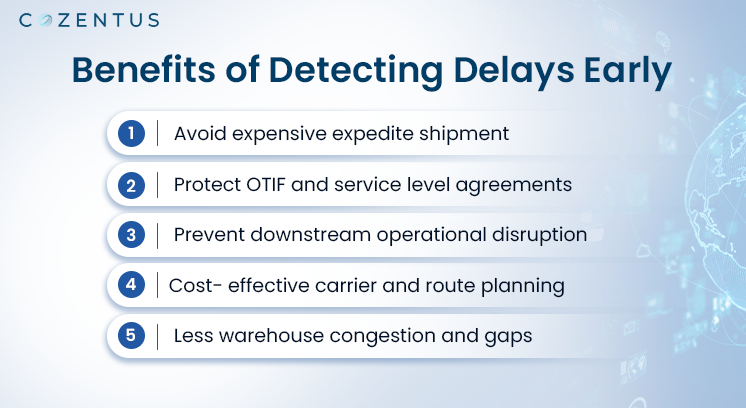
How Early Delay Detection Changes Operational Strategy
When delays are detected early, organizations gain options.
Instead of emergency responses, teams can make controlled adjustments.
Examples include:
- Rerouting shipments before congestion worsens
- Adjusting production schedules
- Reallocating inventory across warehouses
- Switching transportation carriers
- Updating customer delivery commitments early
Early intervention improves service levels and reduces operational costs.
Predictive AI systems have been shown to significantly reduce logistics costs while improving service reliability through proactive planning.
For executives overseeing complex operations, the biggest advantage is decision time.
More time means better decisions.
The Growing Role of AI in Supply Chain Delay Prediction
Supply chains operate as highly interconnected networks where even small disruptions can create ripples across multiple operations. As these networks grow more complex, more and more organizations are turning to AI to identify risks earlier and manage delays more effectively.
- Supply chains involve many interconnected activities: Shipments move across several carriers, routes, and facilities before delivery. When one part of the network slows down, it can easily affect other downstream operations.
- AI helps analyze signals across the entire network: Modern predictive models study data from sources such as GPS tracking, IoT sensors, carrier performance records, traffic conditions, and weather feeds. By analyzing these signals together, AI can identify patterns that indicate a potential delay forming.
- Early detection improves operational decision making: When risks are identified early, operations teams have time to adjust routes, reassign capacity, or shift inventory across locations. This helps reduce the impact of disruptions and maintain service levels.
- Supply chain leaders are moving from visibility to prediction: Visibility helps teams understand where shipments are at a given moment. Prediction helps them understand what may happen next so they can act before delays affect operations.
How to Turn Early Signals into Intelligence
Detecting signals is only the first step. The real value comes from translating those signals into clear operational guidance.
Leading organizations are building AI-driven operational control layers that sit above traditional enterprise systems. These systems monitor behavioural signals, network signals, and external risk indicators continuously.
When a risk emerges, the system recommends mitigation strategies. For example:
- Alternative transportation routes
- Carrier substitution
- Inventory repositioning
- Delivery schedule adjustments
Instead of forcing planners to analyze raw data, AI shows actionable insights. This allows the operational teams to focus on decisions, rather than data interpretation.
In many modern platforms, these capabilities are quietly embedded into existing operational workflows. The result is an operational environment that feels familiar to teams while becoming significantly more intelligent behind the scenes.
Conclusion: Predictive Intelligence is a Competitive Advantage
Over the next decade, predictive intelligence will become a standard capability across operations. Organizations will move from monitoring systems to anticipating systems.
AI will continuously interpret behavioral patterns, network signals, and environmental indicators to identify emerging risks.
Instead of asking: “Why did this delay happen?”
Organizations will ask: “What risk is forming right now?”
Teams that detect problems early will have the ability to respond calmly and intelligently. Those who detect them late will be forced into costly reactive decisions. Many forward-thinking organizations are already adding these predictive capabilities within their operational ecosystems.
The future of operations will not depend on faster reaction.
It will depend on earlier understanding.
And that understanding begins with the signals that appear long before a delay becomes visible.