How Time Impacts Logistics Costs
If you have ever reviewed your logistics costs and wondered where the unexpected expenses are coming from, it’s probably the dwell time.
Cargo does not just move. It waits. At ports, warehouses, terminals, or yards. And every extra hour it waits can transform into detention and demurrage charges that quickly add up.
Most organizations try to manage this using static reports or manual tracking. But by the time delays appear on a dashboard, the cost has already been incurred.
This is where machine learning changes the narrative.
Instead of reacting to delays, you start to predict them. Instead of tracking dwell time after it happens, you start understanding it before it occurs. That shift alone can transform how logistics teams operate, make decisions, and control costs.
Let’s break this down in a practical and business-focused way.
What is Dwell Time in Logistics
Dwell time refers to how long cargo, containers, or vehicles stay idle at a location before moving to the next stage.
This could be:
- Containers sitting at a port before clearance
- Trucks waiting at a warehouse gate
- Shipments paused at a distribution center
While some dwell time is expected, excessive dwell time leads to two major cost drivers:
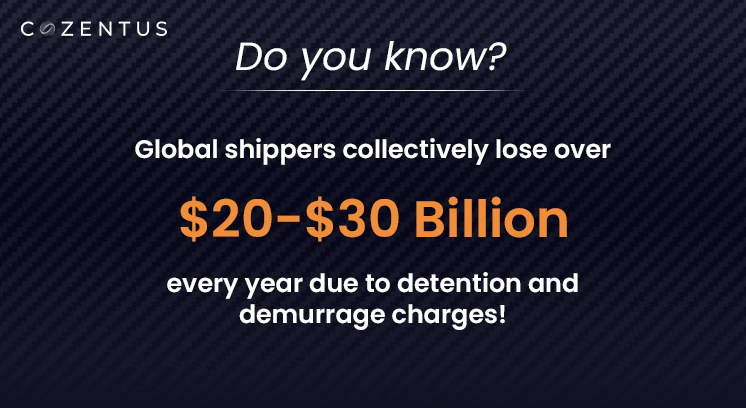
Detention: Charges applied when containers are held outside the terminal beyond the allowed free time.
Demurrage: Charges applied when containers stay inside the terminal longer than permitted.
These are not minor costs. For many organizations, they represent a significant and recurring financial burden.
More importantly, they signal deeper inefficiencies:
- Poor coordination between stakeholders
- Lack of visibility across the network
- Inability to anticipate disruptions
Why Traditional Prediction Falls Short
Most companies still rely on historical reports and manual monitoring.
These methods:
- Show what has already happened
- Do not explain why it happened
- Cannot predict what will happen next
For example, a report might tell you that a container stayed at a port for five days. But it does not tell you:
- Whether the delay could have been avoided
- What signals indicated the delay early
- Which shipments are likely to face similar delays tomorrow
This gap between visibility and action is where many supply chains struggle. And that gap is where dwell time turns into detention and demurrage costs.
How Machine Learning Predicts Dwell Time
Machine learning works by identifying patterns across large volumes of data. In logistics, this data comes from multiple sources:
- Historical shipment records
- Port and terminal activity
- Carrier performance data
- Weather conditions
- Traffic patterns
- Documentation timelines
- Operational events such as gate-in and gate-out
By analyzing these variables together, machine learning models can estimate how long a shipment is likely to dwell at a specific location.
1. Pattern Recognition Across Historical Data
Machine learning models study large volumes of historical shipment data across lanes, ports, carriers, and time periods.
They identify patterns such as:
- Certain ports having longer clearance times during peak seasons or during specific weeks of the year when volume spikes.
- Specific routes consistently facing congestion due to infrastructure limits, recurring bottlenecks, or regional demand surges.
- Particular carriers showing delays under certain operational conditions, such as tight schedules, transhipment dependencies, or limited capacity.
Beyond these, models can also uncover deeper correlations, such as how documentation delays combined with port congestion increase dwell time risk, or how weekend cutoffs impact weekday movement.
These patterns are often too complex, layered, and interconnected for manual analysis. Traditional reporting may highlight delays, but it cannot connect multiple influencing factors at once. Machine learning brings these hidden relationships to the surface and turns them into usable insights for planning and decision-making.
2. Real-Time Signal Processing
The real strength of machine learning comes from combining historical intelligence with real-time signals. This is what allows predictions to move from static assumptions to live insights.
For example:
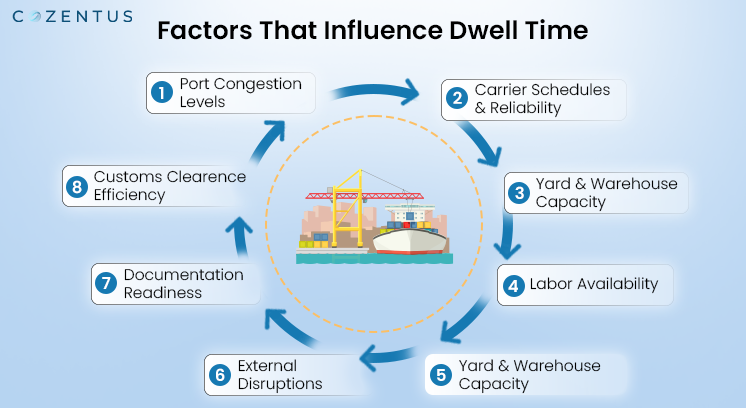
- A sudden increase in port congestion due to vessel bunching or operational slowdowns.
- Weather disruptions along a route that impact transit schedules or terminal operations.
- Delays in documentation submission that may slow down customs clearance.
Along with these, systems can also factor in live gate activity, yard capacity constraints, labor availability, and even unexpected disruptions like strikes or equipment failures.
The model continuously processes these inputs and recalibrates its predictions. This means the system is not relying on outdated assumptions. It is responding to what is happening right now across the network.
As a result, dwell time is no longer treated as a fixed estimate based on past averages. It becomes a dynamic, continuously updated prediction that reflects real-world conditions. This gives the ops teams a much more accurate and real-time view of potential delays.
3. Predictive Risk Scoring
Instead of only predicting how long a shipment might dwell, advanced machine learning systems go a step further by assigning a risk score to each movement.
This directly answers a critical business question: “Which shipments are most likely to face detention or demurrage charges?”
The system evaluates multiple variables such as location, timing, carrier performance, congestion levels, and documentation status to calculate the likelihood of delay. Each shipment is then ranked based on its risk level.
This allows teams to:
- Focus attention on high-risk shipments instead of reviewing everything manually.
- Prioritize interventions where the financial impact is highest.
- Allocate resources more effectively across operations.
For example, a shipment with moderate dwell time but high risk due to congestion and documentation delays may require immediate action, while another with similar dwell time but low risk may not.
4. Continuous Learning and Improvement
One of the most valuable aspects of machine learning is its ability to improve continuously. The system does not remain static after deployment. It evolves as more data becomes available.
As more data flows in:
- Predictions become more accurate as the model refines its understanding of patterns
- New patterns are discovered, including emerging risks or changes in operational behavior
- Exceptions are better handled, including rare events that traditional systems struggle to interpret
Over time, the model starts recognizing subtle signals that were previously missed. For example, it may learn how a combination of minor delays across multiple stages leads to significant dwell time at the final node.
This creates a strong feedback loop where every shipment improves future predictions. The system becomes more aligned with actual operations, more responsive to change, and more reliable for decision-making.
In practical terms, this means your supply chain intelligence keeps getting sharper without requiring constant manual intervention.
How Machine Learning Reduces Detention and Demurrage
Predicting delays is only the starting point. The real impact comes when those predictions are turned into timely, informed actions. Along with highlighting potential risks, machine learning also helps teams to act early, make better decisions, and stay ahead of delays before they turn into expensive repairs.
Here is how machine learning helps reduce costs:
1. Early Alerts for Potential Delays
Instead of discovering delays after they occur, teams receive early warnings.
For example:
- A shipment is likely to exceed free time by 24 hours
- A container is at risk due to port congestion
- This allows teams to act before penalties apply.
2. Better Planning and Coordination
When dwell time is predictable:
- Pickup schedules can be adjusted
- Documentation can be expedited
- Resources can be allocated more efficiently
This reduces idle time across the network.
3. Smarter Decision-Making
Machine learning provides decision support, such as:
- Should a shipment be rerouted
- Should priority clearance be requested
- Should alternate transport modes be used
These decisions are backed by data, not guesswork.
4. Better Carrier and Partner Performance
By analyzing performance data, organizations can:
- Identify underperforming carriers
- Optimize partner selection
- Negotiate better contracts
Over time, this leads to a more reliable supply chain.
Practical Use Case: A Day in Operations
Imagine a logistics manager reviewing shipments for the week.
Instead of scanning static reports, they see:
- A list of shipments ranked by risk
- Predicted dwell time for each container
- Alerts for shipments likely to face penalties
For one high-risk shipment:
- The system flags potential port congestion
- Suggests early pickup
- Recommends prioritizing documentation
The manager takes action immediately.
Result:
- The container moves out on time
- No detention or demurrage charges are incurred
Conclusion: It’s Important to Build a Predictable Supply Chain
Dwell time has always existed. Detention and demurrage have always been part of logistics.
What has changed is our ability to predict and control them.
Machine learning allows organizations to move beyond tracking delays. It enables them to anticipate, act, and optimize in ways that were not possible before.
As machine learning evolves, we can expect:
- More accurate predictions using advanced models
- Better use of real-time IoT data
- Autonomous decision-making in logistics operations
- More collaboration across supply chain partners
The question is no longer whether delays will happen.
The real question is whether you will see them coming in time to do something about them.